
Immaculée Ilibagiza — Survival Through Prayer in the Rwandan Genocide
The story in one line
Immaculee Ilibagiza survived the Rwandan genocide through prayer, concealment, and extraordinary endurance.
The basic story
A Tutsi woman survived 91 days hidden in a 3-by-4-foot bathroom with seven others during the 1994 Rwandan genocide, during which her family was killed and her weight fell from 115 to 65 pounds. She credits sustained prayer as the source of her mental survival.
Historical setting
Immaculee Ilibagiza's testimony is set in the 1994 Rwandan genocide, where survival, prayer, and later public witness form the center of the record.
Historical setting
Rwandan genocide, April-July 1994
The genocide setting is independently documented outside Ilibagiza’s memoir.
Hiding period
91 days in a small bathroom
Her public account consistently centers on 91 days hidden with seven other women.
Documented aftermath
Family killed; one brother survived abroad
Her memoir and later bios repeat the same family-loss outline.
Public record type
Memoir plus mainstream and historical sources
This case has a stronger external historical substrate than most personal-testimony pages in the archive.
The short Hay House interview below gives a concise public introduction to Ilibagiza’s story, book, and framing of prayer as the key to her survival.[4]
Primary-source file
Section titled “Primary-source file”Her official biography preserves the 91-day hiding account, family losses, 65-pound exit weight, and later public work.
immaculee.com Independent genocide record Human Rights Watch - Leave None to Tell the StoryThis Human Rights Watch report documents the wider genocide setting and the killing structures operating in Kibuye and elsewhere in Rwanda.
hrw.org Mainstream interview 60 Minutes Archive - Rwandan genocide: Hiding from deathCBS preserves Ilibagiza’s 60 Minutes interview about the genocide, hiding period, and later forgiveness.
cbsnews.com Publisher interview Hay House UK - Immaculee Left to TellThis short interview presents the memoir and its prayer-centered interpretation in Ilibagiza’s own public voice.
youtube.comWho She Is
Section titled “Who She Is”Immaculée Ilibagiza was born approximately 1972 in the village of Mataba, Kibuye province, western Rwanda, into a Tutsi Catholic family. Her father was a director of local Catholic schools; her mother was a schoolteacher. She received a scholarship to a national high school and was enrolled at the National University of Rwanda studying electrical and mechanical engineering. She was 22 years old and home on university holiday when the genocide began.[1]
She currently lives in New York. She has worked at the United Nations and is a Carnegie Corporation “Outstanding Americans by Choice” honoree. She speaks at secular universities, corporate venues, Catholic institutions, and UN events — not solely Catholic media.[1]
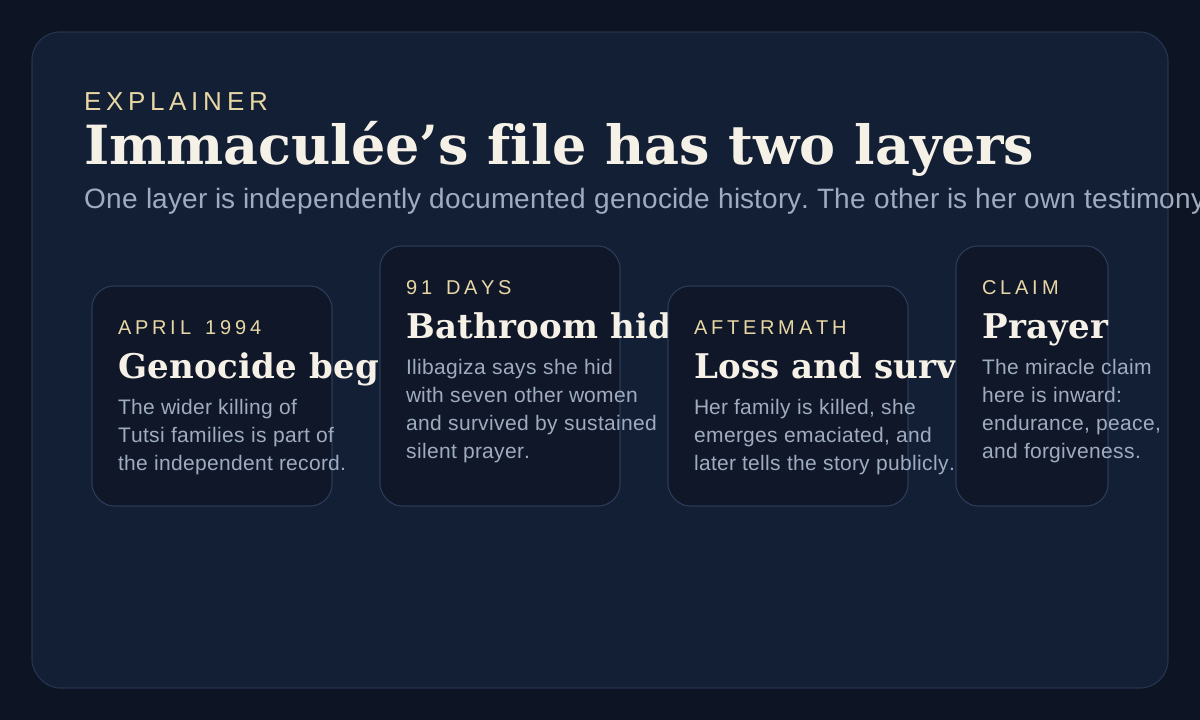
Immaculée’s testimony structure
- Setting Rwandan genocide The outer historical setting is independently documented anti-Tutsi violence in 1994.
- Hiding Ninety-one days concealed Her testimony centers on surviving in a cramped bathroom with other women.
- Prayer Inner spiritual account The miracle claim on the page is bound to prayer, endurance, and forgiveness inside that hiding place.
- Later Public witness She later turns the survival account into a widely known memoir and testimony circuit.
What Happened
Section titled “What Happened”April 6, 1994: The plane carrying Rwandan President Juvénal Habyarimana was shot down. Within hours, the systematic killing of Tutsi people began. Over the following 100 days, an estimated 800,000 to 1,000,000 people were killed — approximately 70% of Rwanda’s Tutsi population.[2]
Ilibagiza’s father sent her to the home of a local Hutu pastor, Félicien Murinzi, whom he trusted. Murinzi concealed Ilibagiza and seven other Tutsi women in a bathroom measuring approximately 3 feet by 4 feet, hidden behind a wardrobe pushed against the door. He hid them even from his own household.[1]
They remained in that bathroom for 91 days.
Her family’s fate: Her mother, father, and two brothers (Damascene and Vianney) were killed. Only her brother Aimable, who was studying abroad in Senegal, survived.[1]
Her physical condition on emerging: She entered the bathroom weighing approximately 115 pounds. She emerged weighing 65 pounds (approximately 29 kg).[1]
Publicly documented chronology
Section titled “Publicly documented chronology”- April 6, 1994: the Rwandan president’s plane was shot down, a trigger event independently documented in genocide histories and in Ilibagiza’s own account.[1] [2]
- During the following days, Ilibagiza says her father sent her to the house of Félicien Murinzi, where she was hidden with seven other women in a 3-by-4-foot bathroom.[1] [5]
- She remained there for 91 days, emerging severely emaciated after the genocide period had turned against her family and community.[1] [5]
- 1998: her official biography says she emigrated from Rwanda to the United States and later worked through the United Nations.[5]
- 2006: Left to Tell was published and she appeared on 60 Minutes, bringing the account into a mainstream U.S. broadcast archive.[3] [5]
The Faith Claim
Section titled “The Faith Claim”Ilibagiza does not claim a single miraculous event such as a vision, apparition, or visible sign. Her claim is more interior and more human: that sustained prayer during 91 days of concealment was what kept her mind from breaking and gave her strength to keep living. She prayed the Rosary for hours daily, in silence so no one would hear her, and she says that over time the panic inside the bathroom gave way to a peace she understood as God’s presence.[1]
The claim that is most unusual in her account is not the survival itself but the forgiveness: after emerging, she sought out the specific man who had ordered the murder of members of her family, visited him in prison, and told him she forgave him. By her account this forgiveness was not a warm feeling or instant emotional healing. It was a decision that grew out of prayer during hiding.[1]
Corroboration and Source Quality
Section titled “Corroboration and Source Quality”| Element | Corroboration |
|---|---|
| The Rwandan genocide (scale, dates, nature) | One of the most thoroughly documented genocides in history; UN documentation, Human Rights Watch, extensive academic literature[2] |
| Tutsi targeting and mass killing in Kibuye province | Specifically documented in genocide records |
| Pastor Murinzi’s role | Named and specific; could in principle be verified through Rwandan records |
| Her family’s deaths | Consistent with documented patterns; brothers and parents named |
| Her physical condition on emergence (65 lbs) | Consistent with extreme caloric deprivation over 91 days; medically plausible |
| The sense of God’s presence in prayer | None — no physical correlate; interpretive |
| 60 Minutes (CBS) segment | Mainstream secular broadcast journalism, December 3, 2006[3] |
| New York Times bestseller, translated into 17 languages | Documented publishing record[1] |
| Academic engagement | A 2024 ResearchGate paper analyzed Left to Tell through postcolonial trauma theory as a serious literary/historical document |
References
Section titled “References”- Ilibagiza, I. with Erwin, S. (2006). Left to Tell: Discovering God Amidst the Rwandan Holocaust. Hay House. — New York Times bestseller; nearly 2 million copies sold; translated into 17 languages. Primary source for the hiding account, family deaths, prayer practice, and forgiveness. Note: co-written memoir; mediated narrative standard applies.
- Human Rights Watch (1999). Leave None to Tell the Story: Genocide in Rwanda. Human Rights Watch / Fédération Internationale des Ligues des Droits de l’Homme. Independent documentation of the Rwandan genocide, including the organization of killings and the structure of anti-Tutsi violence. Available at: https://www.hrw.org/legacy/reports/1999/rwanda/Geno4-7-03.htm
- CBS News / 60 Minutes Archive. “Rwandan genocide: Hiding from death.” Archive page for Ilibagiza’s 60 Minutes interview about the genocide and her survival in hiding. Available at: https://www.cbsnews.com/video/rwandan-genocide-hiding-from-death-60-minutes-archive/
- Hay House UK. “Immaculee Left to Tell.” Short video interview introducing Ilibagiza’s book and public testimony. Available at: https://www.youtube.com/watch?v=_k2Pkd7-D6s
- Immaculée Ilibagiza official biography. “About.” Official site biography giving the 91-day hiding account, family losses, U.S. move, book publication, and later speaking career. Available at: https://www.immaculee.com/pages/about