
Buenos Aires, Argentina — 1996
The story in one line
a consecrated Host in Buenos Aires changed into bloody tissue-like material and was later subjected to laboratory study.
The basic story
A discarded Host in Buenos Aires was found to have transformed. Samples were sent without explanation to a series of independent scientists. A forensic cardiologist at Columbia University identified it as living human heart muscle with actively moving white blood cells. He had no explanation.
Historical setting
The Buenos Aires case is a late twentieth-century parish event in a modern city, later connected to laboratory testing and to the ordinary church life of Santa Maria parish.
Parish record
Santa María, Almagro
The public record centers on Santa María parish at Avenida La Plata 286 in Buenos Aires, where local Catholic reporting documents signs in 1992, 1994, and 1996.
Main sampled event
August 15–26, 1996
The 1996 host found discarded in the church became the main sample later described in laboratory reporting and archived photography.
Testing record
Blind laboratory work in 1999
AICA’s parish-history summary says samples from the 1992 and 1996 signs were sent to two United States forensic laboratories in 1999 under a blind protocol.
Current custody
Buenos Aires archdiocese guidance in 2024
Archbishop Jorge García Cuerva stated in 2024 that the sign is to be venerated only at Santa María and not removed from the parish without express authorization.
Primary-source file
Section titled “Primary-source file”Archbishop Jorge García Cuerva’s published 2024 measures on custody, veneration, and the official handling of the Santa María sign.
aica.org Official Catholic news agency AICA: 30-year parish history of the Buenos Aires signsThe Argentine Catholic news agency’s timeline of the 1992, 1994, and 1996 events at Santa María, including the parish’s public anniversary summary.
aica.org Peer-reviewed critique Kearse and Ligaj (2024): forensic review of Eucharistic miracle investigationsPeer-reviewed methodological analysis addressing Buenos Aires directly, including chain-of-custody, tissue interpretation, and storage-condition concerns.
doi.org Peer-reviewed microbiology Grzybowski et al. (2025): methodology for peri-eucharistic biological impuritiesA later peer-reviewed paper proposing standardized microbiological and forensic protocols for recent Eucharistic phenomena.
doi.orgPublicly documented chronology
Section titled “Publicly documented chronology”- May 1 and May 8, 1992: Santa María parish reported the first Buenos Aires sign after host fragments were placed in water and later found with blood-like drops.[7]
- July 24, 1994: A further sign was reported during a children’s Mass at the same parish.[7]
- August 15, 1996: A consecrated host was found dirty and hidden in a side crucifix at Santa María and was reserved in water in the tabernacle according to normal practice.[7]
- August 26, 1996: Parish personnel reported that the 1996 host had not dissolved and had instead taken on a reddish appearance; photographs were taken and the material was preserved.[1][7]
- 1999: AICA’s summary states that samples from the 1992 and 1996 signs were sent to two United States forensic laboratories under a blind procedure.[7]
- May 12, 2024: The Archdiocese of Buenos Aires published new rules stating that the sign is to be guarded and publicly venerated only at Santa María parish under the archbishop’s directives.[3]
What happened
Section titled “What happened”On August 15, 1996, at the Parish of Santa María in Buenos Aires, Argentina, a consecrated Host was found discarded on a candleholder.[1] Father Alejandro Pezet, following standard protocol for a Host that cannot be consumed, placed it in a container of water and stored it in the tabernacle to dissolve.[1]
On August 26, eleven days later, the Host had not dissolved. It had transformed into a reddish, fleshy substance.[1]
Photographs were taken.[3] The substance was preserved.
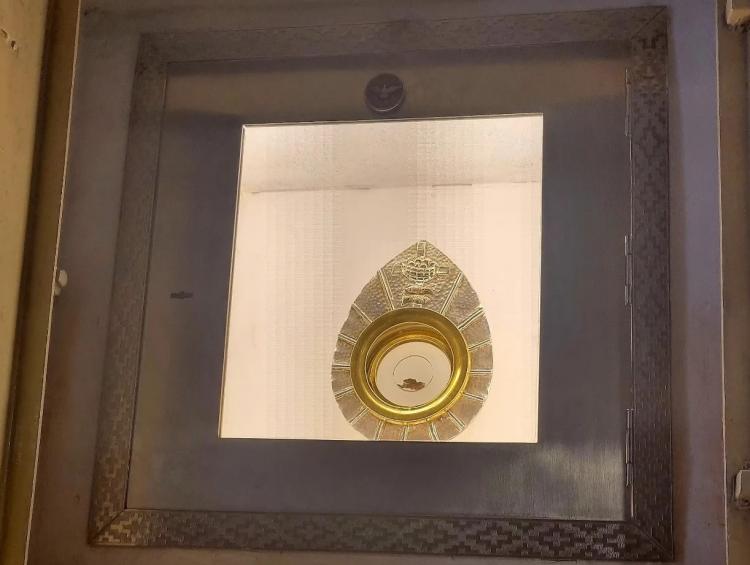
Three years later, samples were sent to a series of independent laboratories. The scientists who analyzed them were not told what the samples were, where they came from, or that they had any connection to a religious event.[1]
The investigators
Section titled “The investigators”Dr. John Walker — San Francisco
Section titled “Dr. John Walker — San Francisco”An initial analysis confirmed the sample was human biological tissue consistent with cardiac muscle.[2] This finding directed the investigation toward specialized cardiac analysis.
Dr. Frederick Zugibe — New York
Section titled “Dr. Frederick Zugibe — New York”The central analysis was conducted by Dr. Frederick Zugibe:[1][2]
- Chief Medical Examiner, Rockland County, New York (1969–2002)
- Adjunct Professor, Columbia University
- Fellow of the American College of Cardiology
- Author of The Crucifixion of Jesus: A Forensic Inquiry (2005) and Cardiac Arrest! A Medical Examiner’s Account (2005)
- One of the leading forensic cardiologists in the United States at the time
Dr. Zugibe was given the sample without any explanation of its origin. He was asked to analyze the tissue.[1]
What Dr. Zugibe found
Section titled “What Dr. Zugibe found”Dr. Zugibe identified the sample as:[2]
- Human cardiac muscle tissue (myocardium)
- Specifically from the left ventricle of the heart
- In a state of acute inflammation — the tissue showed the biological markers of severe physical trauma or stress
The most anomalous aspect of Zugibe’s findings:[2]
The white blood cells (leukocytes) within the tissue were actively moving under the microscope.
White blood cells require a living biological environment to remain motile. Dead tissue does not produce moving cells. Preserved or stored tissue does not produce moving cells. The sample had been sitting in water since 1996 — three years before the analysis.[2]
No known biological mechanism accounts for living, motile white blood cells in a tissue sample stored under these conditions.
| Finding | Result |
|---|---|
| Tissue type | Human cardiac muscle (myocardium) |
| Location in heart | Left ventricle |
| Condition | Acute inflammation; evidence of physical stress |
| White blood cell activity | Actively motile — cells visibly moving |
| Blood type | AB |
| Origin disclosed to analyst | No — blind analysis |
Dr. Zugibe’s own words
Section titled “Dr. Zugibe’s own words”When Dr. Zugibe was informed — after completing his analysis — that the sample had come from a consecrated host that had been sitting in water since 1996, he responded:[1]
“What is it that you want me to tell you? I can only say that this is an extraordinary event, that I have never seen something like this before. This tissue is from the myocardium. The heart muscle was alive. I cannot explain this.”
Zugibe's written findings or filmed testimony identifying the tissue as myocardium with active white blood cells — produced before he was told the sample's origin
Dr. Ricardo Castañón Gómez published documentation of the investigation in 'A Scientist Researches Mary' (2002). Zugibe also gave recorded testimony — search 'Frederick Zugibe Buenos Aires eucharistic miracle testimony.' The Archdiocese of Buenos Aires holds the full report.
Zugibe made no explicit religious claims in his analysis. He stated what the tissue findings showed and acknowledged what the science could not explain. As noted above, he was already a committed Catholic at the time of his analysis — a fact not disclosed in many accounts of the investigation.
The pattern across two investigations
Section titled “The pattern across two investigations”The investigation coordinator
Section titled “The investigation coordinator”The scientific investigation was organized by Dr. Ricardo Castañón Gómez, a Bolivian neurologist and specialist in psychophysiology.[1]
He later wrote about the investigation in:[1]
Castañón Gómez, R. (2002). A Scientist Researches Mary: The Virgin of the Revelation. [Includes documentation of the Buenos Aires case.]
The original photographs and sample documentation are on file with the Archdiocese of Buenos Aires,[3] which was headed at the time of the miracle by Cardinal Jorge Mario Bergoglio — later Pope Francis.[3]
Methodological challenges — what peer-reviewed science found
Section titled “Methodological challenges — what peer-reviewed science found”The Buenos Aires investigation has been directly examined in the peer-reviewed scientific literature. The key findings are as follows.
Kearse & Ligaj (2024)[5] — published in the Journal of Forensic Science Research — conducted a systematic methodological critique of the Buenos Aires investigation:
- Expert selection: Investigators sought pathologists and cardiologists — experts predisposed by training to identify cardiac tissue — rather than microbiologists or mycologists who could have assessed whether fungal or bacterial contamination accounted for the findings. The conclusion that the tissue was cardiac was potentially shaped by the selection of who was asked.
- Storage conditions and white blood cell viability: The sample had been stored in water for approximately one month, then in distilled water for three years before analysis. White blood cells die within minutes to hours of leaving the body, even under optimal laboratory conditions. The claim that white blood cells were “visibly motile” after three years in distilled water has no biological support and is not consistent with any known mechanism of cell preservation.
- DNA analysis: DNA analysis of the sample produced only very low concentrations of human DNA. Kearse & Ligaj attribute this to contamination rather than to preserved biological material from the original event.
- Chain of custody: The chain of custody was not maintained to forensic standards. The conditions under which the sample was stored and transferred between 1996 and 1999 are not documented to the level required for forensic evidentiary purposes.
Grzybowski et al. (2025)[6] — published in Applied Microbiology and Biotechnology — examined 25 cases of alleged Eucharistic phenomena (instances where communion hosts or wine were reported to transform into or produce blood-like or tissue-like substances). Natural biological explanations — specifically pigment-producing fungi and bacteria, most commonly Serratia marcescens — were identified in all 25 cases examined.
References
Section titled “References”- Castañón Gómez, R. (2002). A Scientist Researches Mary: The Virgin of the Revelation. — Catholic-network publication used in later retellings of the Buenos Aires investigation; cited for the laboratory chronology, Zugibe summary, and his reported post-analysis statement. Not peer-reviewed.
- Zugibe, F. (2005). Forensic pathology report [internal document]. Scanned reports circulated by the North American Center for Nervo (NACN-USA); reproduced in Tesoriero, R. Unseen (self-published). — Zugibe’s written findings identifying the sample as human left-ventricular cardiac muscle in acute inflammation, with reportedly motile white blood cells. Never submitted to or published in any peer-reviewed scientific journal. Internal forensic document only. Zugibe was a deeply committed Catholic — a Eucharistic Minister, Franciscan Tertiary Prefect, and member of the Blue Army of Our Lady of Fatima — which is relevant to evaluating analyst independence even under a blind protocol.
- Agencia Informativa Católica Argentina (AICA). “Mons. García Cuerva puntualiza la versión oficial sobre un milagro eucarístico.” May 12, 2024. Available at: https://aica.org/noticia-mons-garcia-cuerva-puntualiza-la-version-oficial-sobre-un-milagro-eucaristico. — Official Argentine Catholic news report on Archbishop García Cuerva’s 2024 custody and veneration directives for the Santa María sign.
- American Red Cross. “Blood Types.” Available at: https://www.redcrossblood.org/donate-blood/blood-types.html. — Basic public reference for AB blood-type prevalence used in comparative discussions of Buenos Aires and Lanciano.
- Kearse, K.P. & Ligaj, F. (2024). Scientific analysis of Eucharistic miracles: importance of a standardization in evaluation. Journal of Forensic Science Research, 8(1), 078–088. DOI: 10.33425/2639-9563.1068. — Peer-reviewed methodological critique of the Buenos Aires investigation, addressing expert selection bias, white blood cell viability under storage conditions, DNA concentration findings, and chain-of-custody deficiencies.
- Grzybowski, T., Wrzosek, M., Wołyniec, W., et al. (2025). Methodology for the analysis of biological impurities associated with peri-eucharistic phenomena. Applied Microbiology and Biotechnology, 109, 58. DOI: 10.1007/s00253-025-13439-9. PMC: PMC11882681. — Peer-reviewed paper proposing standardized microbiological and forensic protocols for recent Eucharistic-phenomena investigations.
- Agencia Informativa Católica Argentina (AICA). “Se cumplen 30 años del primer Signo Eucarístico en Buenos Aires.” May 5, 2022. Available at: https://aica.org/noticia-se-cumplen-30-anos-del-primer-signo-eucaristico-en-buenos-aires. — Parish-history summary published for the 30th anniversary, covering the 1992, 1994, and 1996 Santa María signs and the 1999 laboratory testing.