The Apparitions of Fatima and the Miracle of the Sun
The story in one line
the Virgin Mary appeared to three shepherd children at Fatima in 1917 and that a public solar phenomenon was seen there on October 13.
The basic story
Between May and October 1917, the Virgin Mary appeared six times to three shepherd children in Portugal. On October 13, as predicted months in advance, 70,000 witnesses — including atheists and secular journalists — saw the sun appear to dance and plunge toward the earth.
Reported message
Historical setting
Fatima unfolded in rural Portugal during World War I and the anticlerical First Republic, where monthly reports from three shepherd children built toward the public October gathering.
Apparition cycle
May 13 to October 13, 1917
The Shrine of Fatima preserves six 1917 Marian apparitions at Cova da Iria, with the August encounter moved to Valinhos after the children were detained.
Witnesses at the final day
50,000 to 70,000
The shrine chronology and the O Século report both preserve the very large public turnout on October 13, 1917.
Canonical judgment
October 13, 1930
The Diocese of Leiria concluded the local inquiry and authorized devotion to Our Lady of Fatima in 1930.
Continuing shrine record
Pilgrimage site since 1919
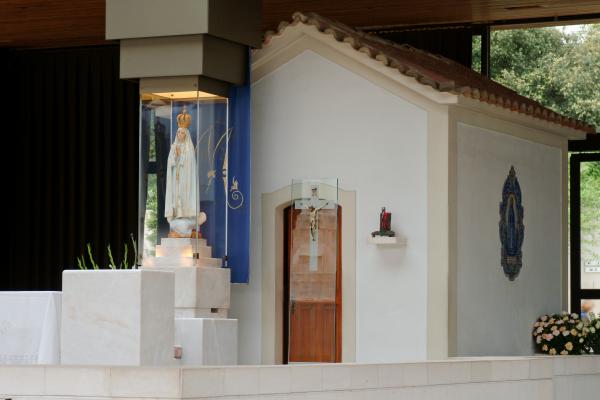
The Chapel of the Apparitions was built at the requested location and remains the center of the sanctuary record.
Primary-source file
Section titled “Primary-source file”Official sanctuary narrative for the six 1917 Marian apparitions and the reported October sign.
fatima.pt Official shrine chronology Shrine of Fatima: Chronology of the Three SeersSanctuary timeline for the seers, the 1917 dates, and later shrine-linked milestones.
fatima.pt Vatican file The Message of FatimaOfficial Vatican publication of the Fatima message and the text released in 2000.
vatican.va Official shrine record Shrine of Fatima: Places of the ApparitionsSanctuary page on Cova da Iria, the Chapel of the Apparitions, and the built shrine record.
fatima.ptThe story
Section titled “The story”On October 13, 1917, approximately 70,000 people gathered in a muddy field outside Fatima, Portugal, to see what three shepherd children had predicted: a public sign visible to everyone present.[6]
The crowd included atheists, journalists from secular anticlerical newspapers, government officials, university professors, and medical doctors.[1] Many had come specifically to document the failure of the prediction.[1]
What they witnessed was reported the following day in major secular newspapers.[1] [2] The journalists’ accounts were not sympathetic — they were written by people who had not expected to see anything and did not want to admit that they had.[1]
That is why Fatima keeps drawing people back. The story moves from private apparitions to a public day in front of an enormous crowd, and the surviving file preserves both the children’s testimony and the next-day accounts from people who were there.
The Witnesses
Section titled “The Witnesses”The Children
Section titled “The Children”Born March 22, 1907. Age 10 at the time of the apparitions.[4]
Lúcia was the eldest of the three and the primary recipient of the messages. She later entered religious life as a Carmelite nun (Sister Lúcia of the Immaculate Heart) and lived until 2005, dying at the age of 97.[4]
Throughout her long life, she was interviewed repeatedly by bishops, cardinals, and Vatican officials.[4] Her account never changed in any material respect. She maintained until her death that she had seen the Virgin Mary and that the messages she received were authentic.[4]
Born June 11, 1908. Age 8 at the time of the apparitions.[4]
Francisco was Lúcia’s cousin. Unlike Lúcia and Jacinta, Francisco could not hear the apparition speak — he saw her but did not receive her words directly.[4]
He died on April 4, 1919, at the age of 10, of influenza — as the apparition had predicted.[4] He was beatified by Pope John Paul II in 2000 and canonized by Pope Francis in 2017.[6]
Born March 11, 1910. Age 7 at the time of the apparitions.[4]
Jacinta was Francisco’s younger sister. She died on February 20, 1920, at the age of 9, of pleurisy — also as predicted.[4] She was beatified alongside Francisco and canonized in 2017.[6]
Jacinta’s young age is one of the features frequently noted in later discussions of the Fatima witnesses.[6]
Witness context
Section titled “Witness context”The three children were:
- From an illiterate peasant family with no religious sophistication[4]
- Subjected to repeated interrogation by priests, civil authorities, and eventually the Portuguese government (which was actively anticlerical at the time)[5]
- Imprisoned by the Administrator of Ourem, Artur de Oliveira Santos, who threatened them with death to make them recant — they refused [5] [6]
- Interviewed independently and found to be consistent in every essential detail[5]
Their testimony was given amid mockery, imprisonment, and social disruption, and the children did not recant.[4]
Publicly documented chronology
Section titled “Publicly documented chronology”| Date | Location | Key Events |
|---|---|---|
| May 13, 1917 | Cova da Iria | First apparition; Lady identifies herself as coming from heaven |
| June 13, 1917 | Cova da Iria | Crowd grows; Lady reveals Francisco and Jacinta will die young |
| July 13, 1917 | Cova da Iria | The Three Secrets of Fatima revealed |
| August 19, 1917 | Valinhos | Apparition moves due to children’s imprisonment; cloud phenomena witnessed |
| September 13, 1917 | Cova da Iria | ~25,000 witnesses; “shower of white petals” visible to crowd |
| October 13, 1917 | Cova da Iria | 70,000+ witnesses; the Miracle of the Sun |
The Three Secrets of Fatima
Section titled “The Three Secrets of Fatima”During the July 13 apparition, the Lady communicated three secrets to the children.[4]
A vision of Hell — a sea of fire with the souls of the damned.[4] Lúcia later described it as terrifying and said the vision lasted only a moment but was seared into her memory permanently.[4]
The children were explicitly told not to reveal this until further instruction.[4]
A prophecy that the First World War would end — but that if mankind did not convert, a worse war would begin, announced by “a night illuminated by an unknown light.”[4]
On the night of January 25–26, 1938, an extraordinary aurora borealis lit the skies across Europe and was visible as far south as North Africa.[4] It was described in newspapers worldwide as an “unknown light.” Within months, Hitler had seized Austria. The Second World War began the following year.[6]
Lúcia later wrote that when she saw the news reports of the aurora borealis in 1938, she immediately understood it as the sign foretold at Fatima.[4]
Revealed in writing by Lúcia in 1944 and sealed by the Vatican until the year 2000, the Third Secret describes a bishop in white (understood to be the Pope) being shot and killed by soldiers, surrounded by other martyrs.[7]
On May 13, 1981 — the anniversary of the first apparition — Pope John Paul II was shot by Mehmet Ali Ağca in St. Peter’s Square.[7] He survived. He later credited Our Lady of Fatima with saving his life.[7] He donated the bullet removed from his body to the Fatima shrine, where it is now set into the crown of the statue of Our Lady.[7]
John Paul II publicly stated that the Third Secret was fulfilled in the assassination attempt — a connection he believed with great personal conviction.[7]
The Miracle of the Sun — October 13, 1917
Section titled “The Miracle of the Sun — October 13, 1917”The Prediction
Section titled “The Prediction”At each of the six apparitions, the Lady had promised that on October 13, she would perform a public miracle so that everyone would believe.[4] The children reported this publicly. Word spread. On October 13, an estimated 70,000 people traveled to the Cova da Iria — a field outside Fatima — in driving rain, to see what would happen.[1] [6]
The Crowd
Section titled “The Crowd”The crowd was not composed entirely of believers. It included:
- Atheists and non-Christians[1]
- Journalists from O Século (a major secular, anticlerical Lisbon newspaper), O Dia, and other publications[1] [2]
- Government officials[5]
- Medical doctors[3]
- University professors[3]
- Ordinary villagers and pilgrims[6]
Many had come specifically to expose the children as frauds.[1]
What Happened
Section titled “What Happened”At approximately noon, the rain stopped. The clouds parted. The sun appeared, and then — according to thousands of independent accounts — it began to behave in a way that defies ordinary description.[1] [2] [3]
The accounts describe:[1] [2] [3]
- The sun spinning — rotating rapidly on its own axis, throwing off colored light in all directions
- Colored light — waves of red, orange, yellow, green, blue, and violet light sweeping across the crowd, the land, and the clouds
- The sun plunging — the sun appearing to detach from its position and plunge toward the earth in a zigzag pattern, causing widespread panic among the crowd, who believed the world was ending
- Sudden drying — the crowd, which had been standing in heavy rain for hours, found their clothes completely dry at the end of the event
- Duration — the phenomenon lasted approximately ten minutes

How people have tried to explain it
Section titled “How people have tried to explain it”Some writers have tried to explain Fatima through crowd expectation or a shared emotional event. That remains part of the discussion. The reason the explanation does not end the story is that reports also came from outside the main field, including people who were not standing in the crowd at Cova da Iria.[6]
Other writers look to atmospheric optics and unusual light conditions. That line of explanation addresses part of the testimony, but the reports about movement, colored light, sudden drying, and sightings from more than one location are why the discussion has continued.[3]
Witnesses at Distance
Section titled “Witnesses at Distance”Several witnesses reported seeing the solar phenomenon from locations far outside the Cova da Iria, including people who had no knowledge that anything was expected to happen that day.[6] These distant witnesses — in towns such as Alburitel, 18 kilometers from Fatima — reported the same phenomena described by the crowd.[6]
Those outlying reports are part of the reason later writers keep returning to the event. They suggest that the October 13 story was not confined only to one emotionally charged crowd in one field.[6]
The journalist’s account — primary source
Section titled “The journalist’s account — primary source”One of the most important early texts in the Fatima story is a newspaper article written by a secular journalist.
Avelino de Almeida was editor of O Século — Portugal’s largest secular daily, explicitly anticlerical in its editorial stance.[1] He traveled to Fatima on October 13, 1917, to write a dismissive piece on peasant superstition. His article, published October 15, 1917, was headlined “Como o Sol Bailou ao Meio-dia em Fátima” (“How the Sun Danced at Noon in Fatima”).[1]
From that article:[1]
“Before the astonished eyes of the crowd, whose aspect was Biblical as they stood bare-headed, eagerly searching the sky, the sun trembled, made sudden incredible movements outside all cosmic laws — the sun ‘danced’ according to the typical expression of the people.”
“People were weeping and praying with uncovered heads and… one heard cries of repentance, calls to the Holy Virgin… and other exclamations of a people deeply moved by the event that was taking place.”
De Almeida did not convert. He continued as editor of a secular newspaper. But he published what he saw.[1]

A second journalist, Avelino de Almeida’s colleague at O Dia, wrote:[2]
“The silver sun… was seen to whirl and turn in the circle of broken clouds… The light turned a beautiful blue, as if it had come through the stained-glass windows of a cathedral, and spread itself over the people who knelt with outstretched hands. The people wept and prayed with uncovered heads, in the presence of a miracle they had awaited.”
Dr. José Maria de Almeida Garrett, Professor of Natural Sciences at the University of Coimbra, was present as a scientific observer.[3] He later published a detailed account:[3]
“It was not the sparkling of a heavenly body, for it spun round on itself in a mad whirl. Then, suddenly, one heard a clamor, a cry of anguish breaking from all the people. The sun, whirling wildly, seemed all at once to loosen itself from the firmament and, blood-red, advance threateningly upon the earth as if to crush us with its huge and fiery weight.”
The formal investigation
Section titled “The formal investigation”The Diocese of Leiria conducted a canonical investigation from 1922 to 1930, gathering testimony from hundreds of witnesses and cross-examining the children’s accounts.[5] On October 13, 1930, the Bishop of Leiria formally concluded that the events warranted credibility.[5]
In ordinary terms, the local Church did not claim to have solved every scientific question about what the crowd saw. It concluded that the witness record was strong enough that the case should not be dismissed as fraud or fantasy.[5]
What peer-reviewed science says about the Miracle of the Sun
Section titled “What peer-reviewed science says about the Miracle of the Sun”The scientific literature directly addressing the 1917 event is limited. The following papers represent the primary peer-reviewed attempts to analyze what occurred.
Campbell, S. (1989). “The Miracle of the Sun at Fátima.” Journal of Meteorology, 14(142).[8] — Proposed that stratospheric dust reduced the sun’s brightness to safe viewing levels and produced color changes consistent with witness accounts. Note: Campbell is a British science writer, not a credentialed atmospheric physicist. The Journal of Meteorology in this context has limited authority as a peer-review venue for atmospheric optics claims.
Wirowski, A. (2014). “The Dynamic Behavior of the Electrically Charged Cloud of Ice Crystals.” Applied Mathematics and Physics, 2(1), 19–26.[9] — Mathematical model of vibrating charged ice crystals producing optical color-change and motion effects consistent with some witness accounts. Published in a SCIRP-family open access journal; SCIRP journals have faced criticism for lax peer review standards.
Dalleur, P. (2021). “Fatima Pictures and Testimonials: In-Depth Analysis.” Scientia et Fides, 9(1), 9–45.[10] — Argues that naturalistic explanations do not adequately account for witnesses reported up to 35 km from Fatima. Published in a peer-reviewed theology/faith-science journal (Scopus Q1 in Philosophy and Religious Studies) at Nicolaus Copernicus University. Relevant disclosure: Scientia et Fides is a faith-science dialogue journal — its editorial context is oriented toward theological engagement with scientific questions, which is relevant when assessing the framing of its conclusions.
On “mass hallucination”: The term appears frequently in popular discourse as a dismissive explanation. It is not, however, a recognized clinical phenomenon at the scale described. Hallucinations are private experiences; they do not produce identical sensory content across thousands of people simultaneously. The scientifically precise framing involves crowd expectation effects (the crowd was told to expect a miracle on that exact date and had traveled there specifically), retinal afterimage effects from staring at the sun, localized atmospheric optics, and collective social reinforcement of ambiguous perceptions. These mechanisms can account for some reported features but do not fully explain all aspects of the testimony, particularly accounts from distant witnesses who were not part of the expectant crowd.
Limits of scientific investigation
Section titled “Limits of scientific investigation”The Fatima events occurred in 1917. There is no physical trace to examine:
- No instrument data from that day — no observatory detected anomalous solar behavior
- No authenticated photographs of the solar phenomenon (photographs taken at the event show the crowd and an overcast sky, not a dancing sun)
- No biological or material samples of any kind
- No surviving witnesses
A prospective scientific investigation is impossible. A retrospective one can work only with the surviving written testimony.
References
Section titled “References”- de Almeida, A. (October 15, 1917). “Como o Sol Bailou ao Meio-dia em Fátima.” O Século, Lisbon. — Primary eyewitness account from the editor of Portugal’s largest anticlerical newspaper. De Almeida traveled to Fatima expecting to write a dismissive report and still published an account describing what he said he saw.
- O Dia (October 17, 1917). Correspondent account. — Independent secular newspaper account of the same events.
- Garrett, J.M.A. (1922). Scientific observer account. In: Documentação Crítica de Fátima. Diocese of Leiria. — University of Coimbra Professor of Natural Sciences; present as a scientific observer with no documented religious stake in the outcome.
- Kondor, L. (Ed.). (1976). Fatima in Lucia’s Own Words. Postulation Centre, Fatima. — Lúcia dos Santos’ direct testimony. Note: produced under episcopal instruction over decades; elaboration over time is difficult to assess independently.
- Diocese of Leiria — Canonical investigation archive (1922–1930). Hundreds of depositions; formal conclusion October 13, 1930. Note: canonical investigations operate on theological rather than scientific criteria.
- Walsh, W. T. (1947). Our Lady of Fatima. Doubleday Image. — Detailed historical account including witness depositions.
- Vatican Congregation for Divine Worship. (2000). The Message of Fatima. — Official Vatican document releasing the Third Secret; available at: https://www.vatican.va/roman_curia/congregations/cfaith/documents/rc_con_cfaith_doc_20000626_message-fatima_en.html
- Campbell, S. (1989). The Miracle of the Sun at Fátima. Journal of Meteorology, 14(142). — Proposed stratospheric dust as explanation for reduced solar brightness and color changes. Note: Campbell is a science writer, not a credentialed atmospheric physicist.
- Wirowski, A. (2014). The Dynamic Behavior of the Electrically Charged Cloud of Ice Crystals. Applied Mathematics and Physics, 2(1), 19–26. — Mathematical model of vibrating charged ice crystals producing optical effects. Published in SCIRP open-access journal family; SCIRP has faced criticism for lax peer review.
- Dalleur, P. (2021). Fatima Pictures and Testimonials: In-Depth Analysis. Scientia et Fides, 9(1), 9–45. — Peer-reviewed analysis arguing naturalistic explanations are insufficient. Published in a faith-science dialogue journal (Scopus Q1, Philosophy and Religious Studies) at Nicolaus Copernicus University. Institutional context is theology/faith-science dialogue.