Medjugorje, Bosnia and Herzegovina (1981–present)
The story in one line
several seers at Medjugorje began receiving ongoing Marian apparitions and messages in 1981.
The basic story
Beginning in June 1981, six young people in Medjugorje reported apparitions of the Virgin Mary. The site became one of the world’s largest Catholic pilgrimage destinations, and in 2024 the Dicastery for the Doctrine of the Faith issued a nihil obstat for the spiritual experience linked to Medjugorje while not declaring the reported apparitions supernatural.
Reported message
Historical setting
Medjugorje belongs to late socialist Yugoslavia in 1981, where reported visions in a Herzegovinian village rapidly became an international pilgrimage story.
Reported beginning
June 24–25, 1981
The Medjugorje file begins with reports by six young people in the parish of St. James.
Visionaries in the file
Six original seers
The public record consistently names six original visionaries in the first days of the phenomenon.
Public message cycle
Monthly messages still posted
The official parish site continues to publish monthly messages dated the 25th.
Current church status
Nihil obstat for the spiritual experience
The 2024 DDF note did not declare the apparitions supernatural.
Public record shape
Ongoing messages, pilgrimages, and Vatican review
The case is unusually large and extends far beyond the first week of reports.
The core public record
Section titled “The core public record”The Medjugorje story begins in late June 1981, when six young people from the parish of St. James in Medjugorje said they saw the Virgin Mary on the hill now known as Podbrdo.[1] What makes this file different from many apparition pages is that the story did not end after one day or one week.
From that point forward, Medjugorje turned into a long-running public file: the original hill reports, a parish built around pilgrimage, a stream of published messages, annual apparition reports for some seers, and decades of church review that finally led to the 2024 note of the Dicastery for the Doctrine of the Faith.[1] [2]
So the page is not only about what the six original seers said happened in 1981. It is also about what the parish and Vatican still publish now. The official parish site continues to post monthly messages on the 25th of the month, and parish news still reports annual apparitions for specific visionaries, including Mirjana Dragicevic-Soldo on March 18, 2026.[3] [4]
Medjugorje record
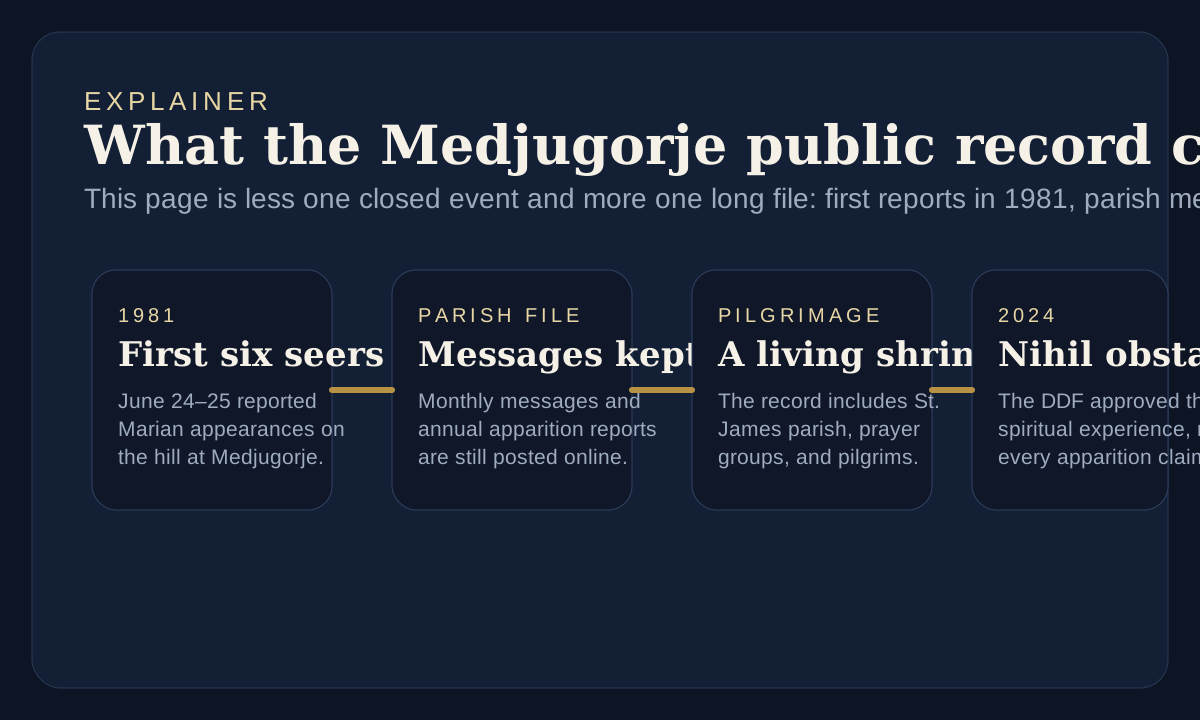
- 1981 Reported beginning The file opens with six young visionaries in 1981 claiming repeated apparitions.
- Messages Continuing archive The parish and related sites preserve a long-running public archive of reported messages.
- Pilgrimage Living shrine setting The town became an active international pilgrimage destination long before final resolution of the claims.
- 2024 Vatican note The nihil obstat concerns pastoral good around Medjugorje, not a blanket confirmation of every apparition claim.
What the published messages are about
Section titled “What the published messages are about”Medjugorje is unusual because its public message record did not end after the first week in 1981. The official parish site still publishes monthly messages and annual apparition texts.[3] [4]
Across that published archive, the recurring themes are peace, conversion, prayer, fasting, confession, and return to God.[1] [3] So the Medjugorje “message” is not one short sentence from one apparition night. It is a long-running stream of brief exhortations that the parish continues to circulate publicly.
Primary-source file
Section titled “Primary-source file”The 2024 Vatican note gives the current official status and explains what was and was not approved.
vatican.va Official parish site Medjugorje parish informationThe parish site preserves the shrine setting, pilgrimage life, and the basic way Medjugorje presents itself publicly today.
medjugorje.hr Current message archive Our Lady's messages archiveThe official parish archive continues to publish monthly messages dated the 25th and marked "With Ecclesiastical approval".
medjugorje.hr Current apparition report Annual apparition to Mirjana, March 18, 2026The parish news page records Mirjana’s annual apparition in 2026 with a time range and published message.
medjugorje.hr Archived parish guide Prayer groups in the Marian prayer movementArchived official parish material describes Ivan’s prayer-group meetings, sometimes open to the public, as taking place weekly or more often with apparitions reported during prayer.
archive.medjugorje.hrWhat the 2024 Vatican note says
Section titled “What the 2024 Vatican note says”The 2024 DDF note uses the category nihil obstat for the spiritual experience connected with Medjugorje.[1] In plain language, that means the Vatican is saying Catholics may visit, pray there, and receive spiritual help there without the Church warning them away from the place.
The same note also makes an important distinction: it does not declare the reported apparitions themselves to be established as supernatural.[1] So the Vatican’s position is basically, “the place can be pastorally fruitful,” while still stopping short of saying, “every apparition and every message has been proved supernatural.”
Publicly documented chronology
Section titled “Publicly documented chronology”- June 24–25, 1981: the first reported Marian sightings were claimed by the six original seers.[1]
- The parish of St. James and the surrounding hills became the center of an international pilgrimage movement.[2]
- Archived parish material describes an early and continuing prayer-group pattern in which Ivan’s group met several times a week and later twice weekly, sometimes in gatherings open to everyone, with apparitions reported during the prayer.[5]
- The official parish site continues to publish monthly messages dated the 25th, including messages from 2025 and 2026 marked “With Ecclesiastical approval”.[3]
- Parish news continues to post annual apparition reports for specific visionaries, including Mirjana in 2026.[4]
- The Medjugorje phenomenon remained under church review for decades, involving local, national, and Roman attention.[1]
- September 19, 2024: the DDF published its note granting nihil obstat to the spiritual experience connected with Medjugorje.[1]
What pilgrims can still publicly observe in the record
Section titled “What pilgrims can still publicly observe in the record”The public file is unusually large. It includes:
- a fixed starting point in June 1981[1]
- named original visionaries[1]
- decades of organized pilgrimage and parish life at Medjugorje[2]
- a live monthly message archive still being updated on the official parish site[3]
- annual apparition reports still being published by the parish, such as Mirjana’s March 18, 2026 entry[4]
- archived parish material describing public or semi-public weekly prayer-group meetings tied to Ivan, Marija, and Vicka[5]
- a formal Vatican note from 2024 explaining the present status[1]
The same public file also remains open-ended in one important respect: the 2024 note does not resolve the supernatural status of each reported apparition.[1]
That is why Medjugorje can feel confusing to new readers. It is both a live pilgrimage center with official church permission and an apparition file whose every claimed supernatural detail has not been finally settled.
References
Section titled “References”- Dicastery for the Doctrine of the Faith. “La Reine de la Paix”. Note sur l’expérience spirituelle liée à Medjugorje, 19 September 2024. Official Vatican note establishing the current status of the Medjugorje phenomenon. Available at: https://www.vatican.va/roman_curia/congregations/cfaith/documents/rc_ddf_doc_20240919_nota-esperienza-medjugorje_fr.html
- Parish Office of St. James, Medjugorje. Official English-language site for the Medjugorje parish and pilgrimage destination. Available at: https://www.medjugorje.hr/en/
- Parish Office of St. James, Medjugorje. “Our Lady’s Messages” archive. Official parish archive showing continuing monthly messages dated the 25th and marked “With Ecclesiastical approval.” Available at: https://medjugorje.hr/en/our-lady-messages-archive
- Parish Office of St. James, Medjugorje. “The annual apparition of Our Lady to Mirjana Dragicevic-Soldo on March 18, 2026.” Official parish news entry giving the time and text of Mirjana’s 2026 annual apparition. Available at: https://medjugorje.hr/en/news/the-annual-apparition-of-our-lady-to-mirjana-dragicevic-soldo-on-march-18-2026/225
- Medjugorje parish archive. “Prayer Groups in the Marian Prayer Movement” (1996). Archived official parish material stating that Ivan’s prayer group met three times a week in the beginning, later twice a week, and that some of those meetings were open to everyone, with apparitions reported during the time of prayer. Available at: https://archive.medjugorje.hr/en/medjugorje-phenomenon/guide/prayer-groups/