Our Lady of Betania (1976–1984)
The story in one line
Maria Esperanza reported visions of the Virgin Mary at Betania and that prayer gatherings there later drew wider public devotion.
The basic story
At Finca Betania in Venezuela, Maria Esperanza Bianchini reported Marian apparitions beginning in 1976, and a large group of witnesses later reported seeing the Virgin Mary there in 1984. On November 21, 1987, Bishop Pio Bello Ricardo issued a pastoral instruction declaring the apparitions authentic and of supernatural character.
Reported message
Historical setting
Betania belongs to late twentieth-century Venezuela, where prayer gatherings around Maria Esperanza's reported visions gradually turned a rural property into a pilgrimage site.
First apparition date
March 25, 1976
The official Betania site dates Maria Esperanza’s first reported apparition to March 25, 1976.
Mass witness event
March 25, 1984
The same source says around 150 people later reported seeing the Virgin Mary at the site.
Bishop’s instruction
November 21, 1987
Bishop Pio Bello Ricardo issued the pastoral instruction declaring the apparitions authentic and supernatural.
Site status
Sacred place for pilgrimage
The pastoral instruction treats Finca Betania as a sacred place for prayer, reflection, and worship.
The story
Section titled “The story”The official Betania site says that Maria Esperanza Bianchini first reported an apparition of the Virgin Mary at Finca Betania on March 25, 1976.[1]
The same source says the case became much broader on March 25, 1984, when around 150 people reported seeing the Virgin Mary clearly and distinctly at the site.[1]
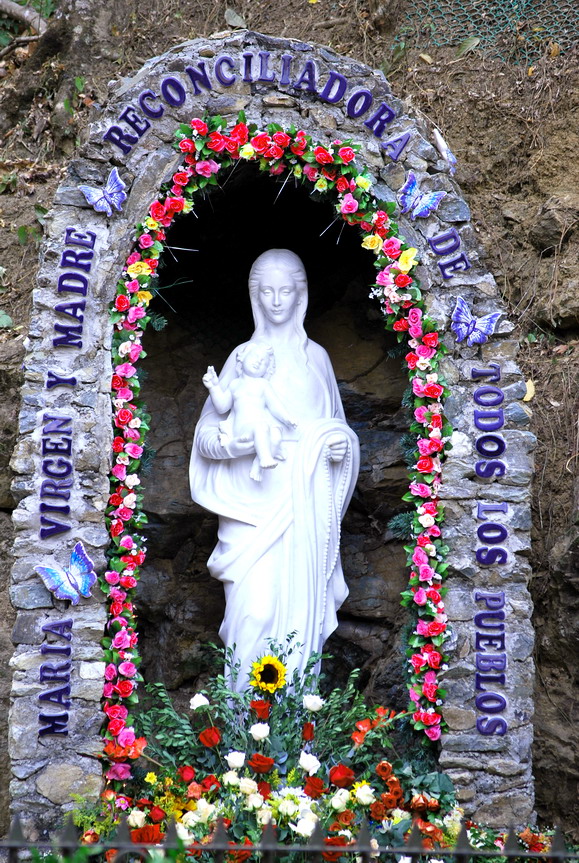
Betania is especially associated with the Marian title:
- Mary, Virgin and Mother Reconciler of All Peoples and Nations[1]
and with a message centered on:
- prayer and pilgrimage[1]
- reconciliation among peoples and nations[1]
- Church and people united in one heart[1]
What the Betania messages were about
Section titled “What the Betania messages were about”The official Betania material does not preserve one famous short sentence in the way some apparition sites do.[1] Instead, it says the reported messages kept circling back to the same ideas: people should return to prayer, come to the site as pilgrims, and seek reconciliation instead of division.[1] [3]
So if a reader asks, “What was Mary said to be asking for at Betania?”, the public answer is basically this: prayer, pilgrimage, reconciliation, and unity among peoples and nations, with Mary honored there as the Virgin and Mother, Reconciler of All Peoples and Nations.
Primary-source file
Section titled “Primary-source file”The official Betania page gives the land chronology, the 1976 start, the 1984 witness event, and later shrine development.
mariaesperanza.org Pastoral instruction Pastoral Instruction on the Apparitions in Finca BetaniaBishop Pio Bello Ricardo’s 1987 text declares the apparitions authentic and of supernatural character and designates the place for pilgrimage and worship.
mariaesperanza.org Official movement history Betania Spirituality Movement home pageThe official movement overview summarizes the 1984 public witness event, the later ecclesial approval, and the continued life of the movement tied to the sanctuary.
mariaesperanza.orgHow the site enters the story
Section titled “How the site enters the story”The official narrative says the story of Betania starts with the land itself, before the later crowd event ever happened.[1] In the movement’s telling, Maria Esperanza believed she had been shown in advance that a certain place would one day become a place of prayer. Then, in 1974, she and her family reached the land later called Finca Betania and took it as that promised place.[1]
- on March 29, 1974, Maria Esperanza and her family visited the land later called central to the mission[1]
- the site was understood as the promised place of prayer and pilgrimage she had been told about earlier[1]
- the tradition also preserves the sign of a blue butterfly as a confirmation linked to the discovery of the land[1]
That matters because Betania was not first presented as only a private vision in someone’s mind. From the beginning, the story was tied to a real piece of land that followers believed would become a sanctuary.
The 1984 mass-witness event
Section titled “The 1984 mass-witness event”The part of the story most often cited is the event of March 25, 1984. The official Betania account says people were gathered at Finca Betania for prayer when the case changed from one woman’s reported apparitions into a much larger public claim: around 150 people later said they had seen the Virgin Mary there.[1]
That is why Betania is often treated differently from a purely private apparition report. The official site presents 1984 as the day when many people, not just Maria Esperanza, said something extraordinary had happened in the same place.[1]
The site emphasizes the diversity of that group:
- children and students[1]
- adults and military personnel[1]
- physicians, psychiatrists, psychologists, engineers, and judges[1]
The same official page also links that day with other reported signs such as the scent of roses, singing, and solar phenomena.[1] In plain terms, the Betania story is that a normal prayer gathering suddenly became, in the view of the participants, a public Marian event.
The cited sources document a named visionary, a sanctuary site, a later mass-witness episode, and a published episcopal declaration.[1] [2]
Publicly documented chronology
Section titled “Publicly documented chronology”The cited Betania record is built around four dated points:
- the discovery of the land in 1974 as the future place of prayer[1]
- Maria Esperanza’s first reported apparition on March 25, 1976[1]
- the larger March 25, 1984 witness event with around 150 reported observers[1]
- the bishop’s pastoral instruction of November 21, 1987[2]
The official site also adds the later donation of land to the diocese in 1989, which it presents as part of the sanctuary’s continuing institutional life.[1]
The bishop’s judgment
Section titled “The bishop’s judgment”The official text cited most directly in the case is the November 21, 1987 pastoral instruction of Bishop Pio Bello Ricardo of Los Teques.[2]
In that document, the bishop says he had looked into the events and the religious life growing around the site. He then states, in his own judgment:
- the apparitions at Finca Betania are authentic[2]
- they are of supernatural character[2]
- the place is to be considered sacred and maintained as a site for pilgrimage, prayer, reflection, and worship[2]
The official Betania account also says that part of the land was later given to the diocese in 1989.[1] In practical terms, that means the place did not remain just an unofficial prayer spot. It became tied to the local Catholic structure in a permanent way.
The movement’s official home page repeats that the Betania Spirituality Movement was created around the apparitions and that the 1984 public event and 1987 approval remain the key public landmarks of the file.[3]
What is documented
Section titled “What is documented”In plain terms, the public Betania record gives us four main things:
- a named visionary with a longer apparition history[1]
- a specific place later developed as a shrine[1]
- a 1984 event in which many people said they saw Mary[1]
- a bishop’s 1987 text saying he judged the apparitions authentic and supernatural[2]
That combination is what makes Betania notable in the public record: a named seer, a named place, a crowd event, and a written bishop’s approval.[1] [2]
References
Section titled “References”- Sierva de Dios Maria Esperanza. “Apparitions in the Sanctuary of Betania.” Official site summary of the apparitions, the 1974 discovery of the land, the 1976 beginning of the case, the 1984 mass-witness event, and the later sanctuary. Available at: https://www.mariaesperanza.org/apparitions-in-finca-betania/
- Pio Bello Ricardo, Bishop of Los Teques. “Pastoral Instruction on the Apparitions of the Blessed Virgin in Finca Betania” (21 November 1987). Official pastoral instruction declaring the apparitions authentic and of supernatural character, and approving the site for pilgrimage and worship. Available at: https://mariaesperanza.org/html/pdf/Microsoft%20Word%20-%20pastoraleningles%20carta.pdf
- Sierva de Dios Maria Esperanza. “Official Web Page.” Official Betania Spirituality Movement overview connecting the apparitions, the 1984 public witness event, and the later approval by Bishop Pio Bello Ricardo. Available at: https://www.mariaesperanza.org/home-page/