
Lanciano, Italy — 750 AD
The story in one line
a consecrated Host and wine at Lanciano changed into human flesh and blood and were preserved as relics.
The basic story
A host and wine were preserved in Lanciano, Italy after an 8th-century Mass. In 1970, a professor of anatomy and histological chemistry analyzed them. He found human cardiac tissue and human blood — both type AB — with no preservatives and no scientific explanation for their state.
Historical setting
Lanciano is one of the oldest Eucharistic miracle traditions, set in early medieval Italy and later reframed through twentieth-century laboratory examination.
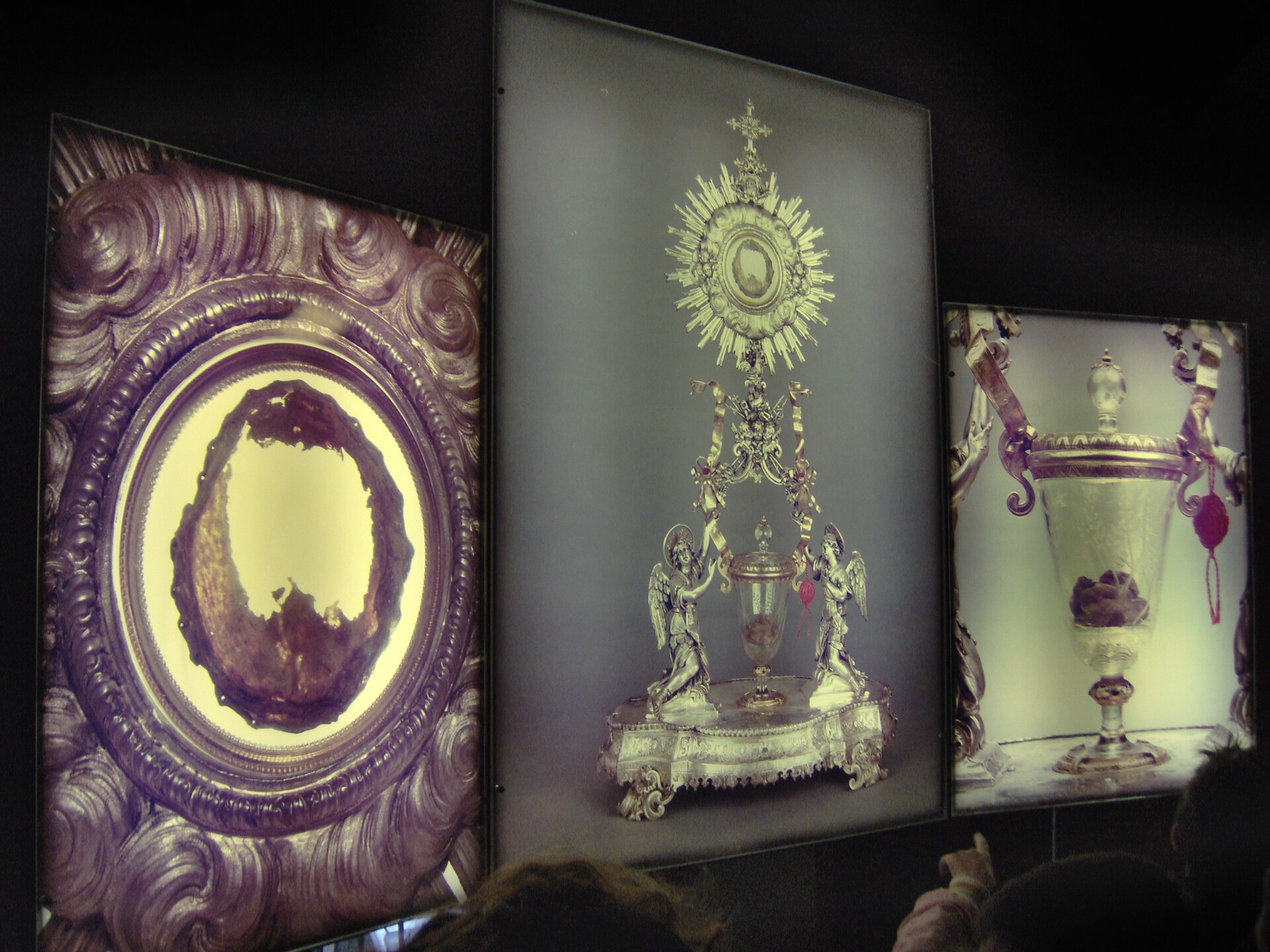
Traditional event date
8th century
Local sanctuary tradition places the reported change during a Basilian monk’s Mass in Lanciano sometime in the 700s.
Preservation site
San Francesco, Lanciano
The relics are kept at the Sanctuary of the Eucharistic Miracle in the church of San Francesco in Lanciano.
Scientific testing
November 1970 to March 1971
Odoardo Linoli conducted the main laboratory work, with Ruggero Bertelli cited for independent histological confirmation.
Published record
Linoli (1971), PMID 4950729
The only peer-reviewed article reporting original laboratory analysis of the Lanciano samples is Linoli’s 1971 paper indexed in PubMed.
Primary-source file
Section titled “Primary-source file”The institutional bibliographic record for the 1971 laboratory paper on the Lanciano relics.
pubmed.ncbi.nlm.nih.gov Local archive copy Original Italian scan of Linoli’s 1971 paperLocal archive copy of the Italian article used on this page.
/images/lanciano/Linoli_1971_Original_Italian.pdf Local archive copy English translation of Linoli’s 1971 paperLocal English translation of the 1971 article for readers following the laboratory details.
/images/lanciano/Linoli_1971_English_Translation_Final.pdf Official Italian bishops portal BeWeB: San Francesco, Sanctuary of the Eucharistic MiracleItalian bishops’ cultural-heritage portal describing San Francesco and the Lanciano Eucharistic miracle tradition.
beweb.chiesacattolica.itPublicly documented chronology
Section titled “Publicly documented chronology”- 8th century: Local Lanciano tradition places the reported transformation of the host and wine during a Mass celebrated by a Basilian monk.[1][2]
- Subsequent centuries: The relics were preserved in Lanciano and eventually housed in the church of San Francesco, which remains the principal sanctuary for the case today.[2]
- November 18, 1970 to March 4, 1971: Odoardo Linoli carried out the documented laboratory examination later published in Quaderni Sclavo di Diagnostica Clinica e di Laboratorio.[3]
- 1971: Linoli’s article was published and later indexed in PubMed as PMID 4950729.[3]
- May 5, 2005: Linoli gave a public interview during the Year of the Eucharist congress in Rome, revisiting the findings decades after publication.[7]
The basic facts
Section titled “The basic facts”In the town of Lanciano, Italy, sometime in the 8th century, a consecrated host and wine were reportedly preserved in their transformed state after a Mass at a small monastery.[1][2] The preserved tissue and blood remained in Lanciano for over twelve centuries.[1]
In 1970, they were submitted for scientific analysis.[3]
The investigators were not asked to determine whether a miracle had occurred. They were asked to determine what the substance was.[3] — see the stated scope of investigation in the paper’s opening section
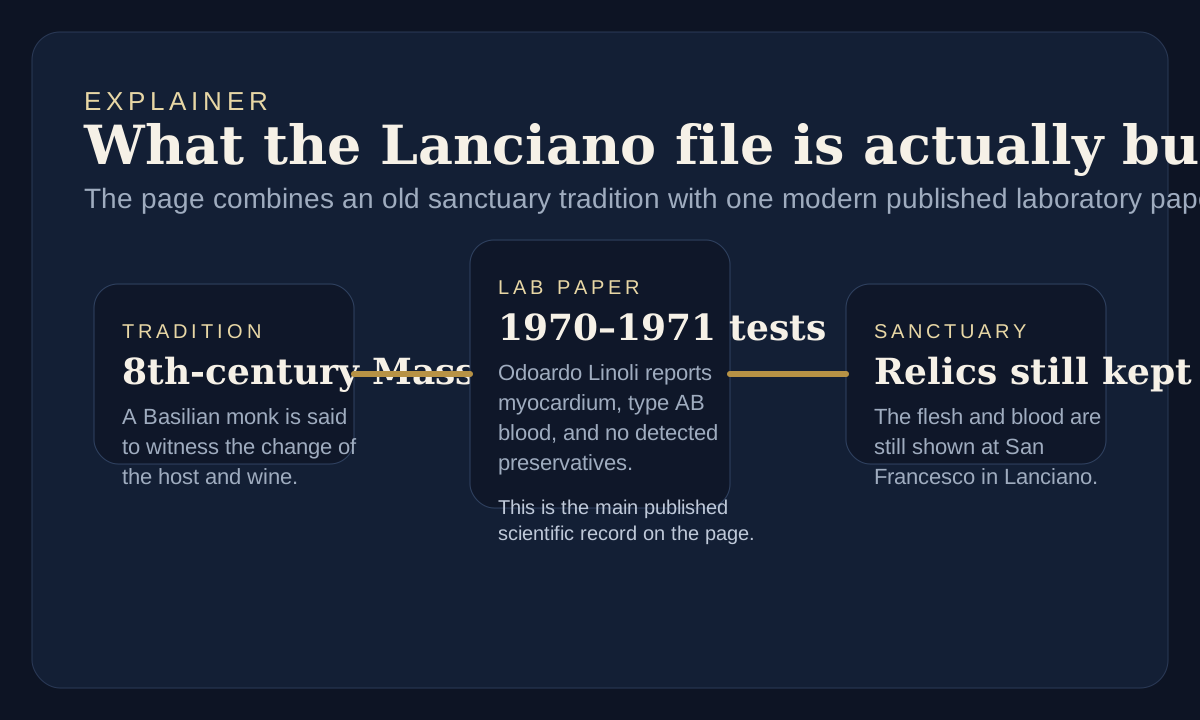
Lanciano in three layers
- Tradition Ancient sanctuary claim The old story says a doubting monk saw bread and wine become visible flesh and blood.
- Testing Linoli laboratory paper The best-known modern public evidence is the 1970–71 laboratory investigation and later publication.
- Custody Relics still displayed The same church still preserves and publicly displays the relics tied to the tradition.
The investigation (1970–1971)
Section titled “The investigation (1970–1971)”Who conducted it
Section titled “Who conducted it”The analysis was authorized by the local archdiocese[2] and carried out by:
- Professor Odoardo Linoli — Professor of Anatomy and Histological Chemistry, Head of the Laboratory of Pathological Anatomy at the Hospital of Arezzo, faculty at the University of Siena[3] — credentials stated on the paper’s title page
- Professor Ruggero Bertelli — Emeritus Professor of Normal Human Anatomy, University of Siena[4]
The investigation ran from November 18, 1970 to March 4, 1971.[3]
Linoli published his findings in a peer-reviewed journal:[3]
Linoli, O. (1971). Ricerche istologiche, immunologiche e biochimiche sulla carne e sul sangue del miracolo eucaristico di Lanciano. Quaderni Sclavo di Diagnostica Clinica e di Laboratorio, 7(3), 661–674. PMID: 4950729
About this source
Section titled “About this source”Here is the practical source situation. A 1971 paper by Odoardo Linoli really exists, and it is indexed in PubMed under PMID 4950729. That record confirms the journal, issue, page range, and publication year. So readers are not being asked to trust a rumor that “a study once existed.” There is a real bibliographic record for the article.
The PDFs linked on this page are local archive copies of that paper. They come from storiaechiesa.it, an Italian Catholic academic archive rather than a publisher site. So the strongest secure point is this: the paper is real and indexed, and these scans match that indexed record. The weaker point is that the scans are still archive copies rather than files downloaded directly from the original journal platform.
Why these scans can be treated as the paper they claim to be:
- The specific numbers in the scans — albumin at 61.93%, calcium at 114.29 mg%, blood type AB — match exactly what Linoli described in his 2005 ZENIT interview
- The journal name, volume, issue, page numbers, and date match the PubMed record exactly
- The typographical style and citation conventions are consistent with 1971 Italian medical publishing
- The hosting site (storiaechiesa.it) is an Italian Catholic academic resource
What they found
Section titled “What they found”Specifically, Linoli’s histological examination identified the tissue as striated muscular tissue of the myocardium.[3]
From Linoli’s Conclusion I:[3]
“the structural picture emerged from the study of the ancient Flesh of Lanciano presents itself as a striated muscle tissue which, by virtue of the clear, ubiquitous syncytial unions between fibres, is revealed as myocardial tissue.”

The tissue is human.[3] Its identification as cardiac muscle is not disputed by anyone who has examined the histology.[4][8]
The Blood was identified as real human blood, type AB.[3]
Analysis of the blood revealed:[3]
- Haemoglobin confirmed by thin-layer chromatography (alkaline haematin method)
- Blood type AB in both the Flesh and the Blood samples — identical
- Protein composition normally fractionated — albumin at 61.93%, with ratios consistent with fresh normal blood serum
- Mineral composition documented; calcium measured at 114.29 mg% (normal range: 9–11 mg%). Linoli noted the anomalously high calcium and offered a possible explanation: contamination from masonry powder introduced during medieval handling of the relics.[3]
From Linoli’s Concluding Considerations:[3]
“the Blood…proved truly such, on the basis of the demonstration of haemoglobin (alkaline haematin) by thin-layer chromatography”
“the blood group…proved identical (AB) in the Flesh and Blood”
“in the elution liquid of the Blood the proteins were demonstrated, fractionated in the percentage ratios that are found in the serum-protein picture of normal fresh blood”
Linoli's blood analysis: type AB, albumin 61.93%, protein fractionation consistent with fresh normal blood — from a sample preserved without refrigeration or chemicals for over 1,200 years
Download the Italian PDF above — blood chemistry and typing section
No preservatives of any kind were found in either sample.[3]
All findings from Linoli (1971).[3] Histological findings independently confirmed by Bertelli (1971).[4]
| Finding | Result |
|---|---|
| Species | Human |
| Tissue type (Flesh) | Myocardium — striated cardiac muscle |
| Blood type | AB |
| Albumin | 61.93% |
| Blood protein ratios | Normal — consistent with fresh, healthy blood |
| Calcium | 114.29 mg% (anomalously high; Linoli attributed to masonry powder) |
| Preservatives | None found |
| Bacterial contamination | None found |
| Blood type match across Flesh and Blood | Yes — both AB |
The five coagulated fragments
Section titled “The five coagulated fragments”The Blood preserved at Lanciano consists of five coagulated fragments of different sizes and shapes, with a total weight of 15.85 grams.[3]
An ancient record associated with the preservation claims that each fragment weighs the same individually — and that together, all five weigh the same as any one of them.[1] We at The Miracle Record are not aware of any other analyses of this phenomenon.
The “WHO review” — a fraudulent claim
Section titled “The “WHO review” — a fraudulent claim”For decades, books and articles about Lanciano stated that the Higher Council of the World Health Organization appointed a commission in 1973 that conducted 500 separate examinations over 15 months and confirmed Linoli’s findings.[1]
This claim is fraudulent. It has been confirmed as such in peer-reviewed literature.[10]
Kearse & Ligaj (2024) traced the “500 examinations” figure to its source and found it derives from data concerning Egyptian mummies — content that was apparently interpolated between pages discussing the Lanciano miracle in a secondary source, creating a false association. No WHO commission report on the Lanciano relics exists. Serafini (2021) had previously identified the same problem from the secondary literature.[8][10]
Linoli in 2005: a rare public reemergence
Section titled “Linoli in 2005: a rare public reemergence”After publishing his 1971 paper, Linoli gave no known public interviews on his findings for 34 years. No popular books, no press appearances, no further public statements on the subject appear in the record between the paper’s publication and the 2005 congress.[7]
The paper spoke for itself.
In 2005 — the Year of the Eucharist proclaimed by Pope John Paul II — Linoli accepted an invitation to present at a congress organized by the Science and Faith master’s program at Rome’s Regina Apostolorum Pontifical University, in cooperation with the St. Clement I Pope and Martyr Institute.[7] He was in his eighties. It was, as far as is known, his only extended public commentary on the investigation since 1971.
ZENIT news agency published an interview following the congress:[7]
“As regards the flesh, I had in my hand the endocardium. Therefore, there is no doubt at all that it is cardiac tissue.”
On the blood type and its geographic significance:[7]
“The blood group is the same as that of the man of the holy Shroud of Turin, and it is particular because it has the characteristics of a man who was born and lived in the Middle East regions.”
“The AB blood group of the inhabitants of the area [of Lanciano, Italy] in fact has a percentage that extends from 0.5% to 1%, while in Palestine and the regions of the Middle East it is 14–15%.”
The implications of that last statement are left to the reader.
The full ZENIT interview is available at: zenit.org — “Physician Tells of Eucharistic Miracle of Lanciano” (May 5, 2005). It is also archived at the EWTN library.[7]
Dr. Franco Serafini: cardiological interpretation and investigation
Section titled “Dr. Franco Serafini: cardiological interpretation and investigation”Dr. Franco Serafini is an Italian cardiologist at the Azienda USL di Bologna (Bologna Health Authority).[8]
What Serafini’s cardiological interpretation adds — provable from his published work and interviews:[8]
- Reading Linoli’s histological sections through the lens of modern cardiology, Serafini identified the tissue as specifically from the left ventricle, near a valvular area — a more precise anatomical location than Linoli stated in 1971
- The histological appearance of the tissue is consistent with acute inflammation — the biological pattern seen in cardiac muscle under severe physical stress or trauma. This is a clinical reading of Linoli’s slides, not a new analysis
- The AB blood type is found in approximately 0.5–1% of Italian/European populations and 14–15% in Middle Eastern populations — a statistical observation Serafini drew from Linoli’s blood typing result and cross-referenced with demographic data (though this argument is challenged — see below)
- He personally interviewed Linoli and other people involved in the 1971 investigation, and reported that Linoli stood fully by his findings
- He traced the fraudulent WHO “500 examinations” claim to its likely source — content about Egyptian mummies misattributed to Lanciano in a secondary publication (later confirmed in peer-reviewed literature by Kearse & Ligaj 2024)[10]
His book:
Serafini, F. (2021). A Cardiologist Examines Jesus: The Stunning Science Behind Eucharistic Miracles. Sophia Institute Press. ISBN: 9781644134771.
Available from Sophia Institute Press and major booksellers.
Filmed interview — EWTN Vatican:[8]
Dr. Serafini’s full archive of interviews and media: francoserafini.it/audio-video
The peer-reviewed record: what it actually shows
Section titled “The peer-reviewed record: what it actually shows”There is exactly one peer-reviewed paper reporting original laboratory analysis of the Lanciano samples: Linoli (1971). Every paper below cites it rather than conducting new analysis of the relics.
Three subsequent peer-reviewed papers engage critically with Linoli’s methodology. None dispute the histological finding that the tissue is cardiac muscle — that finding has not been challenged in the scientific literature. What has been challenged is the blood typing and species identification methodology.
Kearse, K.P. & Ligaj, F. (2024) — Methodological standardisation[10]
Section titled “Kearse, K.P. & Ligaj, F. (2024) — Methodological standardisation[10]”Kearse, K.P. & Ligaj, F. (2024). Scientific analysis of Eucharistic miracles: importance of a standardization in evaluation. Journal of Forensic Science Research, 8(1), 078–088. DOI: 10.33425/2639-9563.1068
A peer-reviewed review of the methodology used in Lanciano and five other Eucharistic miracle investigations. Key findings:[10]
- Linoli’s immunological species test used only bovine and rabbit controls — an insufficiently broad panel by modern standards. Without ruling out a wider range of species, the “human” identification cannot be considered definitively validated
- Confirms that the WHO “500 examinations” report is fraudulent — tracing the “500 examinations” figure to data about Egyptian mummies that was misattributed to Lanciano in secondary literature
- Calls for standardised investigation protocols for future Eucharistic miracle claims
Potential bias: Kearse is a self-identified Catholic (trained at Johns Hopkins, worked at the NIH). Notably, his Catholic faith did not bias him toward confirming the miracle — his analysis is critical of the methodology. A Catholic researcher writing critically of miracle evidence has less motivated reasoning toward a positive conclusion than a faith-motivated investigator, which is relevant to how the work should be read.
Kearse, K.P. (2025) — AB blood type challenge[9]
Section titled “Kearse, K.P. (2025) — AB blood type challenge[9]”Kearse, K.P. (2025). The relics of Jesus and Eucharistic miracles: scientific analysis of shared AB blood type. Forensic Science, Medicine and Pathology. DOI: 10.1007/s12024-024-00915-3. PMC: PMC12491371
A peer-reviewed challenge to the AB blood type argument across Lanciano, the Shroud of Turin, and related relics. Kearse is a Catholic immunologist trained at Johns Hopkins who worked at the NIH. Key finding:[9]
- Bacteria also express A and B surface antigens. The AB result cannot be taken as uniquely human without first ruling out bacterial contamination — which Linoli’s original methodology did not adequately address
- This does not mean the result is wrong; it means it is insufficiently validated to rule out a non-human source
Potential bias: Same as above — Kearse is Catholic but his analysis is critical of the miracle claim. His conclusions run against what a faith-motivated researcher might be expected to produce.
Grzybowski, T. et al. (2025) — 25 recent cases, all naturally explained[11]
Section titled “Grzybowski, T. et al. (2025) — 25 recent cases, all naturally explained[11]”Grzybowski, T., Wrzosek, M., Wołyniec, W., et al. (2025). Methodology for the analysis of biological impurities associated with peri-eucharistic phenomena. Applied Microbiology and Biotechnology, 109, 58. DOI: 10.1007/s00253-025-13439-9. PMC: PMC11882681
A March 2025 paper by 13 researchers across forensic medicine, mycology, pathology, and molecular biology from multiple Polish universities. They analyzed 25 recent alleged Eucharistic phenomena using microbiology, histology, and forensic DNA.[11]
- All 25 cases had natural biological explanations (contamination, bacterial/fungal growth, environmental factors)
- Cites Linoli (1971) directly
- Explicitly notes that with very few exceptions, Eucharistic miracle findings have never been communicated through peer-reviewed literature — a direct critique of the broader field, including Serafini’s book
- Proposes a standardised forensic protocol for future investigations
Potential bias: The 13 authors are affiliated with Polish universities. Poland is a predominantly Catholic country and many of the authors likely have Catholic cultural backgrounds — no specific religious affiliations are disclosed in the paper. However, their findings uniformly identify natural explanations for all 25 cases, which cuts against a faith-motivated bias toward confirming miracles. No funding conflicts are declared.
Investigation history
Section titled “Investigation history”Before 1971
Section titled “Before 1971”The relics have been in Lanciano since the 8th century. For most of that time, the scientific tools required to analyze them — histology, immunology, blood group serology, biochemical protein analysis — simply did not exist. These disciplines developed through the 19th and 20th centuries. There was no meaningful laboratory analysis that could have been conducted before the modern era.
There is also no tradition in Catholic relic veneration of scientific verification. Prior to the 20th century, Catholic authorities authenticated relics through canonical and theological processes: witness testimony, historical documentation, and approval by church authorities. Laboratory science was not part of the framework.
What prompted the 1971 investigation
Section titled “What prompted the 1971 investigation”The specific trigger for the 1971 investigation is not documented in Linoli’s paper, which states only that the analysis was authorized by the archdiocese. The broader context is the aftermath of the Second Vatican Council (1962–1965), which explicitly called for the Catholic Church to engage with the modern world and modern science. The post-Vatican II period saw a wave of scientific investigations of religious claims — the STURP investigation of the Shroud of Turin (1978) emerged from the same cultural moment. Scientific confirmation was seen as valuable to Catholic credibility in a secular age.
The Diocese of Chieti-Vasto authorized the 1971 investigation. Who specifically proposed it and why that moment is not established in the primary sources available.
Since 1971
Section titled “Since 1971”No later direct laboratory examination is documented in the public record used for this page. The situation involves both theological and practical constraints.
The practical reasons no further investigation has occurred:
- Access is controlled by diocesan and shrine authorities. The relics are sacred objects in Catholic custody. No external institution has the authority to compel access or demand new samples.
- Any additional sampling would remove material from an object of active veneration.
- The critical peer-reviewed papers (Kearse 2024, 2025; Grzybowski et al. 2025) raise methodological concerns about the 1971 analysis but none of their authors were given access to the relics to conduct new testing. They can only critique what was done — they cannot independently replicate or extend it.
- The 1971 investigation is the only data set that exists. Every subsequent discussion — Serafini’s book, the critical papers, this page — is commentary on a single study conducted over fifty years ago.
The connection to Buenos Aires (1996)
Section titled “The connection to Buenos Aires (1996)”Over a thousand years later, in Buenos Aires, Argentina, a very different investigation produced remarkably similar findings:
- A forensic cardiologist given a biological sample with no explanation of its origin identified it as human cardiac muscle from the left ventricle[6]
- The blood type was AB[6]
- The white blood cells in the tissue were visibly moving under the microscope[6]
The two investigations were conducted independently, by different scientists, on different continents, 1,246 years apart. The tissue type and blood type match.[3][6]
Read the Buenos Aires investigation →The preserved relics today
Section titled “The preserved relics today”The Flesh and Blood are kept in a reliquary above the high altar of the Church of San Francesco (formerly St. Legonziano), Lanciano, Chieti, Italy.[2] They are available for examination by pilgrims and researchers year-round.
The shrine is open to scientific researchers who wish to perform further investigation.[2]
References
Section titled “References”- Cruz, J.C. (1987). Eucharistic Miracles. TAN Books. — Chapter on Lanciano includes translated excerpts from Linoli’s report and the historical record of the five globules’ weight property. Note: Cruz’s account includes the “WHO 500 examinations” claim, which has since been challenged by Serafini (2018/2021) — see ref. [8].
- Diocese of Chieti-Vasto / Shrine of the Eucharistic Miracle, Lanciano. Official shrine documentation. Available through the diocese or directly at the Church of San Francesco, Lanciano, Chieti, Italy.
- Linoli, O. (1971). Ricerche istologiche, immunologiche e biochimiche sulla carne e sul sangue del miracolo eucaristico di Lanciano. Quaderni Sclavo di Diagnostica Clinica e di Laboratorio, 7(3), 661–674. PubMed PMID: 4950729. — Primary source for all histological, immunological, and biochemical findings. The paper’s scope (substance identification, not miracle determination) is stated in its opening section. Digital scans of both the original Italian and an English translation are available for download above; a physical copy has been ordered via interlibrary loan for independent verification.
- Bertelli, R. (1971). Independent confirmation of Linoli’s histological findings. University of Siena. — This is an internal report, not a peer-reviewed journal publication. Bertelli was Emeritus Professor of Normal Human Anatomy at Siena; his confirmation of the myocardial identification is documented but has not been published in a scientific journal and therefore carries different evidential weight than Linoli’s paper.
- Cruz, J.C. (1987). Eucharistic Miracles. TAN Books. (Secondary source for the WHO claim, which has since been confirmed fraudulent — see ref. [10].)
- Castañón Gómez, R. (2002). A Scientific Analysis of the Eucharistic Miracle of Buenos Aires. — Documents the independent findings of Dr. Ricardo Bertone and Dr. Frederick Zugibe, including tissue identification as left-ventricular cardiac muscle, blood type AB, and the observation of living white blood cells.
- Linoli, O. (May 5, 2005). Interview — Year of the Eucharist congress, Regina Apostolorum Pontifical University, Rome. Published by ZENIT news agency: zenit.org — “Physician Tells of Eucharistic Miracle of Lanciano”. Archived at: EWTN Library. — Linoli’s first extended public commentary since 1971; confirms specific findings including the AB blood type, its rarity in Italian vs. Middle Eastern populations, and the cardiac tissue identification.
- Serafini, F. (2021). A Cardiologist Examines Jesus: The Stunning Science Behind Eucharistic Miracles. Sophia Institute Press. ISBN: 9781644134771. Italian edition: Un cardiologo visita Gesù (2018). — A popular book, not a peer-reviewed journal paper. Serafini is a cardiologist at the Azienda USL di Bologna. His contribution is expert cardiological interpretation of Linoli’s published histological findings, personal interviews with Linoli and others involved in the 1971 investigation, and identification of the fraudulent WHO claim. He conducted no independent laboratory analysis of the relics. Available at: Sophia Institute Press. Media: EWTN Vatican interview (2023).
- Kearse, K.P. (2025). The relics of Jesus and Eucharistic miracles: scientific analysis of shared AB blood type. Forensic Science, Medicine and Pathology. DOI: 10.1007/s12024-024-00915-3. PMC: PMC12491371. — Peer-reviewed challenge to the AB blood type argument across Lanciano, Shroud of Turin, and related relics. Kearse (Johns Hopkins-trained immunologist, NIH) argues bacterial AB antigen expression means contamination was not adequately ruled out in the original studies.
- Kearse, K.P. & Ligaj, F. (2024). Scientific analysis of Eucharistic miracles: importance of a standardization in evaluation. Journal of Forensic Science Research, 8(1), 078–088. DOI: 10.33425/2639-9563.1068. — Peer-reviewed methodological review of Lanciano and five other cases. Finds Linoli’s species test insufficiently validated; confirms the WHO report is fraudulent. Calls for standardised investigation protocols.
- Grzybowski, T., Wrzosek, M., Wołyniec, W., et al. (2025). Methodology for the analysis of biological impurities associated with peri-eucharistic phenomena. Applied Microbiology and Biotechnology, 109, 58. DOI: 10.1007/s00253-025-13439-9. PMC: PMC11882681. — 13 researchers from multiple Polish universities; analyzed 25 recent alleged Eucharistic phenomena — all 25 had natural explanations. Cites Linoli (1971); notes that Eucharistic miracle findings are almost never published in peer-reviewed literature; proposes standardised forensic protocol.
Further reading
Section titled “Further reading”- Cruz, J. C. (1987). Eucharistic Miracles. TAN Books.
- The Shrine of the Eucharistic Miracle, Lanciano — Official documentation available through the Diocese of Chieti-Vasto.
- francoserafini.it — Dr. Serafini’s website with full archive of interviews and media on eucharistic miracle science.