
Our Lady of Akita (1973–1981)
The story in one line
Sister Agnes Katsuko Sasagawa received Marian messages at Akita and that a wooden statue associated with the convent showed reported weeping and other signs.
The basic story
In Akita, Japan, Sr. Agnes Katsuko Sasagawa reported Marian messages in 1973 connected to a wooden statue that was said to bleed, sweat, and later weep 101 times. After years of investigation, the local bishop judged the events worthy of belief and authorized veneration within his diocese.
Reported message
Historical setting
The Akita reports belong to postwar Japanese Catholic life: a convent in northern Japan, a recent convert turned religious sister, and a sequence of reported messages and statue-related phenomena in the 1970s.
Main event span
1973 to 1981
The public Akita chronology centers on the 1973 messages and the 1975–1981 weeping reports.
Visionary
Sr. Agnes Katsuko Sasagawa
The case record is tied to one Japanese religious sister in the Handmaids of the Eucharist.
Physical signs in the file
Blood, sweat, and 101 weepings
The cited summaries present the statue’s bleeding, sweating, and 101 weepings as the key physical phenomena.
Local judgment
April 22, 1984
Bishop John Shojiro Ito authorized veneration and recognized the supernatural character in his diocese.
The story
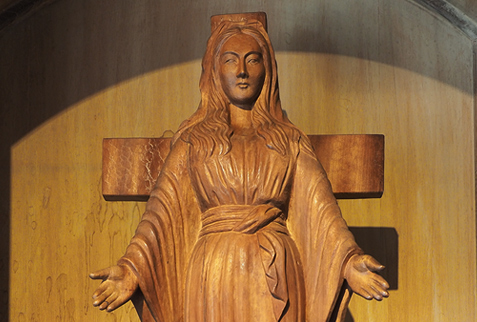
Section titled “The story”The Akita events center on Sr. Agnes Katsuko Sasagawa, a member of the Handmaids of the Eucharist in Yuzawadai, near Akita, Japan.[1] In 1973 she reported hearing messages from a wooden statue of the Virgin Mary in the convent chapel.[1]
What made the case unusual was not only the messages. The statue was also reported to manifest:
- a bleeding wound on the hand in 1973[1]
- perspiration-like moisture on the statue[1]
- repeated tears from January 4, 1975 until 1981, said to total 101 separate occasions[1]
Primary-source file
Section titled “Primary-source file”This long-form text gives the standard chronology, the three messages, and the wording of Bishop Ito’s 1984 judgment.
ewtn.com Official shrine and convent Seitai Hoshikai convent siteThe convent’s English site shows the chapel, the statue, and present-day pilgrimage access at Akita.
seitaihoshikai.com Pilgrim summary ANA travel guide to the Akita conventANA’s travel page confirms the local shrine setting and the public presentation of the 101 weepings tradition.
ana.co.jpThe principal events
Section titled “The principal events”-
June 12–13, 1973 — Light from the tabernacle
Sr. Agnes reported seeing intense rays of light coming from the tabernacle during prayer.[1]
-
June 28, 1973 — Wound on Sr. Agnes’s hand
A cross-shaped wound appeared on Sr. Agnes’s left hand and reportedly bled, causing significant pain.[1]
-
July 6, 1973 — First message and blood on the statue
Sr. Agnes said she heard a voice from the statue. On the same day, members of the convent reported blood flowing from the statue’s right hand.[1]
-
August 3, 1973 — Second message
A second message emphasized prayer, penance, and reparation for sin.[1]
-
October 13, 1973 — Third and most famous message
On the anniversary of the Miracle of the Sun at Fatima, Sr. Agnes reported a final message warning of grave chastisement if humanity did not repent, while urging the Rosary and prayer for the Pope, bishops, and priests.[1]
-
January 4, 1975 to 1981 — The statue weeps
The central public phenomenon of Akita began when the statue reportedly shed tears. According to the standard account, this occurred 101 times over six years and eight months and was seen by nuns, pilgrims, visitors, and Bishop John Shojiro Ito.[1] [2]
Publicly documented chronology
Section titled “Publicly documented chronology”Across the cited sources, the Akita file presents a compact but stable sequence:
- unusual light at the tabernacle in June 1973[1]
- a wound on Sr. Agnes’s hand in late June 1973[1]
- three reported messages between July and October 1973[1]
- weeping reports from January 4, 1975 to 1981[1]
- Bishop Ito’s judgment in 1984[1]
The same public record also includes the continued preservation of the statue at the convent and its presentation to pilgrims today.[4] [5]
Sr. Agnes and the case record
Section titled “Sr. Agnes and the case record”Sr. Agnes was not a child visionary and not a public celebrity. She was an adult Japanese religious sister living in a small contemplative community.[1] The case begins with her reported experiences, and one associated claim — that her hearing, once badly impaired, was later restored — became part of the broader Akita narrative.[1]
Akita depends heavily on a single visionary and a tightly bounded religious community. The public record therefore rests largely on the reported physical phenomena and on the bishop’s investigation rather than on a broad public witness pool.[1]
The statue and the reported physical phenomena
Section titled “The statue and the reported physical phenomena”The statue at the center of the case is a carved wooden image of Mary, approximately three feet tall, made from a single block of katsura wood.[1]
The reported progression was:
- blood from the hand[1]
- sweat-like moisture on the statue[1]
- tears on 101 occasions between 1975 and 1981[1]
The cited sources state that these phenomena were reportedly observed by many people over time, not only by Sr. Agnes, and that the local bishop personally judged the case credible after years of inquiry.[1] [2]
The shrine as it presents itself today
Section titled “The shrine as it presents itself today”The convent’s own English site presents it as an active place of pilgrimage and prayer, preserving both the statue and the Japanese-style chapel built for the community.[4] The site explains that the chapel was dedicated in 2002 and that the statue of Our Lady of Akita is enshrined in the left corridor, with pilgrims continuing to visit from inside and outside Japan.[4]
The ANA Akita travel guide describes the same location as a small pilgrimage destination centered on the statue that wept 101 times.[5]
Bishop Ito’s judgment
Section titled “Bishop Ito’s judgment”After years of investigation, Bishop John Shojiro Ito of Niigata issued a pastoral letter on April 22, 1984 stating that he recognized the supernatural character of the events connected with the statue and authorized devotion to the Holy Mother of Akita throughout the diocese.[1]
Under Catholic norms for alleged apparitions and private revelations, the local bishop is ordinarily the first competent authority to investigate and rule on such events.[1]
The public ecclesial status cited on this page is a positive diocesan judgment after formal review.[1]
What the record shows
Section titled “What the record shows”Akita does not offer the same kind of public witness base as a mass phenomenon or the same kind of published scientific record as a modern relic study.
It combines:
- a clearly dated sequence of events in 1973[1]
- a prolonged reported public phenomenon involving a statue weeping over years[1]
- a local bishop’s explicit positive judgment in 1984[1]
- a message focused on repentance, the Rosary, and prayer for the Catholic Church[1]
The page cites a positive diocesan ruling issued in Asia.[1]
References
Section titled “References”- EWTN. “A Message From Our Lady - Akita, Japan.” Includes a transcription of the standard Akita chronology, the three reported messages, and Bishop John Shojiro Ito’s 1984 recognition. Available at: https://www.ewtn.com/catholicism/library/message-from-our-lady—akita-japan-5167
- St. Patrick’s Lilydale (Catholic parish summary). “Our Lady of Akita and Sr Agnes Sasagawa (Part 2).” Summarizes Bishop Ito’s 1984 judgment and the restoration of Sr. Agnes’s hearing in 1982. Available at: https://www.stbrigidshealesville.cam.org.au/news/our-lady-of-akita-and-sr-agnes-sasagawa-part-2
- Mother of All Peoples. “Who is Our Lady of Akita?” Secondary summary citing the common claim that tests on blood, tears, and perspiration found human material and differing blood types. Useful for documenting the claim’s circulation, though not a substitute for a primary lab report. Available at: https://www.motherofallpeoples.com/post/who-is-our-lady-of-akita
- Catholic Convent Seitai Hoshikai. Official English site for the Akita convent and shrine, including the chapel history, the statue section, and pilgrimage information. Available at: https://www.seitaihoshikai.com/us/
- ANA Travel & Life. “Catholic Convent Seitai Hoshikai.” Travel guide page describing the Akita convent, the statue that shed tears 101 times, and the chapel open to pilgrims. Available at: https://www.ana.co.jp/en/it/japan-travel-planner/akita/0000017.html