
Astronomical Signs at the Crucifixion
The story in one line
the sky signs remembered around the crucifixion may correspond to real ancient astronomical events, especially the red moon on April 3, 33 CE.
The basic story
A documented astronomical question tied to Jesus' death: whether the reported darkness and the later 'moon to blood' language connect with a real eclipse visible from Jerusalem. Modern eclipse calculations strongly favor a partial lunar eclipse on April 3, 33 CE, not a solar eclipse.
Historical setting
This page belongs to the intersection of biblical chronology and astronomy, where later readers compared Gospel darkness language with eclipse calculations and ancient calendars.
Main date candidate
April 3, 33 CE
NASA’s lunar eclipse catalog lists a partial lunar eclipse on April 3, 33 CE, the date most often discussed in this chronology.
Astronomy constraint
Passover implies full moon
NASA’s eclipse geometry pages explain why a solar eclipse does not fit the standard Passover setting while a lunar eclipse can.
Biblical texts cited
Joel 2:31; Luke 23; Acts 2
The page tracks the darkness and blood-moon language through the biblical passages most often discussed.
Main open question
30 CE or 33 CE crucifixion date
The astronomy becomes especially relevant if one adopts April 3, 33 CE rather than April 7, 30 CE.
Why the eclipse discussion points lunar, not solar
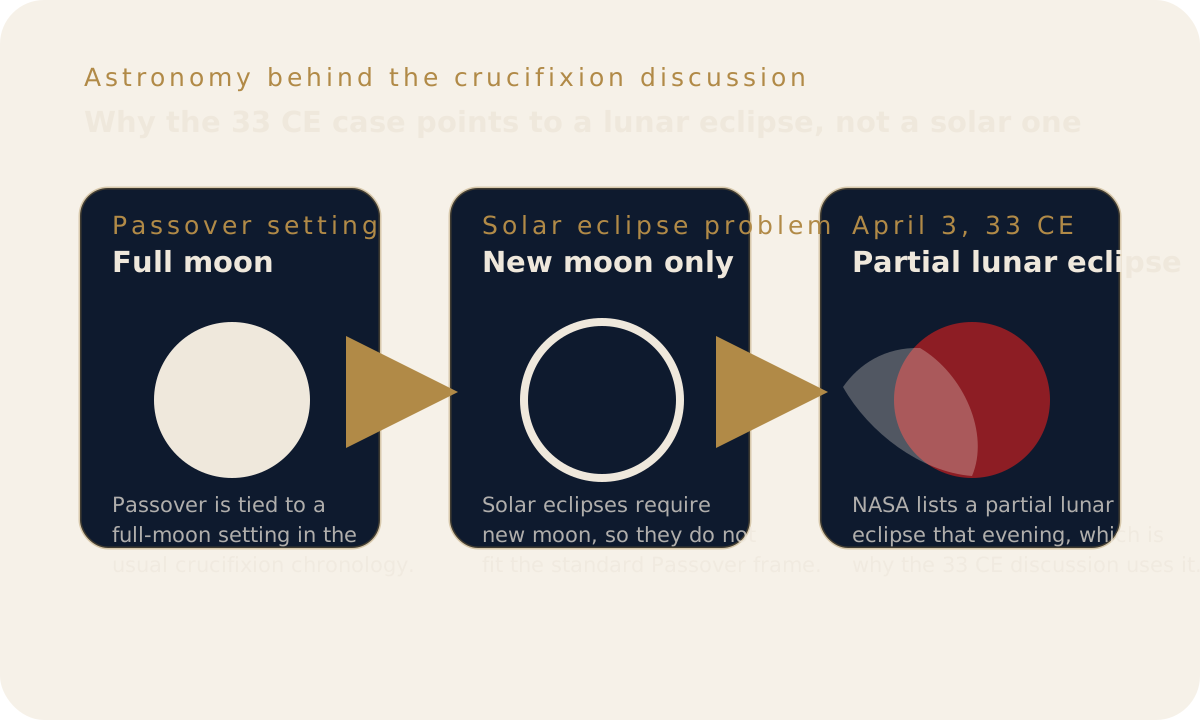
- Passover Full moon setting The crucifixion tradition is tied to Passover, which occurs at full moon.
- Rule Solar eclipses need new moon That means a normal solar eclipse does not fit the calendar setting.
- Candidate Lunar eclipse on April 3, 33 NASA lists a partial lunar eclipse on the date many scholars connect with the crucifixion.
Primary-source file
Section titled “Primary-source file”Official NASA explanation of solar and lunar eclipse geometry.
science.nasa.gov NASA lunar eclipses Eclipses and the MoonOfficial NASA page on lunar eclipses and the reddish appearance of the Moon during totality.
science.nasa.gov NASA catalog Catalog of Lunar Eclipses: 0001 to 0100Official catalog listing the partial lunar eclipse of April 3, 33 CE.
eclipse.gsfc.nasa.gov Published chronology paper Humphreys and Waddington (1983)Nature paper arguing for the April 3, 33 CE chronology and its relation to the lunar eclipse.
nature.comPublicly documented chronology
Section titled “Publicly documented chronology”What the astronomy can and cannot show
Section titled “What the astronomy can and cannot show”The New Testament describes darkness over the land during the crucifixion, and Peter in Acts quotes Joel’s prophecy: “The sun shall be turned to darkness, and the moon to blood”.[4] Modern astronomy can test whether any real eclipse occurred around the leading proposed dates for Jesus’ death.
The key chronological point is that a solar eclipse does not fit the standard Passover setting. NASA’s eclipse geometry explains why:
- solar eclipses occur only at new moon[1]
- lunar eclipses occur only at full moon[2]
- Passover is set at full moon
So if one is asking which kind of eclipse could line up with April 3, 33 CE under the usual Passover chronology, the stronger candidate is a lunar eclipse visible that evening, not a solar eclipse at midday.
The April 3, 33 CE lunar eclipse
Section titled “The April 3, 33 CE lunar eclipse”NASA’s Catalog of Lunar Eclipses: 0001 to 0100 lists a partial lunar eclipse on April 3, 33 CE.[3] Colin Humphreys and W. G. Waddington argued in Nature and later in Tyndale Bulletin that this eclipse, occurring on one leading crucifixion date, would have been visible from Jerusalem at moonrise and could have given the rising Moon a darkened or reddened appearance.[5] [6]
Their proposal links several points:
- a real eclipse did occur on a leading proposed crucifixion date[3]
- the event was consistent with later “blood moon” language[5]
- it strengthens April 3, 33 CE as a plausible historical date for the crucifixion[5]
This is why the case keeps appearing in both biblical chronology and astronomy discussions.
Eclipses near April 3, 33 CE
Section titled “Eclipses near April 3, 33 CE”NASA’s solar and lunar eclipse catalogs make it possible to place the April 3, 33 CE lunar eclipse inside the surrounding eclipse seasons.[3] [8] The nearby eclipses are:
| Date | Type | NASA classification | Relation to April 3, 33 CE |
|---|---|---|---|
| October 7, 32 CE | Lunar | Total[3] | 178 days before |
| October 23, 32 CE | Solar | Partial[8] | 162 days before |
| March 19, 33 CE | Solar | Total[8] | 15 days before |
| April 3, 33 CE | Lunar | Partial[3] | The eclipse tied to the crucifixion-date discussion |
| September 12, 33 CE | Solar | Annular[8] | 162 days after |
| September 27, 33 CE | Lunar | Partial[3] | 177 days after |
Only the April 3, 33 CE eclipse is the one Humphreys and Waddington connect directly to Jerusalem moonrise and to the chronology of the crucifixion.[5] [6] The surrounding entries are useful mainly for seeing the broader astronomical context.
Main chronology positions
Section titled “Main chronology positions”Scholars have proposed several dates for the crucifixion within the years of Pontius Pilate’s prefecture. Two dates dominate the discussion summarized on this page:
- Friday, April 7, 30 CE: this date is favored in works by James D. G. Dunn, John P. Meier, Jerome Murphy-O’Connor, Rainer Riesner, and Ben Witherington III.[7]
- Friday, April 3, 33 CE: this date is argued by Humphreys and Waddington, and it is the date on which NASA’s catalog lists the partial lunar eclipse discussed above.[3] [5] [6]
The April 3, 33 CE eclipse matters specifically in the 33 CE chronology. If one prefers April 7, 30 CE, then the 33 CE lunar eclipse is not part of that reconstruction.
References
Section titled “References”- NASA Science. “Why Do Eclipses Happen?” Official NASA explanation of eclipse geometry, including that solar eclipses occur only at new moon. Available at: https://science.nasa.gov/eclipses/geometry/
- NASA Science. “Eclipses and the Moon.” Official NASA page explaining that lunar eclipses occur at full moon and can make the Moon appear red. Available at: https://science.nasa.gov/moon/eclipses/
- NASA Goddard Space Flight Center. “Catalog of Lunar Eclipses: 0001 to 0100.” Official eclipse catalog listing the partial lunar eclipse of 0033 Apr 03. Available at: https://eclipse.gsfc.nasa.gov/LEcat5/LE0001-0100.html
- Joel 2:31; Luke 23:44-45; Acts 2:20. Joel’s prophecy about the sun being turned to darkness and the moon to blood is quoted by Peter in Acts and is regularly discussed alongside the crucifixion darkness traditions.
- Humphreys, Colin J., and W. G. Waddington. “Dating the Crucifixion.” Nature 306 (1983): 743-746. Abstract available at: https://www.nature.com/articles/306743a0
- Humphreys, Colin J., and W. G. Waddington. “The Jewish Calendar, A Lunar Eclipse and the Date of Christ’s Crucifixion.” Tyndale Bulletin 43.2 (1992): 331-351. Available at: https://www.tyndalebulletin.org/article/30487-the-jewish-calendar-a-lunar-eclipse-and-the-date-of-christ-s-crucifixion
- Representative scholars favoring April 7, 30 CE include Dunn, James D. G. Jesus Remembered (Grand Rapids: Eerdmans, 2003), 312; Meier, John P. A Marginal Jew (New York: Doubleday, 1991), 402; Murphy-O’Connor, Jerome. Jesus and Paul: Parallel Lives (Collegeville: Liturgical Press, 2007), 53; Riesner, Rainer. Paul’s Early Period (Grand Rapids: Eerdmans, 1998), 58; and Witherington, Ben. New Testament History: A Narrative Account (Grand Rapids: Baker Academic, 2001), 134. For a scholarly discussion summarizing the dominance of 7 April 30 CE and the continuing minority case for 33 CE, see the survey in New Testament Studies: Cambridge Core abstract and bibliography.
- NASA Goddard Space Flight Center. “Catalog of Solar Eclipses: 0001 to 0100.” Official eclipse catalog listing the nearby solar eclipses of 0032 Oct 23, 0033 Mar 19, and 0033 Sep 12. Available at: https://eclipse.gsfc.nasa.gov/SEcat5/SE0001-0100.html