
The Eucharistic Miracle of Santarem (13th century)
The story in one line
a stolen consecrated Host at Santarem bled and was later preserved as a relic.
The basic story
In Santarem, Portugal, a consecrated Host reportedly began to bleed after being removed from Mass for sacrilegious purposes. The relic has been venerated for centuries and remains at the Sanctuary of the Most Holy Miracle of Santarem.
Historical setting
The Santarem tradition belongs to medieval Portugal, where a domestic crisis, a stolen Host, and later shrine custody formed the shape of the story.
Santarém tradition
- Beginning Host removed from Mass The tradition begins with a woman taking a consecrated Host out of church.
- Claim Bleeding on the way home The Host is then said to bleed while hidden in a cloth.
- Return Back to Saint Stephen’s The relic returns to church and becomes fixed to the shrine’s public memory.
- Today Sanctuary devotion The diocesan sanctuary still presents the miracle as a living local devotion.
Traditional date
1247 or 1266
The diocese itself notes two competing medieval chronologies for the origin of the Santarém miracle tradition.
Core claim
Bleeding consecrated Host
The diocesan account centers on a Host taken from Mass, bleeding in transit, and later returned in procession.
Relic setting
Crystal vessel and monstrance
The shrine says the Host was later found enclosed in a small crystal vessel and remains venerated in a silver-gilt monstrance.
Current shrine
Sanctuary of the Most Holy Miracle
The former parish church of Saint Stephen continues as the diocesan sanctuary tied to the miracle tradition.
Primary-source file
Section titled “Primary-source file”Official diocesan account of the miracle story, competing dates, crystal vessel tradition, and relic setting.
diocese-santarem.pt Official diocesan report Celebracao do Milagre de SantaremOfficial diocesan report on the annual celebration and procession of the relic.
diocese-santarem.pt Official diocesan video Report on the Eucharistic Miracle of SantaremVideo report linked directly from the diocesan sanctuary page.
youtube.comThe story
Section titled “The story”The traditional account of Santarem says that in the 13th century, a woman in distress removed a consecrated Host from the church of Saint Stephen for superstitious purposes.[1] On the way home, the Host reportedly began to bleed through the cloth in which it had been wrapped, drawing attention from passersby.[1]
Terrified, she returned the Host, and the event became the basis of one of Portugal’s most famous Eucharistic miracle traditions.[1]
Publicly documented chronology
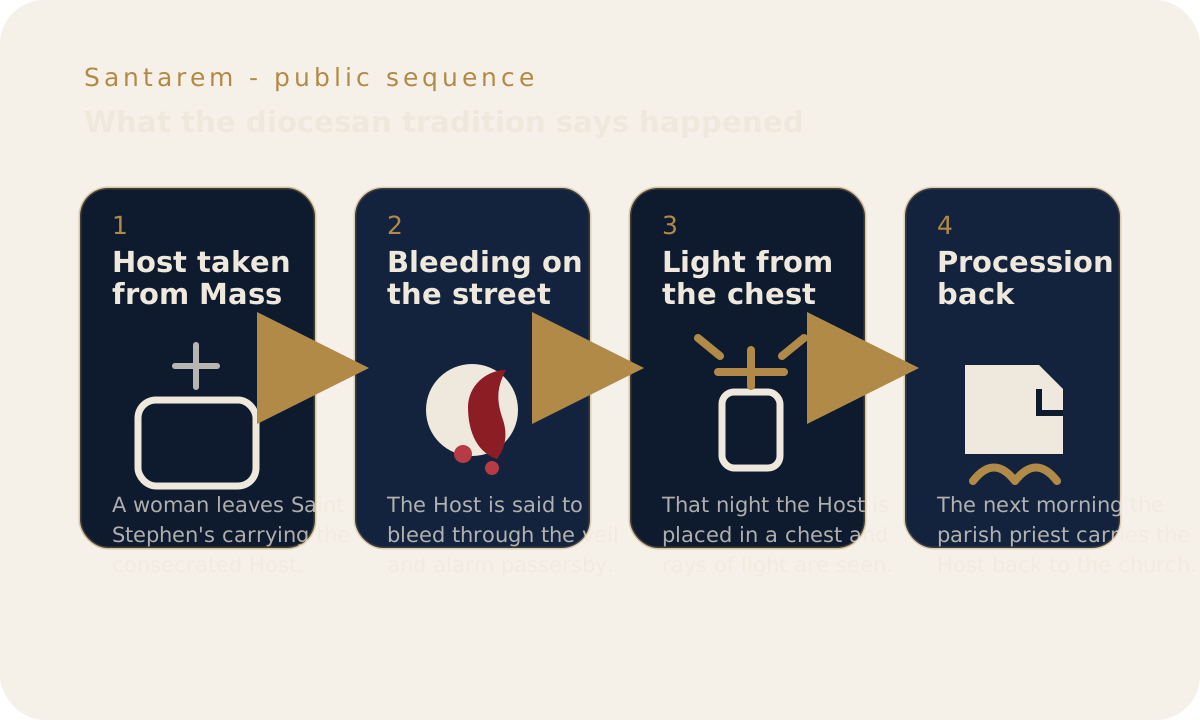
Section titled “Publicly documented chronology”The diocesan sanctuary page gives the story in several stages.[1]
- the woman first received the consecrated Host at the church of Saint Stephen and concealed it in a veil[1]
- the Host began to bleed while she was on the street, alarming witnesses[1]
- that night, she and her husband saw rays of light issuing from the chest where the Host had been placed[1]
- the next morning, the parish priest carried the Host back in procession to the church[1]
This sequence shows that Santarem’s tradition is not merely “a bleeding Host.” It is a whole local narrative of sacrilege, fear, exposure, procession, and enduring public devotion.
The relic tradition
Section titled “The relic tradition”The official diocesan page says the Host was first kept in a wax container, but that in 1340 the wax was found broken and the sacred Host was discovered enclosed in a small crystal vessel that had appeared miraculously.[1]
That crystal vessel was then placed in a silver-gilt monstrance, where the relic continues to be venerated.[1]
Devotion over the centuries
Section titled “Devotion over the centuries”Today the former parish church of Saint Stephen is the Sanctuary of the Most Holy Miracle of Santarem.[1] The diocese continues to present the miracle as part of the city’s living devotional identity, and annual processions still commemorate it.[2]
The same page also preserves echoes of the sanctuary’s older prestige:
- the miracle became the object of royal and noble processions in times of crisis[1]
- Saint Elizabeth of Portugal is remembered as taking part in penitential devotion linked to the miracle[1]
- Afonso VI is recorded as visiting the site in 1664[1]
- the site of the woman’s house is remembered locally as the Ermida do Milagre[1]
The cited diocesan pages document an uninterrupted devotion centered on the relic and sanctuary.[1] [2]
The Diocese of Santarem itself links to a report on the miracle and sanctuary:
The shrine today
Section titled “The shrine today”The cited diocesan material documents:
- a long-standing relic-centered devotion[1]
- diocesan and sanctuary continuity into the present[1]
- public processions and enduring liturgical memory[2]
The public record cited on this page is primarily historical and devotional rather than a modern scientific case file.
References
Section titled “References”- Diocese of Santarem. “Santuario do Santissimo Milagre.” Official diocesan page describing how the miracle occurred, the competing chronologies, the crystal vessel tradition, and the shrine’s continuing devotion. Available at: https://diocese-santarem.pt/santuario-do-santissimo-milagre/
- Diocese of Santarem. “Celebracao do Milagre de Santarem.” Official diocesan report on the annual celebration and procession of the relic. Available at: https://diocese-santarem.pt/2023/04/17/celebracao-do-milagre-de-santarem/
- Diocese of Santarem. Official video report linked from the diocesan sanctuary page. Available at: https://www.youtube.com/watch?v=I8J21a6LEtk