
The Eucharistic Miracle of Walldürn (c. 1330)
The story in one line
consecrated wine at Walldurn was spilled and left a blood-red imprint on the corporal.
The basic story
In Walldürn, Germany, a priest reportedly spilled the consecrated chalice, and the corporal was said to bear an image of the Crucified Christ and multiple crowned heads. The relic became the center of one of Germany's great Holy Blood pilgrimages.
Historical setting
Walldurn belongs to fifteenth-century Germany, where a Mass-associated blood imprint on a corporal became the center of a long pilgrimage tradition.
Date
c. 1330
The public shrine narrative places the original blood wonder around 1330.
Relic
Blood corporal in the Holy Blood altar
The corporal remains the center of devotion inside the basilica.
Oldest written anchor
Papal indulgence document of 1445
The shrine says this is the earliest written witness to the pilgrimage tradition.
Current pilgrimage
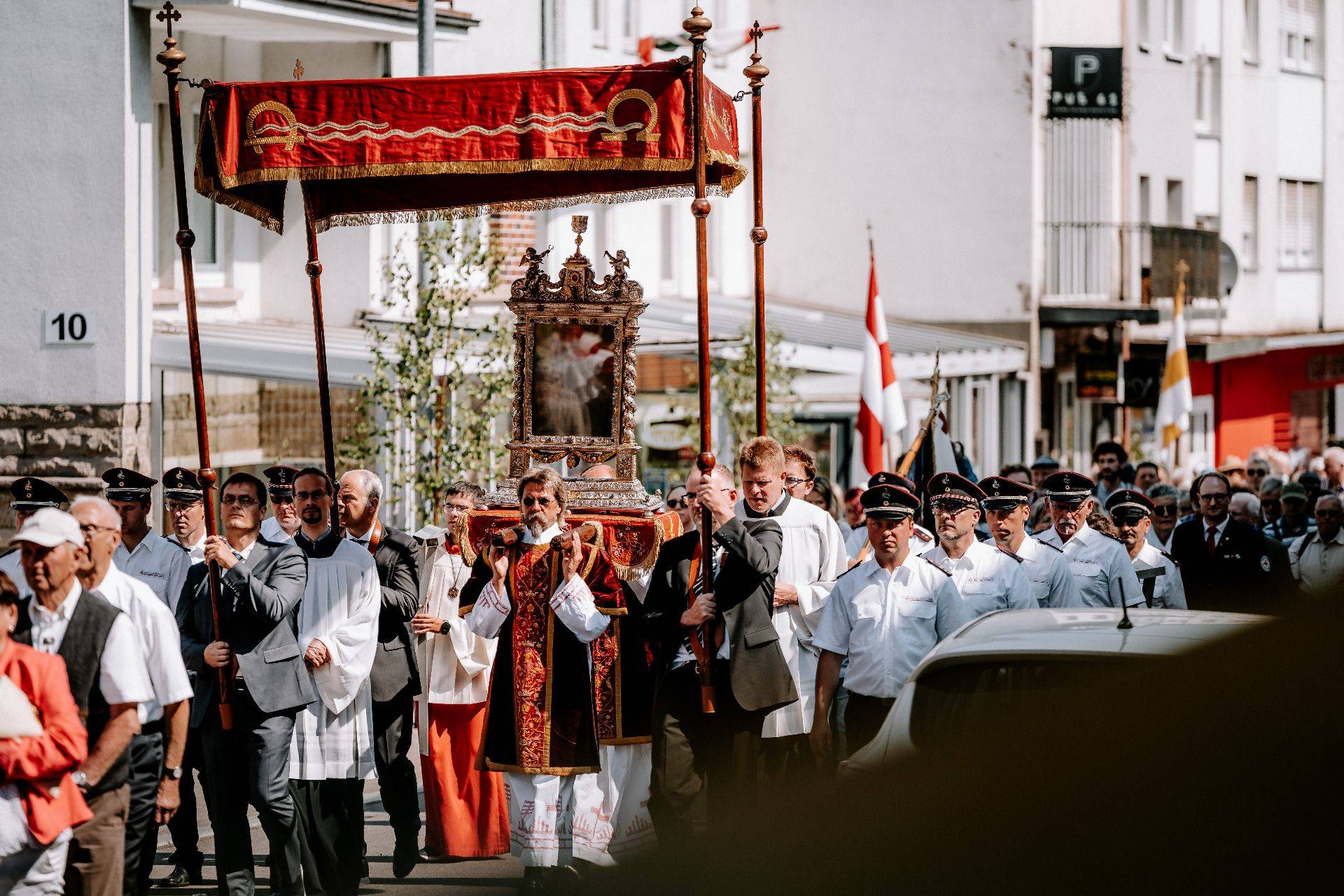
Main four-week season with 100+ groups
The shrine continues to frame Walldürn as a major Eucharistic pilgrimage site.
The story
Section titled “The story”The official pilgrimage site of Walldürn recounts that around 1330 a priest named Heinrich Otto accidentally overturned the consecrated chalice during Mass in the church of St. George.[1]
According to the shrine’s account:
- the spilled Precious Blood marked the corporal[1]
- an image of the Crucified Christ appeared in the center[1]
- multiple Veronica-like heads of Christ appeared at the sides[1]
The priest reportedly hid the corporal, confessed the event only near death, and the cloth then became the center of local and regional devotion.[1]
Two quick clarifications help here. A corporal is the square liturgical cloth spread on the altar during Mass beneath the chalice and Host. And the phrase Veronica-like heads of Christ refers to face images of Christ like the ones traditionally associated with Veronica’s veil. So the Walldürn claim is that after the spill, the altar cloth itself bore both a crucifixion image and repeated face images of Christ.[1]
Primary-source file
Section titled “Primary-source file”The official page preserves the priest Heinrich Otto narrative, the corporal image tradition, and the 1445 papal indulgence reference.
wallfahrt-wallduern.de Official pilgrimage page Current Holy Blood pilgrimage seasonThe shrine describes the four-week main season and notes that more than 100 pilgrim groups normally come to Walldürn.
wallfahrt-wallduern.de Official altar dossier Heiligblutaltar von A–ZThis official shrine dossier adds details about the altar, the silver shrine, the blood corporal, and later documentary tradition.
wallfahrt-wallduern.dePublicly documented chronology
Section titled “Publicly documented chronology”Pilgrimage record
Section titled “Pilgrimage record”The official pilgrimage site presents Walldürn as a continuing Holy Blood pilgrimage center in Germany.[1] [2] In other words, the strongest public evidence here is not a modern scientific report but the long shrine history that grew around the cloth.
The official pilgrimage site itself stresses:
- the spread of devotion after the relic was found[1]
- the later formal journey of the cloth to Rome[1]
- Pope Eugene IV’s recognition with an indulgence in 1445[1]
- the still-active annual pilgrimage season[2]
The shrine culture around the relic
Section titled “The shrine culture around the relic”The official Walldurn pages frame the Blutwunder not simply as a narrated origin story but as the foundation of an ongoing shrine culture. The pilgrimage site highlights the main annual pilgrimage season, the Holy Blood altar, and the continuing arrival of organized pilgrim groups from many regions.[1] [2]
The same official page states that the shrine’s standard narrative is preserved through a 1589 report by Pfarrer Jost Hoffmann recounting what had happened “around 1330.”[1] So the story comes down to us through a later church report, the relic itself, and the pilgrimage culture built around it, not through a record written at the altar on the day the spill happened.
The newer shrine dossier on the Heiligblutaltar adds further continuity markers:
- the corporal has been kept in a precious silver shrine since 1683[3]
- the altar itself was created between 1622 and 1626 and still forms the visual center of the pilgrimage basilica[3]
- the shrine says the faded corporal image was made visible again under UV light in 1950[3]
The cited dossier records that the relic and altar were repeatedly curated, described, and kept at the center of public devotion over centuries.[1] [2] [3]
References
Section titled “References”- Wallfahrt zum Hl. Blut in Walldürn. “Blutwunder.” Official pilgrimage page recounting the origin story, the corporal image, the priest’s confession, and Pope Eugene IV’s recognition with an indulgence in 1445. Available at: https://www.wallfahrt-wallduern.de/wallfahrt/blutwunder/
- Wallfahrt zum Hl. Blut in Walldürn. “Wallfahrt.” Official pilgrimage page describing the main annual pilgrimage season and the continued influx of pilgrim groups to the Holy Blood shrine. Available at: https://www.wallfahrt-wallduern.de/wallfahrt/
- Wallfahrt zum Hl. Blut in Walldürn. “Heiligblutaltar von A-Z.” Official shrine dossier on the Holy Blood altar, the silver shrine, the blood corporal, and the documentary tradition connected with the Walldürn pilgrimage. Available at: https://www.wallfahrt-wallduern.de/wallfahrt/heiligblutaltar-von-a-z/