
Astronomical Candidates for the Star of Bethlehem
The story in one line
the star described in Matthew may correspond to a real astronomical event around the time of Jesus’s birth.
The basic story
Modern astronomy can reconstruct the sky around the probable years of Jesus' birth and test whether major conjunctions, planetary groupings, or a comet match Matthew's Star of Bethlehem. The evidence supports several real candidates, but not one universally agreed identification.
Historical setting
This page sits at the meeting point of Gospel infancy tradition and ancient sky events, where later interpreters tried to identify a historical astronomical backdrop for Matthew's star.
Main date window
7-5 BC
The main astronomical proposals cluster in the years before Herod’s death.
Candidate types
Conjunctions and comet
The literature discussed here focuses on Jupiter-Saturn conjunctions, broader Babylonian astrological context, and a 5 BC comet candidate.
Primary biblical text
Matthew 2:1-12
The New Testament source for the Star of Bethlehem tradition is Matthew’s Magi narrative.
Scholarly status
Several candidates, no single consensus
Modern astronomy can confirm the sky events but does not settle one universally accepted identification.
Main Star of Bethlehem candidates
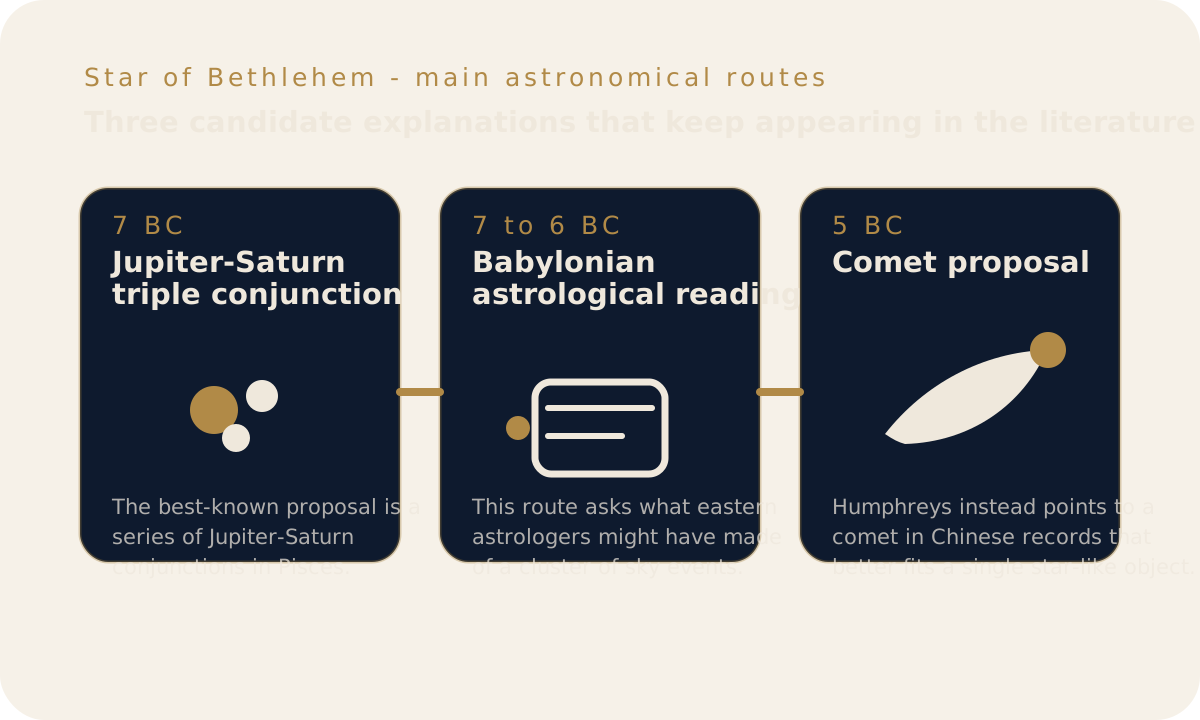
- 7 BC Jupiter-Saturn conjunctions One route focuses on repeated conjunctions in 7 BC.
- 7–6 BC Babylonian omen reading Another route emphasizes how ancient observers might have interpreted the sky rather than one single object.
- 5 BC Comet or nova proposal A third route looks to a comet-like or nova-like event noted in ancient records.
Primary-source file
Section titled “Primary-source file”The Magi narrative and the star tradition in Matthew.
biblegateway.com Published astronomy paper Hughes (1976) The Star of BethlehemNature article arguing for the triple conjunction of Jupiter and Saturn in 7 BC.
nature.com Babylonian astronomy study Sachs and Walker on Kepler's viewStudy connecting the conjunction theory to Babylonian astronomical context.
cambridge.org Comet proposal Humphreys (1991) A comet in 5 BCAstronomy paper proposing a 5 BC comet as the most plausible star candidate.
ui.adsabs.harvard.eduPublicly documented chronology
Section titled “Publicly documented chronology”| Year / window | Candidate |
|---|---|
| 7 BC | Triple conjunctions of Jupiter and Saturn in Pisces.[2] |
| 7/6 BC | Broader Babylonian astrological context tied to the conjunction theory.[3] |
| 5 BC | Chinese-recorded comet candidate emphasized by Humphreys.[4] |
What modern astronomy can actually establish
Section titled “What modern astronomy can actually establish”The Gospel of Matthew describes a star associated with Jesus’ birth that was noticed by the Magi and interpreted as a royal sign.[1] Astronomers can work backward and reconstruct the sky in the years before Herod’s death, testing whether unusual celestial events occurred in the right window.
What this method can show is real and valuable: major conjunctions, planetary groupings, and comets in 7-5 BC can be calculated and compared with the text.
What it cannot do is prove that one specific event is the Star of Bethlehem. The sources themselves are too sparse, and the scholarly literature divides between different candidates.
The main astronomical candidates
Section titled “The main astronomical candidates”1. The Jupiter-Saturn conjunctions of 7 BC
Section titled “1. The Jupiter-Saturn conjunctions of 7 BC”David Hughes argued in Nature that the triple conjunction of Jupiter and Saturn in Pisces in 7 BC is a likely explanation.[2] This theory is based on:
- the conjunctions are real, calculable sky events
- they occurred more than once in a short span, making them unusually noticeable
- ancient astrologers in Mesopotamia could have read such a configuration as politically and religiously significant
This is one of the longest-running scholarly astronomy proposals.
2. The 7/6 BC Babylonian astrological context
Section titled “2. The 7/6 BC Babylonian astrological context”Sachs and Walker revisited the older Kepler-style conjunction theory and connected it to the Babylonian Almanac for 7/6 BC.[3] Their work shifts the discussion from “bright object in the sky” to how eastern astrologers might actually have interpreted a cluster of planetary events.
In other words, the argument is not merely visual. It is also cultural: what would the Magi have thought these skies meant?
3. The comet hypothesis in 5 BC
Section titled “3. The comet hypothesis in 5 BC”Colin Humphreys argued in the Quarterly Journal of the Royal Astronomical Society that the Star of Bethlehem may instead have been a comet visible in 5 BC, likely the one recorded in ancient Chinese sources.[4]
This model is attractive because a comet naturally fits some of Matthew’s language about a star that appeared, persisted over time, and could be described as moving and later standing over a location.[4]
What the evidence supports best
Section titled “What the evidence supports best”The literature does not converge on a single object. Instead, it supports a narrower and more defensible conclusion:
- the sky around the likely years of Jesus’ birth contained several notable astronomical events[2] [3] [4]
- many scholarly candidates cluster around 7 BC to 5 BC
- conjunction theories emphasize astrological meaning
- comet theories emphasize Matthew’s language about a single star-like object
The literature presents multiple candidate identifications rather than a single settled answer, while also preserving several plausible astronomical events in the likely nativity window.[2] [3] [4]
References
Section titled “References”- Matthew 2:1-12. The Magi narrative and the Star of Bethlehem in the New Testament.
- Hughes, David W. “The Star of Bethlehem.” Nature 264 (1976): 513-517. Abstract available at: https://www.nature.com/articles/264513a0
- Sachs, A. J., and C. B. F. Walker. “Kepler’s View of the Star of Bethlehem and The Babylonian Almanac for 7/6 B.C.” Iraq 46.1 (1984): 43-55. Extract available at: Cambridge PDF extract
- Humphreys, Colin J. “The Star of Bethlehem - a Comet in 5 BC - and the Date of the Birth of Christ.” Quarterly Journal of the Royal Astronomical Society 32 (1991): 389-407. Abstract available at: https://ui.adsabs.harvard.edu/abs/1991QJRAS..32..389H/abstract