
Sudarium of Oviedo
The story in one line
the Sudarium of Oviedo is the burial face cloth mentioned in the Gospel of John and preserves blood patterns from Jesus’s Passion.
The basic story
The Cathedral of Oviedo preserves a bloodstained cloth venerated as the head cloth of Jesus. Unlike the Shroud of Turin, it bears no body image; the public file is built around its route tradition, cathedral record, and modern study summaries.
Historical setting
The Sudarium of Oviedo belongs to the early medieval movement of relics out of the Near East and into Iberia, where it was preserved as the face cloth associated with Jesus's burial.
Relic setting
Camara Santa, Oviedo Cathedral
The official cathedral presents the Sudarium as a defining relic of Sancta Ovetensis.
Recorded opening
March 13, 1075
The cathedral ties the known inventory record to the solemn opening of the Arca Santa in 1075.
Cloth dimensions
85.5 x 52.6 cm
Those measurements are given on the official cathedral page.
Public display cycle
Three weeks each year
The cathedral says the Sudarium is shown during Holy Week, Easter Week, and the Holy Cross jubilee period in September.
What the cloth is
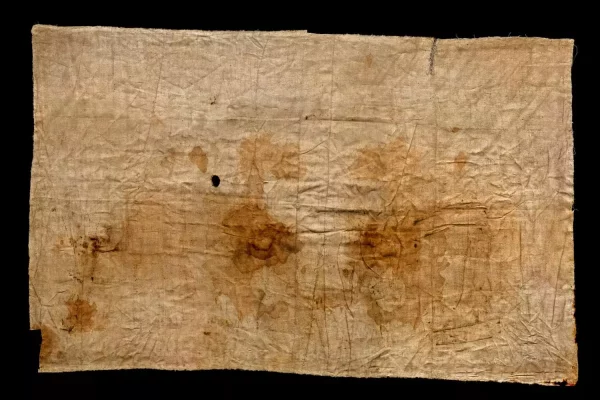
Section titled “What the cloth is”The Sudarium of Oviedo is a small bloodstained cloth preserved in the Camara Santa of the Cathedral of San Salvador in Oviedo, Spain.[1]
By long-standing cathedral tradition, it is venerated as the cloth that covered the head of Jesus after the Crucifixion. The Cathedral of Oviedo emphasizes that the Sudarium is one of the central relics that helped give the church its title Sancta Ovetensis.[1]
Unlike the Shroud of Turin, the Sudarium carries no body image. The public file therefore centers on the cloth’s recorded history, the cathedral’s own description of the relic, and later study summaries.[1] [2]
Primary-source file
Section titled “Primary-source file”The cathedral’s own page gives the Sudarium’s route tradition, dimensions, scientific-study summary, and annual public display schedule.
catedraldeoviedo.com Official Good Friday notice Viernes Santo - showing of the Santo SudarioThis event page shows the continued liturgical use of the Sudarium in the cathedral calendar, including its public showing after the Passion liturgy.
catedraldeoviedo.com Official research association Asociacion Sudario de OviedoThe Oviedo association’s public site preserves the current research-and-preservation framing around the Sudarium and repeats the historical route tradition kept in Oviedo.
sudariodeoviedo.comPublicly documented chronology
Section titled “Publicly documented chronology”- According to the cathedral tradition, the relic left Jerusalem in 614 during the Persian invasion and passed through Alexandria, Carthage, Cartagena, Seville, and Toledo before reaching Asturias.[1]
- The cathedral says the contents of the Arca Santa were solemnly opened on March 13, 1075, and that the inventory included the wording de sudario Domini.[1]
- The same official page describes the cloth as a rectangular linen with Z-twist thread and a size of 85.5 x 52.6 cm.[1]
- The cathedral’s study summary says later examination identified human blood of group AB, multiple fluid exits, and stain patterns it relates to a crucified man whose head had been covered after death.[1]
- The Sudarium remains part of the cathedral’s active liturgical life: the cathedral says it is displayed during Holy Week, Easter Week, and the Holy Cross jubilee period in September, with blessings given on Good Friday, September 14, and September 21.[1] [3]
The case in relation to the Shroud
Section titled “The case in relation to the Shroud”The Sudarium is often discussed alongside the Shroud because writers working on one relic frequently compare it with the other. The official cathedral page itself places two strands into the record: the long route tradition of the cloth’s movement to Oviedo, and the modern study summary that links the blood patterns and handling sequence to a crucified man.[1]
Mark Guscin’s book is one of the best-known modern historical reconstructions of that route from Jerusalem to Spain.[2]
The present public record
Section titled “The present public record”The public file for the Sudarium includes:
- the cloth’s long devotional history in Oviedo[1]
- the cathedral’s own summary of the medieval transfer tradition and the 1075 inventory[1]
- the dimensions and textile description of the cloth[1]
- the cathedral’s scientific-study summary, including blood group, stain sequence, and handling reconstruction[1]
- continuing liturgical exposition and blessing with the Sudarium in Oviedo today[1] [3]
- a contemporary Oviedo association dedicated to research, conservation, and public explanation of the cloth[4]
References
Section titled “References”- Catedral de Oviedo. “Camara Santa.” Official cathedral dossier describing the Sudarium’s route tradition, 1075 inventory record, dimensions, study summary, and annual public display cycle. Available at: https://catedraldeoviedo.com/conoce-cada-rincon/camara-santa/
- Guscin, M. (2004). The History of the Sudarium of Oviedo: How It Came from Jerusalem to Northern Spain in the Seventh Century A.D. A book-length historical reconstruction of the cloth’s route and documentary tradition.
- Catedral de Oviedo. “Viernes Santo.” Official cathedral event page noting the public showing of the Santo Sudario after the Good Friday Passion liturgy. Available at: https://catedraldeoviedo.com/evento/viernes-santo/
- Asociacion Sudario de Oviedo. Official site describing the association’s ongoing work of investigation, conservation, and public explanation of the Sudarium preserved in Oviedo. Available at: https://www.sudariodeoviedo.com/