
Our Lady of Guadalupe
The story in one line
the Virgin Mary appeared to Juan Diego in 1531 and that her image was left on his tilma.
The basic story
In December 1531, a recently converted Indigenous peasant named Juan Diego said he encountered the Virgin Mary four times on a hilltop near Mexico City. The image left on his cloak later became the center of one of the largest pilgrimage traditions in Christianity and centuries of examination followed.
Reported message
Historical setting
Guadalupe belongs to the first decade after the Spanish conquest of Mexico, when evangelization, Indigenous conversion, and the emerging colonial church formed the backdrop to Juan Diego's reports.
Reported apparition dates
December 9 to 12, 1531
The traditional narrative centers on four December 1531 apparitions at Tepeyac and the bishop audience on December 12.
Primary witness in the tradition
Juan Diego Cuauhtlatoatzin
The Guadalupe narrative presents Juan Diego as the messenger sent repeatedly to Bishop Zumarraga.
Early textual witness
Nican Mopohua
The Nahuatl narrative is the earliest surviving written account associated with the apparition tradition.
Public shrine record
Millions of annual pilgrims
The Basilica’s public reporting and major news coverage continue to treat Guadalupe as one of the world’s most visited Catholic shrines.
In plain terms, the 1556 controversy was a fight inside the Church in Mexico. Archbishop Alonso de Montúfar was encouraging devotion to the image at Tepeyac. Franciscan preacher Francisco de Bustamante pushed back in a sermon, warning that people were treating the image superstitiously and saying it had been painted by an Indigenous artist. Church authorities then questioned witnesses about that quarrel. So the file is early and important. It shows that the image was already famous in the 1550s. But it does not work like a painter stepping forward to sign his work, and it does not work like a lab report explaining how the image was made.
Primary-source file
Section titled “Primary-source file”Cambridge-published art-historical study on the cloth, the image, and sixteenth-century sources in New Spain.
doi.org Peer-reviewed iconography Aztec Interpretations of the Sacred TilmaSpringer article on Nahua iconography and the image’s indigenous-symbolic reading.
doi.org Public shrine scale BBC report on the Basilica of GuadalupeIndependent reporting on the basilica’s annual visitor scale and ongoing devotional record.
bbc.comOverview
Section titled “Overview”The Guadalupe story is not just that a famous image exists. It is that in December 1531, a newly baptized Indigenous convert named Juan Diego says he went back and forth between Tepeyac and the bishop of Mexico, carrying a message from a lady he said was the Mother of God.[5] [6]
On the fourth day, according to the tradition, he opened his tilma before Bishop Zumárraga to show the roses he had gathered on the hill. The flowers fell, and the Marian image now known as Our Lady of Guadalupe was said to be visible on the cloak itself.[6]
That cloak later became one of the most visited religious objects in the world. So this page follows three threads at once: the story Juan Diego said happened, the cloth itself, and the long public history of pilgrims, churches, examinations, and arguments that grew up around it.[1] [6] [7]
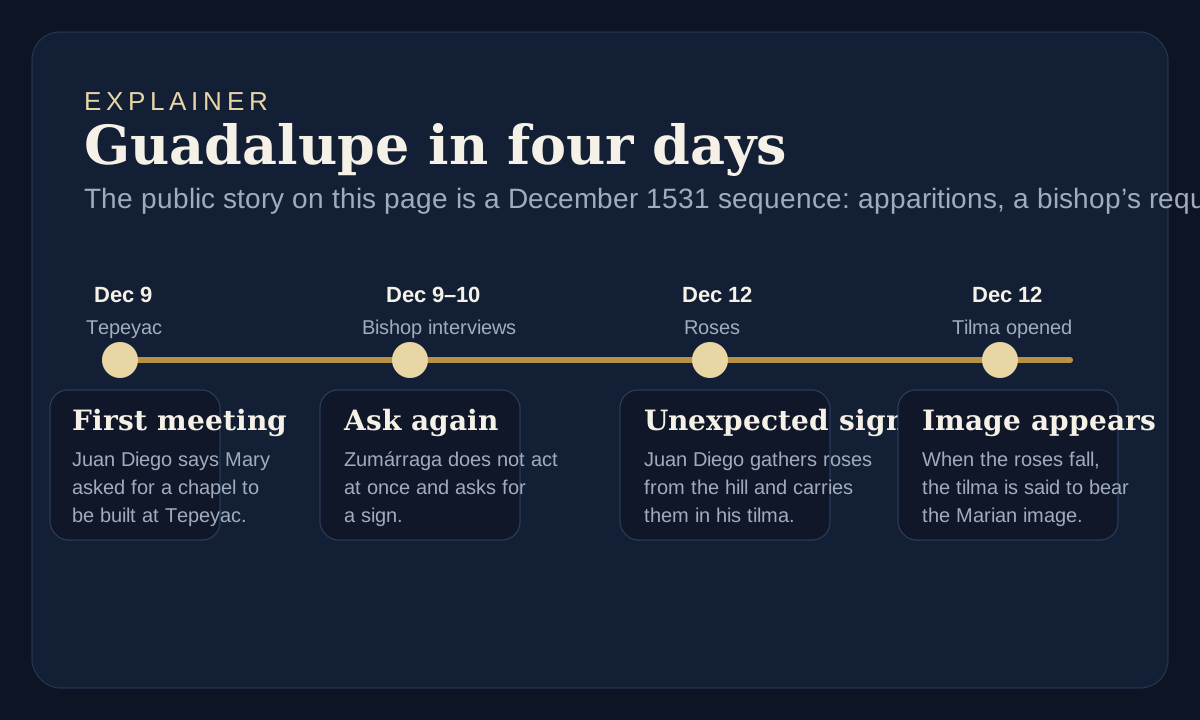
Guadalupe in four days
- Dec 9 First meeting Juan Diego says a lady on Tepeyac asks for a chapel to be built there.
- Dec 9–10 Ask again Bishop Zumárraga does not act at once and asks Juan Diego for a sign.
- Dec 12 Unexpected sign Juan Diego gathers roses from the hill and carries them in his tilma.
- Dec 12 Image appears When the tilma is opened before the bishop, the Marian image is said to be visible on the cloth.
Publicly documented chronology
Section titled “Publicly documented chronology”Juan Diego
Section titled “Juan Diego”Juan Diego Cuauhtlatoatzin was born in 1474 in the Aztec region of Cuauhtitlan (modern-day Mexico).[6] He was among the first generation of Aztec converts to Christianity following the Spanish arrival, having been baptized in 1524 by Franciscan missionaries.[6]
He was 57 years old at the time of the apparitions — an elderly, poor, newly converted Christian of no social standing.[6] He had nothing to gain from fabricating a religious vision. He was the least likely candidate for hagiographical invention.[6]
The Four Apparitions
Section titled “The Four Apparitions”-
December 9, 1531 — First Apparition
At dawn, while crossing the Hill of Tepeyac on his way to Mass in the village of Tlatelolco, Juan Diego heard music and saw a radiant young woman who called him by name.[6] She spoke to him in Nahuatl — his native language — and identified herself as the Virgin Mary, Mother of the true God.[6]
She asked him to go to Bishop Juan de Zumárraga and request that a temple be built on Tepeyac in her honor, so that she might help the people there.[6]
-
December 9, 1531 — The Bishop Refuses
Juan Diego presented himself to Bishop Zumárraga and delivered the message. The bishop — a Franciscan who was cautious about such reports — received him politely but sent him away without action, asking for a sign.[5] [6]
-
December 10–11, 1531 — Second and Third Apparitions
The Lady appeared to Juan Diego again, on his return journey and again the following morning.[6] She encouraged him to return to the bishop and ask again. The bishop again requested a sign.[5]
-
December 12, 1531 — The Sign
On December 12, Juan Diego’s uncle, Juan Bernardino, was critically ill with typhus (or a similar illness) and Juan Diego was rushing to find a priest to administer last rites.[6]
The Lady intercepted him on the hill and told him his uncle had already been cured.[6] She instructed him to climb the hill and gather roses growing there.
This was extraordinary: it was December, in the high desert of central Mexico, where roses do not grow — and certainly not in winter.[6]
Juan Diego climbed the hill and found it covered in Castilian roses, not native to Mexico.[6] He gathered them in his tilma (a rough cactus-cloth cloak). The Lady arranged them with her own hands and told him to bring them to the bishop — opening no one’s view until he was before the bishop himself.[6]
The Image
Section titled “The Image”When Juan Diego opened his tilma before Bishop Zumárraga, the roses fell to the floor. What was left on the cloth was the image now venerated as Our Lady of Guadalupe.[6]
Bishop Zumárraga, who had twice sent Juan Diego away, fell to his knees.[5] [6]
The Tilma: Physical Description
Section titled “The Tilma: Physical Description”The tilma is a cloak approximately 1.7 meters long and 1.05 meters wide, made of two panels of ayate — a rough fabric woven from the fibers of the maguey cactus.[1] The two panels are joined by a visible center seam.[1]
.jpg)
Under normal conditions, ayate fiber degrades within 20–30 years due to:[1]
- Exposure to humidity, salt air, and atmospheric pollutants
- Mechanical stress from handling and display
- Biological degradation (mold, insects, bacteria)
The tilma is now nearly 500 years old.[7]
The Scientific Investigations
Section titled “The Scientific Investigations”Artistic Analysis
Section titled “Artistic Analysis”Beginning in the 19th century and continuing through the 20th, multiple professional artists and art historians have examined the tilma.[1] Widely circulated claims include:
- There is no underdrawing beneath the image
- There is no sizing (preparation layer) applied to the cloth
- There are no visible brush strokes anywhere in the image
- The colors cannot be definitively identified as any known pigment, dye, or paint
The Kuhn (1936) Chemical Analysis
Section titled “The Kuhn (1936) Chemical Analysis”In 1936, German Nobel Prize laureate Dr. Richard Kuhn — a chemist — is reported to have analyzed two fiber samples from the tilma.[4]
Infrared and Ultraviolet Analysis
Section titled “Infrared and Ultraviolet Analysis”In 1979, infrared reflectography was performed by Dr. Phillip Callahan and Jody Brant Smith.[1]
The widely cited claims from this monograph include:
- No evidence of underdrawing visible under infrared illumination (claimed by Callahan 1981; contested by Nickell & Fischer 1985)[1]
- The image “is inexplicable” under conventional artistic and scientific categories (Callahan’s characterization)[1]
- The folding creases of the cloth are visible through the image, suggesting the image was applied to the cloth while it was folded[1]
- The cloth itself shows surprising resistance to degradation inconsistent with its age and material[1]
All natural and synthetic pigments, dyes, and fibers fluoresce under ultraviolet light. They always have a detectable UV signature.
The image on the tilma shows no ultraviolet fluorescence, according to Callahan’s monograph.[1]
Note: This finding has not been independently replicated in a peer-reviewed study. It originates solely from the non-peer-reviewed CARA monograph. The 1982 Sol Rosales examination identified conventional pigments that would be expected to have UV signatures.
The Eyes of the Image
Section titled “The Eyes of the Image”In 1929, photographer Alfonso Marcué González discovered what appeared to be a human figure reflected in the right eye of the image — visible when the eye was photographed at high magnification.[3]
In 1951, researcher Carlos Salinas and collaborator Juan Dávila confirmed the presence of human figures in both eyes of the image.[3]
In 1979, Dr. José Aste Tönsman, a Peruvian engineer with a specialization in digital image processing, applied computer enhancement techniques to high-resolution photographs of both eyes.[3] He identified figures in both eyes at different scales corresponding to the Purkinje-Sanson effect — the way human eyes reflect light from different layers of the eye.[2] [3]
Dr. Aste Tönsman identified approximately 13 distinct human figures in the reflections of both eyes.[3]
The 1787 Acid Incident
Section titled “The 1787 Acid Incident”In 1787, a laboratory worker accidentally spilled nitric acid on the lower right portion of the tilma.[7] The acid visibly stained the cloth, which would normally have caused catastrophic damage to a fabric this old and fragile.[7]
The stain, however, faded over the following decade.[7]
The 1921 Bombing
Section titled “The 1921 Bombing”On November 14, 1921, a bomb disguised in a bouquet of flowers was placed at the feet of the tilma on the altar of the Old Basilica.[7] The bomb exploded with force sufficient to:[7]
- Demolish a nearby marble altar step
- Bend solid brass candlesticks
- Shatter windows throughout the building
The tilma was undamaged.[7] The glass covering it (which had been added by then) was also intact.[7]
What the peer-reviewed record actually shows
Section titled “What the peer-reviewed record actually shows”The tilma has received essentially no examination in mainstream peer-reviewed natural science journals. The peer-reviewed works that exist approach the image as a historical and cultural artifact:
1. Peterson (2005) — Art History (peer-reviewed)
Peterson, J.F. (2005). “Creating the Virgin of Guadalupe: The Cloth, the Artist, and Sources in Sixteenth-Century New Spain.” The Americas, 61(4), 571–610. DOI: 10.1017/S0003161500069327
Published by Cambridge University Press in a peer-reviewed art history journal. Peterson (UC Santa Barbara art historian, no documented religious affiliation) analyzed the tilma as a 16th-century painted artifact, documented the materials (agave fiber cloth, calcium sulfate ground, distemper paints), and identified likely indigenous and European artistic precedents. A 1556 ecclesiastical investigation explicitly attributed the image to “the Indian painter Marcos” (Marcos Cipac de Aquino). Peterson makes no supernatural claims; she treats the image as a colonial syncretic artifact.
2. Arredondo Sevilla (2025) — Theology/Anthropology (peer-reviewed)
Arredondo Sevilla, J.M. (2025). “Aztec Interpretations of the Sacred Tilma: A Nahua Iconographical Reading of Our Lady of Guadalupe.” International Journal of Latin American Religions (Springer). DOI: 10.1007/s41603-025-00306-8
Peer-reviewed theological and anthropological analysis. Argues indigenous (Nahua/Aztec) cosmological symbols are deliberately embedded in the image — consistent with the tilma being a syncretic colonial artifact. The author is affiliated with Notre Dame Theology and Universidad Católica Lumen Gentium (a Catholic institution). Does not make supernatural claims about the image’s origin.
Limits on independent modern investigation
Section titled “Limits on independent modern investigation”No independent scientific body has been granted systematic access for modern comprehensive testing. Access requires permission from the Basilica of Our Lady of Guadalupe (Archdiocese of Mexico City).
The 1982 precedent is instructive: Basilica Abbot Schulenburg commissioned a technical examination (Sol Rosales), received a report concluding the image was a conventional 16th-century human painting, and the report was suppressed. It only became public in 2002, when Juan Diego’s canonization was imminent, via a leak to the Mexican magazine Proceso. The episode is frequently cited in discussions of access because the report remained unpublished for two decades.
The tilma is the most visited Catholic shrine in the world, receiving an estimated 20 million or more annual visitors. [12] Any new testing would therefore take place in an unusually public devotional setting.
The historical consequence
Section titled “The historical consequence”Whatever one concludes about the tilma itself, the historical record contains an anomaly that is not explained by the tilma’s physical properties alone.
Before December 1531, the Spanish had militarily conquered the Aztec civilization but had almost entirely failed to convert its people to Christianity.[5] The Aztec population had witnessed forced conversion attempts and had not responded.[5]
Within a decade of the Guadalupe apparition — in which an image appeared speaking to the indigenous population in their own symbolic language (a pregnant woman clothed with the sun, standing on the moon, crushing a serpent underfoot — each element directly referencing Aztec cosmology and the gods associated with those symbols) — approximately nine million Aztec people voluntarily converted to Christianity.[5]
This is one of the largest and most rapid mass conversions in recorded history.[5] It ended a civilization’s practice of mass human sacrifice. It is documented in the missionary records of the period.[5]
The historical puzzle is this: what changed? The Spanish military had been present for a decade without this effect. A tilma appeared, and millions converted. The causal chain is documented even if its mechanism is not.[5]
References
Section titled “References”- Callahan, P.S. & Smith, J.B. (1981). Photographic Exhibition of an Infrared Photograph of the Tilma of Juan Diego. CARA Studies on Popular Devotion, Vol. II, No. 4. Washington, D.C.: CARA, Georgetown University. — Note: This is a CARA monograph, not a peer-reviewed journal article. CARA is the research arm of the US Catholic Bishops’ Conference. Callahan was a devout Catholic working under commission from a faith-motivated researcher.
- Torroella Bueno, J. (1975). Ophthalmological analysis of the image. Boletín de la Asociación Médica Mexicana de Oftalmología (Bulletin of the Mexican Academy of Ophthalmology). — Identified Purkinje-Sanson reflections. Conducted within Basilica-sanctioned context.
- Aste Tönsman, J. (1981). Los ojos de la Virgen de Guadalupe. Editorial Diana. — Note: This is a book published by a Catholic devotional organization, not a peer-reviewed engineering journal. Identified approximately 13 figures in the eye reflections. Independent confirmation of the identifications is lacking; magnification artifacts have not been ruled out.
- Kuhn, R. (1936). Chemical analysis of tilma fiber samples. — Note: No journal article by Kuhn on the tilma exists in his bibliography. This analysis was communicated privately and has no accessible primary document. The claim circulates exclusively in Catholic secondary literature. Compare: Sol Rosales (1982) identified conventional 16th-century pigments using hands-on examination.
- Diocese of Mexico — Canonical investigations (1666, 1723). — Two formal canonical investigations, both finding the accounts and image authentic.
- Valeriano, A. (c. 1540–1560). Nican Mopohua. — The earliest Nahuatl-language account of the Guadalupe apparitions; written by a close associate of Juan Diego.
- Johnston, F. (1981). The Wonder of Guadalupe. TAN Books. — Documents the history and investigations including the 1531 events.
- Sol Rosales, J. (1982). Technical examination of the tilma of Juan Diego [unpublished report submitted to the Vatican]. — Commissioned by Basilica Abbot Guillermo Schulenburg. Concluded conventional 16th-century materials: calcium sulfate primer, distemper paints (black from pine soot, carmine, earth tones, gold leaf). Report suppressed; leaked 2002 via Proceso magazine (Mexico).
- Peterson, J.F. (2005). “Creating the Virgin of Guadalupe: The Cloth, the Artist, and Sources in Sixteenth-Century New Spain.” The Americas, 61(4), 571–610. Cambridge University Press. DOI: 10.1017/S0003161500069327. — Peer-reviewed art history. Identifies the image as a 16th-century colonial artifact; documents materials and artistic precedents; notes 1556 attribution to painter Marcos Cipac de Aquino.
- Nickell, J. & Fischer, J.F. (1985). “The Image of Guadalupe: A Folkloristic and Iconographic Investigation.” Skeptical Inquirer, 9(4). — Critical review of Callahan’s infrared findings; identified sketch lines and retouching Callahan missed.
- Arredondo Sevilla, J.M. (2025). “Aztec Interpretations of the Sacred Tilma: A Nahua Iconographical Reading of Our Lady of Guadalupe.” International Journal of Latin American Religions. Springer. DOI: 10.1007/s41603-025-00306-8. — Peer-reviewed. Analyzes indigenous cosmological symbolism in the image; consistent with deliberate syncretic colonial manufacture.
- Basilica of Our Lady of Guadalupe, Mexico City. Annual pilgrimage figures. The Basilica’s own public reporting consistently cites 20–22 million annual visitors, making it the most visited Marian shrine and among the most visited Catholic sites worldwide. See also: BBC News (December 12, 2019): “Guadalupe: Mexico’s most visited site” — bbc.com/news/world-latin-america-50757212. Independent press reporting consistently corroborates this order-of-magnitude figure.
- ”Información de 1556. Controversia Montúfar-Bustamante.” Paleographic transcription of the 1556 inquiry ordered by Archbishop Alonso de Montúfar over Fr. Francisco de Bustamante’s sermon attacking the Guadalupe devotion. The document preserves hostile testimony about an image “painted by an Indian,” but it is a controversy file about preaching and devotion, not a technical inspection or signed artist attribution. Available at: https://genealogia.org.mx/informacion-de-1556-controversia-montufar-bustamante/
- “Our Lady of Guadalupe: Historical Sources.” L’Osservatore Romano, reprinted by EWTN (23 January 2002). This survey argues that sixteenth-century Guadalupan documentation is broader than a single 1649 printing, cites Burrus’s catalogue of 25 sixteenth-century documents, and reports the view of Edmundo O’Gorman and Miguel León-Portilla that Antonio Valeriano’s Nican Mopohua belongs to the sixteenth century and is often dated to 1556. Available at: https://www.ewtn.com/catholicism/library/our-lady-of-guadalupe-historical-sources-5605