
The Eucharistic Miracle of Alatri (1228)
The story in one line
a consecrated Host at Alatri became visibly marked with blood during a medieval Communion dispute.
The basic story
In Alatri, Italy, a consecrated Host hidden after a sacrilegious theft was reported to have become visible flesh. The Diocese of Anagni-Alatri continues to venerate the relic and points to Pope Gregory IX's bull Fraternitatis tuae as the foundational recognition.
Historical setting
The Alatri tradition comes out of medieval central Italy, where a Communion dispute and a bleeding fragment story became attached to the cathedral's relic record.
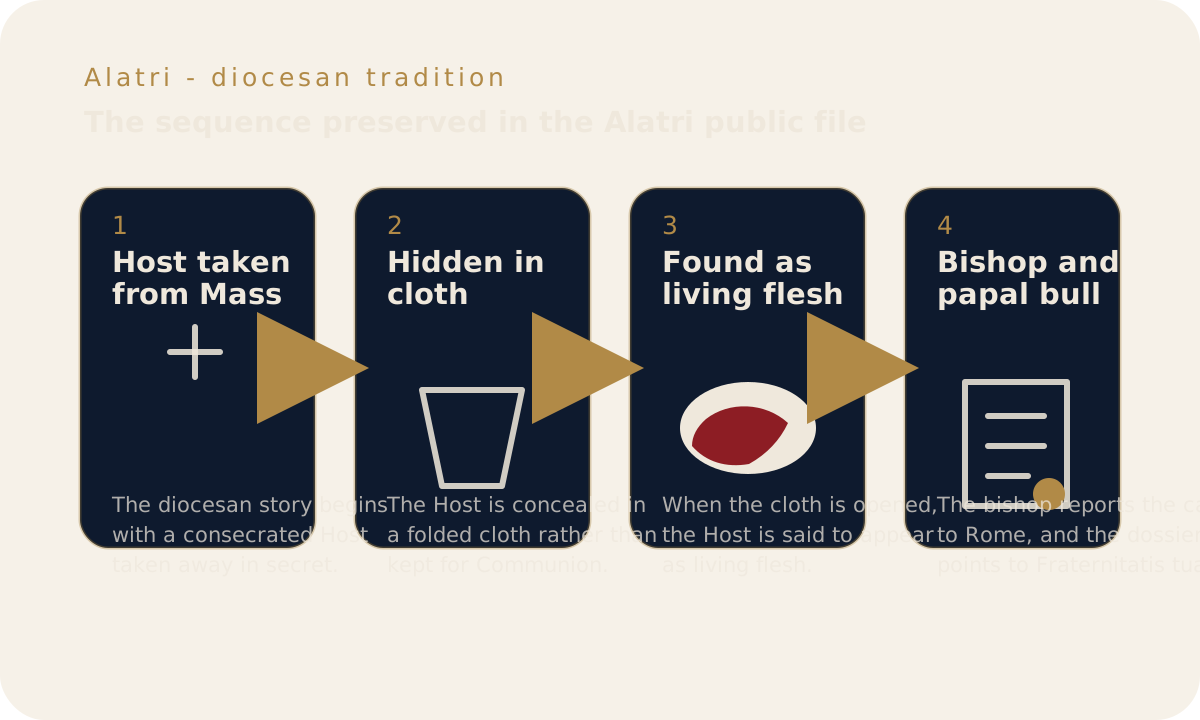
Alatri sequence
- Sacrilege Host taken and hidden The diocesan story begins with a consecrated Host removed from Mass and hidden in cloth.
- Claim Flesh appears When the hiding place is opened, the Host is said to appear as living flesh.
- Authority Reported to church leaders The case is taken to ecclesiastical authorities rather than staying a village rumor.
- Anchor Gregory IX bull The diocese treats Fraternitatis tuae as the key written documentary anchor.
Date
1228
The diocesan tradition ties the event to the end of 1227 and the papal response in March 1228.
Document anchor
Bull Fraternitatis tuae
The Diocese of Anagni-Alatri treats Gregory IX’s mandate as the foundational written witness.
Relic site
Concattedrale di San Paolo, Alatri
The transformed particle is still displayed in the right-side chapel.
Feast life
Annual celebrations on March 13
The diocese still marks the miracle publicly in its liturgical calendar.
The story
Section titled “The story”The Diocese of Anagni-Alatri tells the story this way: a young woman received a consecrated Host at Mass, did not consume it, and hid it in a cloth because someone had wrongly told her it could be used for magical or superstitious purposes.[1]
When she later opened the cloth, the Host was said to look no longer like bread but like living flesh.[1] The object was then taken to church authorities in Alatri rather than kept as a private story.
Primary-source file
Section titled “Primary-source file”The diocesan PDF summarizes the story and explicitly grounds it in Gregory IX’s bull Fraternitatis tuae.
diocesianagnialatri.it Official shrine setting The co-cathedral page for San PaoloThe co-cathedral page identifies the chapel, the glass reliquary, and the March 13, 1228 papal mandate date.
diocesianagnialatri.it Current diocesan devotion Recent annual celebration noticeThe annual diocesan notices show that the Ostia Incarnata still structures public liturgy and local devotion.
diocesianagnialatri.itPublicly documented chronology
Section titled “Publicly documented chronology”Documentary record
Section titled “Documentary record”What gives Alatri unusual weight in the medieval record is that the diocese does not point only to oral tradition. It points to a specific papal document:
- the bull Fraternitatis tuae of Pope Gregory IX[1]
- a report from the bishop of Alatri to the pope[1]
- continuing veneration of the relic in the co-cathedral of Saint Paul[1]
In plain terms, the diocese is saying: this was reported upward to Rome, the pope answered in writing, and the relic was then kept and honored publicly. That gives Alatri a firmer paper trail than many medieval miracle stories.
The relic today
Section titled “The relic today”The diocesan document states that the relic of the transformed Host is kept in a glass-and-metal reliquary, similar in function to a monstrance, and is permanently displayed in a chapel of the Basilica Concattedrale di San Paolo in Alatri.[1]
So this is not just a story preserved in a book. Visitors can still go to the church and see the relic that the local tradition says came from the event.
The diocesan co-cathedral page adds more architectural detail about the shrine setting itself. It states that the Cappella dell’Ostia Incarnata occupies the right side of the church and explicitly identifies the reliquary with the transformed particle as part of the cathedral’s continuing devotional life.[2]
A living diocesan devotion
Section titled “A living diocesan devotion”The miracle is not treated as a dead medieval memory in Alatri. Recent diocesan notices still announce annual liturgies and public celebrations for the Miracolo Eucaristico di Alatri, centered on the feast kept on March 13.[3]
So Alatri is one of those cases where the story, the relic, the church building, and the local calendar all still belong to one living tradition rather than being scattered fragments from the Middle Ages.
References
Section titled “References”- Diocesi di Anagni-Alatri. “Miracolo Eucaristico dell’Ostia Incarnata.” Official diocesan PDF summarizing the story, quoting the 1228 bull Fraternitatis tuae of Pope Gregory IX, and noting the relic’s preservation in the co-cathedral of San Paolo. Available at: https://www.diocesianagnialatri.it/wp-content/uploads/2024/03/Miracolo-Eucaristico-dell-2.pdf
- Diocesi di Anagni-Alatri / BeWeB. “La concattedrale” and cathedral record for the Chiesa di San Paolo Apostolo. Official diocesan and Italian bishops’ cultural-heritage material identifying the chapel and reliquary of the Ostia Incarnata within the co-cathedral. Available at: https://www.diocesianagnialatri.it/la-concattedrale/ and https://www.beweb.chiesacattolica.it/cattedrali/cattedrale/FUJ/Chiesa%2Bdi%2BChiesa%2Bdi%2BSan%2BPaolo%2BApostolo
- Diocesi di Anagni-Alatri. Recent diocesan notices for the annual celebrations of the miracle, confirming that the Ostia Incarnata remains a recurring public devotion in Alatri. Available at: https://www.diocesianagnialatri.it/2025/03/12/miracolo-eucaristico-di-alatri-le-celebrazioni-2/ and https://www.diocesianagnialatri.it/2024/03/11/miracolo-eucaristico-di-alatri-le-celebrazioni/