
The Eucharistic Miracle of Bolsena-Orvieto (1263)
The story in one line
a doubting priest’s Host bled during Mass at Bolsena, staining the corporal later preserved at Orvieto.
The basic story
In 1263, a priest celebrating Mass in Bolsena reportedly saw blood issue from the consecrated Host and stain the corporal. The relic was taken to Orvieto, where official cathedral sources connect it with Corpus Christi devotion and the Chapel of the Corporal.
Historical setting
Bolsena-Orvieto belongs to thirteenth-century Italy, when debates over the Eucharist, priestly doubt, and papal attention formed the backdrop to the famous corporal tradition.
Event date
1263
The official cathedral page dates the priest’s Mass and the bloodstained corporal tradition to 1263.
Places in the record
Bolsena and Orvieto
The Mass is said to have occurred at Bolsena, while the relic and public devotion became centered in Orvieto.
Relic preserved
The Corporal
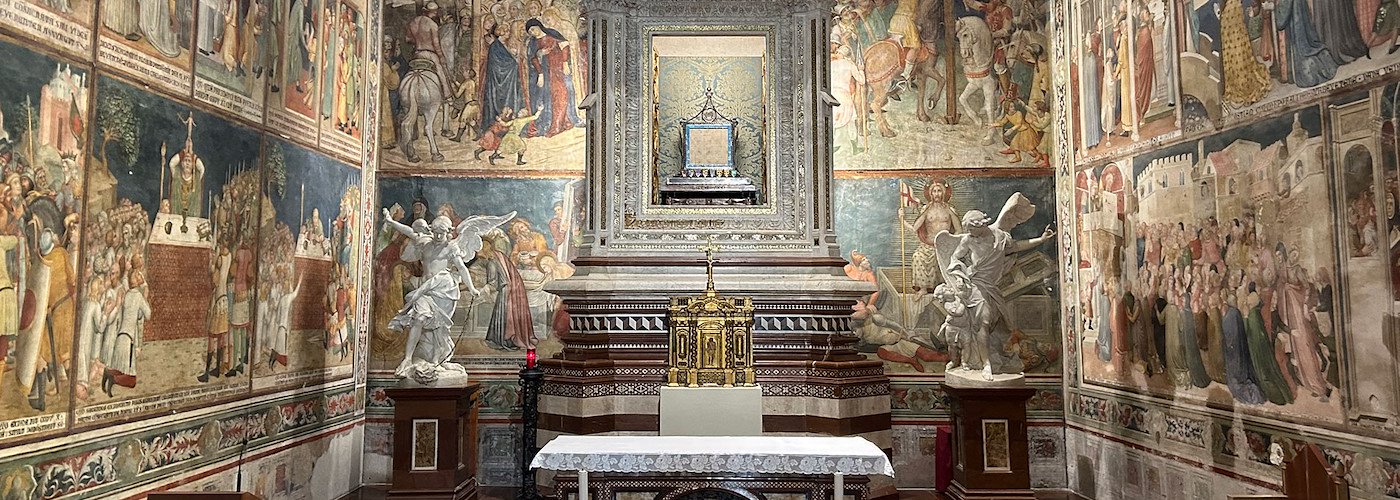
The cathedral says the stained linen is preserved in the Chapel of the Corporal.
Liturgical link
Corpus Christi
The cathedral ties the event to Urban IV and the spread of the feast of Corpus Christi.
The story
Section titled “The story”In 1263, a priest said to be from Bohemia was celebrating Mass in Bolsena while struggling with doubts about the doctrine of transubstantiation.[1] According to the standard account, the consecrated Host began to bleed onto the corporal, the altar linen used during Mass.[1]
The stained corporal was then brought to Orvieto, where Pope Urban IV was residing.[1] The cited cathedral sources connect the relic with Orvieto’s later Eucharistic devotion and the history of Corpus Christi.[1] [2]
Primary-source file
Section titled “Primary-source file”The cathedral page gives the 1263 miracle account, the relic chapel, the display periods, and the Corpus Christi link.
duomodiorvieto.it Official Italian page La Cappella del CorporaleThe Italian page adds the same chapel record and practical display notes from the Orvieto cathedral itself.
duomodiorvieto.it Historical procession record Miracle and Corpus Christi in OrvietoThe official historical-procession site summarizes the Bolsena event and its role in Orvieto’s annual observance.
corteostoricoorvieto.itPublicly documented chronology
Section titled “Publicly documented chronology”From Bolsena to Orvieto
Section titled “From Bolsena to Orvieto”The event is called the miracle of Bolsena because the Mass occurred there, but the devotional center became Orvieto because that is where the relic was transferred and preserved.[1]
The official Orvieto cathedral page ties the case directly to three historical outcomes:
- the relocation of the stained corporal to Orvieto[1]
- the preservation of the relic in a dedicated chapel and tabernacle[1]
- the extension of the feast of Corpus Christi to the universal Church by Pope Urban IV through the bull Transiturus[1]
The Chapel of the Corporal
Section titled “The Chapel of the Corporal”Orvieto’s chapel is part of the way the case was preserved and commemorated over time.[1]
According to the official cathedral page:
- the chapel was built in the mid-14th century specifically around the relic tradition[1]
- its frescoes include narrative scenes of the miracle of Bolsena and other Eucharistic miracle traditions[1]
- the relic is housed behind the altar in the tabernacle of the Sacred Linen[1]
The relic is not displayed continuously. The cathedral notes that, for preservation reasons, the corporal is exposed only during specific liturgical periods such as Christmas to Epiphany, Easter to Pentecost, Corpus Christi, and the Assumption.[1]
Publicly documented continuity in Orvieto
Section titled “Publicly documented continuity in Orvieto”Bolsena-Orvieto is also tied to later historical and liturgical developments.
The miracle is closely associated with:
- the preservation of the corporal in Orvieto[1]
- the building and decoration of the Chapel of the Corporal in the cathedral[1]
- the wider Eucharistic devotion linked to Corpus Christi[1]
- Orvieto’s ongoing annual Corpus Christi procession and historical parade[2]
Source profile
Section titled “Source profile”The cited sources for this page are historical and liturgical rather than biomedical.
They document:
- a long and continuous devotion centered on a specific relic[1]
- monumental sacred architecture built to house and interpret that relic[1]
- annual liturgical commemoration in Orvieto’s Corpus Christi procession[2]
The public record for Bolsena-Orvieto is historical and liturgical rather than a modern scientific case file.
References
Section titled “References”- Duomo di Orvieto. “The Chapel of the Corporal.” Official cathedral page describing the miracle of Bolsena, the stained corporal, the chapel, the exposure of the relic, and the link to Pope Urban IV and Corpus Christi. Available at: https://www.duomodiorvieto.it/en/duomo-of-orvieto/the-chapel-of-the-corporal
- Corteo Storico di Orvieto. “Miracle.” Official historical page summarizing the Bolsena event and its role in Orvieto’s annual Corpus Christi observance. Available at: https://www.corteostoricoorvieto.it/en/history/miracle/