
Sokółka, Poland — 2008
The story in one line
a consecrated Host at Sokolka developed tissue-like material and was later examined under laboratory conditions.
The basic story
During a 2008 Mass in Sokółka, a dropped host was placed in water and over seven days transformed into what appeared to be cardiac tissue. Two pathomorphologists at the Medical University of Białystok identified the substance as human myocardium showing markers of pre-death agony, structurally interwoven with the bread substrate.
Historical setting
Sokolka is a modern Polish case from 2008, when a dropped Host entered a diocesan process and later laboratory examination.
Event date
October 12, 2008
The reported host fall occurred during morning Mass at St. Anthony of Padua parish in Sokółka.
Discovery date
October 19, 2008
A week later, the host was said not to have dissolved and a red fragment was observed in the center.
Scientific record
Internal report dated January 21, 2009
The two Białystok pathomorphologists’ findings entered the diocesan dossier but were not published in a peer-reviewed journal.
Public shrine status
Veneration authorized October 2, 2011
The host has been displayed for adoration in the Divine Mercy Chapel at St. Anthony of Padua Church since 2011.
Sokółka dossier
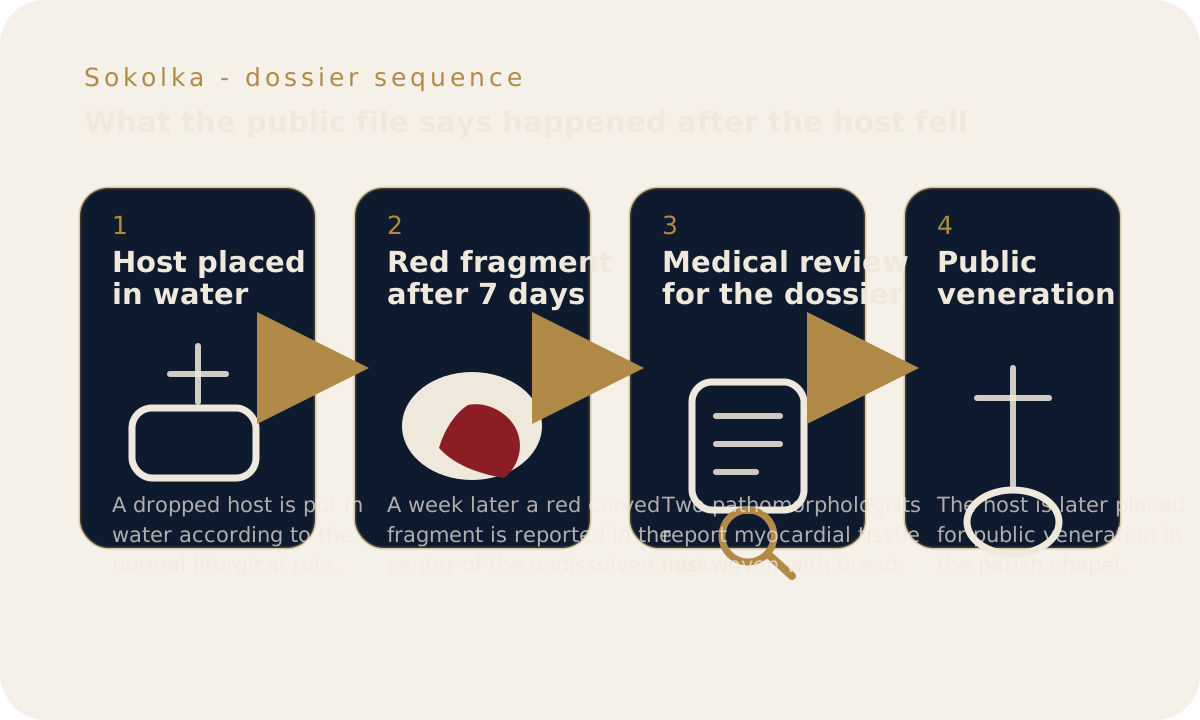
- Event Host placed in water The public record begins with a dropped consecrated host placed in water as prescribed.
- Change Red fragment after days After a week, a red-marked fragment is reported and preserved.
- Review Medical report follows The shrine material highlights the later pathology-style report on the sample.
- Public file Relic and veneration The case then continues as a public sanctuary file with display and pilgrimage.
Primary-source file
Section titled “Primary-source file”Official sanctuary chronology of the 2008 host fall, the later investigation, and the 2011 authorization of public veneration.
sokolka.archibial.pl Official metropolitan communiqué Sokółka Sanctuary: Komunikat Kurii MetropolitarnejOfficial archdiocesan communiqué summarizing the local ecclesiastical judgment and the language used to present the event.
sokolka.archibial.pl Official sanctuary dossier Sokółka Sanctuary: Cząstka Ciała PańskiegoOfficial sanctuary page summarizing the sample collection, the two pathomorphologists’ findings, and the documented preservation of the host.
sokolka.archibial.pl Peer-reviewed critique Kearse and Ligaj (2024): forensic review of Eucharistic miracle investigationsPeer-reviewed methodological review discussing Sokółka alongside other recent Eucharistic cases.
doi.orgThe basic facts
Section titled “The basic facts”On October 12, 2008, at 8:30 a.m., Mass was celebrated at St. Anthony of Padua Parish Church in Sokółka, a town in northeastern Poland in the Archdiocese of Białystok. The celebrant was Father Filip Zdrodowski, a young vicar at the parish. Father Jacek Ingielewicz was assisting with the distribution of Communion.[1]
During Communion distribution, a consecrated host fell to the floor. Following liturgical protocol, a priest retrieved it, placed it in the vasculum — the small water-filled vessel beside the tabernacle — and the Mass continued.[1]
After Mass, Sister Julia Dubowska, a member of the Congregation of Sisters Servants of Jesus in the Eucharist and the parish sacristan, transferred the contents of the vasculum into a separate vessel and secured it in the locked safe in the sacristy.[1][2]
Publicly documented chronology
Section titled “Publicly documented chronology”-
October 12, 2008: Host falls during Communion at 8:30 a.m. Mass. Placed in vasculum. After Mass, Sr. Julia transfers contents to a vessel and locks it in the sacristy safe.
-
October 19, 2008 — one week later: Sr. Julia opens the safe, expecting to find dissolved bread. Instead, the host has not dissolved. A curved, bright red stain — described as resembling a blood clot or “a living particle of a body” — has formed in the center of the host. The surrounding water remains completely clear and untinted. Sr. Julia reports the discovery to the pastor, Msgr. Stanisław Gniedziejko.[1][2]
-
October 29, 2008: Archbishop Edward Ozorowski travels to Sokółka with the chancellor of the Archdiocesan Curia and other diocesan officials to examine the host directly. By his decision, the host is removed from the water and placed on a small corporal (a square of white linen), then put in a pyx (a small covered vessel) and returned to the tabernacle of the Divine Mercy Chapel at the same church.[1]
-
Subsequent weeks and months: The host dries naturally. By mid-January 2009, the altered fragment has taken on the appearance of a dried blood clot. Its appearance remains unchanged thereafter — no deterioration, no bacterial degradation, no smell of decay despite being kept at room temperature without preservatives.[1][2]
-
August 5, 2009: Archbishop Ozorowski, through the Metropolitan Curia of Białystok, sends a formal letter to two professors at the Medical University of Białystok requesting scientific analysis of the sample.[1]
-
August 7, 2009: Professor Maria Sobaniec-Łotowska travels to Sokółka and, in the presence of a diocesan commission, takes a small sample from the transformed portion of the host for laboratory analysis.[1]
-
January 2009 (formal report date: January 21, 2009): Both professors complete their independent analyses and submit their histopathological findings to the Metropolitan Curia of Białystok. The results are formally dated January 21, 2009, and entered into the diocesan dossier.[2]
-
October 14, 2009: The Metropolitan Curia of Białystok issues its first official communiqué regarding the Sokółka event, incorporating the scientific findings.[1]
-
October 2, 2011 — three years after the incident: After completing its formal three-year investigation, Archbishop Ozorowski authorizes public veneration of the host. It is brought in solemn procession before approximately 1,000 pilgrims and permanently installed for adoration in the Divine Mercy Chapel of St. Anthony of Padua Church, where it remains today.[1][2]
The physical appearance when examined
Section titled “The physical appearance when examined”When Sister Julia discovered the transformation on October 19, she found the host largely intact but with a distinct change in part of it. The description across multiple firsthand accounts is consistent:[1][2]
- The host had not dissolved despite seven days in water
- A curved, bright red stain had formed in the center — described as resembling a blood stain or a blood clot
- The stain was described as “a living particle of a body”
- The surrounding water in the vessel was completely clear and untinted — no red or blood-colored diffusion into the water
- The rest of the host surrounding the stain retained a white, intact appearance
As the sample dried over subsequent weeks, it took on the appearance of a dried, dark-red clot or tissue fragment. By the time scientific analysis was conducted in August 2009 — nearly a year after the incident — the substance had remained visibly unchanged from its mid-January 2009 appearance, exhibiting none of the expected signs of bacterial decomposition.[1]
Scientific analysis
Section titled “Scientific analysis”Who conducted it
Section titled “Who conducted it”The analysis was commissioned by Archbishop Ozorowski of Białystok through the Metropolitan Curia and carried out by two independent specialists in pathological anatomy at the Medical University of Białystok:[1][2]
Professor Maria Elżbieta Sobaniec-Łotowska, MD
- Department of Pathomorphology (Institute of Medical Pathomorphology), Medical University of Białystok
- 30 years of specialization in histopathological diagnostics at the time of the analysis
- She personally collected the sample from Sokółka on August 7, 2009, in the presence of the diocesan commission[1]
Professor Stanisław Sulkowski, MD
- Department of General Pathomorphology, Medical University of Białystok
- 30 years of specialization in pathomorphology
- Conducted his analysis independently of Sobaniec-Łotowska[1]
Both professors worked independently and arrived at the same conclusions. The methodology included transmission electron microscopy — an advanced technique that images cellular structures at nanometer resolution, capable of identifying intercellular features not visible under standard optical microscopy.[2]
What they found
Section titled “What they found”The two professors concluded that the transformed portion of the host was human myocardial tissue — cardiac muscle — showing specific histopathological markers consistent with tissue in a state of agony or pre-death stress.
Professor Sobaniec-Łotowska described the specific morphological markers identified:[1]
“We found the presence of several morphologically distinctive markers indicating myocardial tissue. One of these markers is the phenomenon of segmentation, i.e. damage to heart muscle fibers at the zone of insertion.”
Additional markers she identified in the tissue included:[1]
- Fragmentation patterns — appearing as cuts through fiber bundles
- Centralized nuclei configuration — characteristic of cardiac (not skeletal) muscle
- Node contraction patterns along the lengths of fibers
- Micro-fibrillar network outlines
- Intercalated discs — a structural feature unique to cardiac muscle that does not appear in skeletal muscle
The formal conclusion in the histopathological report, as entered in the diocesan dossier and reported by multiple sources, was:[1][2]
“The material indicates myocardial tissue, or at least, of all the tissues of a living body, it most resembles it.”
And more specifically, that it resembled the tissue of a heart in the process of dying — with lesions and contraction patterns consistent with what is observed in cardiac tissue during terminal agony.
Sobaniec-Łotowska stated in public commentary:[2]
“The indication is that there could not have been any human intervention” and that the results were “simply inexplicable” from a scientific standpoint.
In a widely reported formulation, she stated:[2]
“Even NASA scientists, who have at their disposal the most modern analytical techniques, would not be able to artificially recreate such a thing.”
Professor Sulkowski emphasized the physical anomaly of preservation:[1]
“The matter comprising the Host quickly dissolves when immersed in water. But the Blessed Host from Sokółka has not broken down for reasons that remain baffling to science.”
A further notable finding reported in the documentation: the cardiac muscle fibers were described as “deeply intertwined with that of the bread” — structurally integrated at a cellular level rather than simply resting on the surface of the host. This integration was described as something that could not be artificially reproduced.[2]
| Finding | Result reported |
|---|---|
| Species | Human |
| Tissue type | Myocardium — cardiac muscle |
| Anatomical region | Not specified (no left/right ventricle distinction recorded) |
| Cellular markers | Segmentation, fragmentation, centralized nuclei, node contractions, intercalated discs |
| Tissue state | Consistent with pre-death agony / cardiac arrest |
| Integration with host | Fibers structurally interwoven with bread at cellular level |
| Blood typing | Not reported in available documentation |
| DNA testing | Not reported in available documentation |
| Preservatives | None found |
| Bacterial contamination | Not independently assessed (see skeptical analysis below) |
| Peer-reviewed publication | No — findings remain in diocesan dossier only |
Several tests that would be standard in a forensic investigation were not reported as having been conducted:
- Blood typing — no blood group result is recorded for the Sokółka sample, distinguishing it from Lanciano and Buenos Aires (both AB)
- DNA analysis — no genetic testing is documented, in contrast to the Legnica case (2013) where DNA was tested and confirmed human origin
- Bacterial and fungal screening — whether the red substance could be a colony of red-pigment-producing organisms (such as Serratia marcescens or Epicoccum nigrum fungus) was not independently assessed as a control
- Blinded protocol — the analysts knew the sample came from a religious event. There is no record of a blinded analysis where investigators identified the tissue without knowing its claimed origin
These gaps are relevant to the evidentiary standard of the findings. See the skeptical analysis section below.
Published medical reports
Section titled “Published medical reports”The histopathological findings were not published in any peer-reviewed scientific journal. They exist as an internal report dated January 21, 2009, submitted to the Metropolitan Curia of Białystok and incorporated into the diocesan dossier. The results were communicated publicly through the archdiocese’s official communiqué of October 14, 2009 and have been described in Catholic books and media, but the underlying report has not been submitted to, reviewed by, or published in any scientific journal.[3][8]
The 2024 peer-reviewed paper by Kearse & Ligaj (Journal of Forensic Science Research, DOI: 10.33425/2639-9563.1068) explicitly notes that Eucharistic miracle investigations — including Sokółka — have generally not produced peer-reviewed literature and calls for standardized protocols going forward.[8]
The 2025 paper by Grzybowski et al. (Applied Microbiology and Biotechnology, DOI: 10.1007/s00253-025-13439-9) — a study by 13 researchers from multiple Polish universities — analyzed 25 recent alleged Eucharistic phenomena using microbiology, histology, and forensic DNA, and found natural biological explanations for all 25. The paper explicitly critiques the broader pattern of Eucharistic miracle claims not being communicated through peer-reviewed literature.[9]
Archdiocesan investigation and recognition
Section titled “Archdiocesan investigation and recognition”The investigation
Section titled “The investigation”Archbishop Edward Ozorowski, Metropolitan Archbishop of Białystok, oversaw the ecclesiastical investigation from the beginning. He personally traveled to Sokółka on October 29, 2008, to examine the host, and it was by his personal authority that the host was removed from water and placed in the tabernacle. He commissioned the scientific analysis through the Metropolitan Curia in August 2009.[1]
The investigation ran for three years following the incident. A formal ecclesiastical commission within the Archdiocesan Curia verified the chain of custody and confirmed that no foreign substance had been added to the host by any party with access to it.[2]
The formal finding
Section titled “The formal finding”On October 14, 2009, the Metropolitan Curia of Białystok issued its official communiqué. The text of the formal statement concluded:[1][2]
“The Sokółka event is not opposed to the faith of the Church; rather, it confirms it.”
This formulation — “not opposed to the faith of the Church” — is standard Catholic canonical language for a finding that an event is congruent with Catholic belief without formally pronouncing it miraculous. It is a positive disposition without being a declaration of a miracle in the strictest canonical sense.
Public recognition
Section titled “Public recognition”On October 2, 2011, Archbishop Ozorowski authorized public veneration of the host. The host was carried in solemn procession in the presence of approximately 1,000 pilgrims and permanently installed for adoration in the Divine Mercy Chapel at St. Anthony of Padua Church, Sokółka, where it remains today.[1]
Pope Francis / Vatican involvement
Section titled “Pope Francis / Vatican involvement”No direct involvement by Pope Francis or the Holy See’s Dicastery for the Doctrine of the Faith (formerly the Congregation for the Doctrine of the Faith) in the Sokółka case is documented in available sources. The recognition was at the local archdiocesan level only, by Archbishop Ozorowski of Białystok. This distinguishes Sokółka from Legnica (2013), where the diocesan bishop formally submitted the findings to the CDF and received a written response supporting public adoration.[4]
Comparison to Lanciano and Buenos Aires
Section titled “Comparison to Lanciano and Buenos Aires”The Sokółka findings are frequently placed alongside Lanciano and Buenos Aires in Catholic devotional literature, and some commentators make explicit comparisons. The shared features claimed are:[5][6]
- Tissue identified as human cardiac muscle (myocardium) in all three cases
- Evidence of agony-related cellular stress in the tissue in all three cases
- The tissue in each case was found in or derived from a consecrated host
Father Robert Spitzer, a Jesuit priest and physicist, has synthesized the evidence across multiple cases:[5]
“If you put together all the scientific data from those reports…it really forms a strong preponderance of evidence for authenticity — that human heart tissue from the region of the upper left ventricle…is growing out of the substance of the host.”
Dr. Scott French noted a pattern across cases:[5]
“all scientifically studied Eucharistic miracles show the presence of the rare AB blood group, the same blood group found on the Shroud of Turin.”
However, this comparison has a notable limitation for Sokółka specifically: no blood typing was reported for the Sokółka sample. The AB connection cannot be asserted for this case based on available documentation. The AB finding is established for Lanciano (Linoli 1971) and Buenos Aires (Zugibe 2005) — not for Sokółka.
The most direct and methodologically significant comparison is between Sokółka and Buenos Aires: both are recent (post-1990s) investigations, both identified myocardium, and both described the tissue as showing signs of physiological stress. However, Buenos Aires has several methodological features Sokółka lacks: a blinded analysis protocol (Zugibe did not know the sample’s origin), human DNA confirmation, and the involvement of a scientist with higher international recognition (Zugibe was a Fellow of the American College of Cardiology). Sokółka’s analysis also lacks the peer-reviewed publication that Lanciano has in Linoli (1971).
Proposed explanations and open questions
Section titled “Proposed explanations and open questions”The Serratia marcescens / Epicoccum hypothesis
Section titled “The Serratia marcescens / Epicoccum hypothesis”One of the main scientific proposals in recent discussion is microbial contamination. In 2024, Kelly Kearse and Frank Ligaj published a peer-reviewed paper in the Journal of Forensic Science Research (DOI: 10.33425/2639-9563.1068) reporting direct experimental evidence relevant to this question:[8]
- They placed ordinary unconsecrated communion wafers in water under conditions similar to those described in the Sokółka and other Polish accounts
- Approximately 15% of the control wafers developed a reddish or blood-like gelatinous substance within 7–10 days
- Microscopic analysis revealed the substance to be fungal growth — specifically identified as Epicoccum nigrum (also known as Epicoccum purpurascens), a common environmental fungus that produces red-orange pigments
- They also noted that Serratia marcescens, a red-pigment-producing bacterium, is a well-documented cause of “bloody host” appearances throughout Church history — including a historically famous incident at Bolsena (1263) that may have contributed to the Feast of Corpus Christi
Kearse and Ligaj argued that future discussion of cases like Sokółka and Legnica should directly address microbial contamination with more explicit published testing protocols.
The tissue identification challenge
Section titled “The tissue identification challenge”Kearse & Ligaj (2024) note a specific methodological concern about histopathological identification of cardiac tissue from Eucharistic miracle samples:[8]
- The identification of cardiac muscle was based primarily on morphological appearance under microscopy — the tissue looks like myocardium
- More definitive identification would require cell-specific immunohistochemical markers — antibody-based staining that binds specifically to cardiac muscle proteins. This was not reported as having been done in Sokółka
- Without immunohistochemistry, the tissue identification rests on expert visual judgment — which is real and trained expertise, but is less definitive than marker-based confirmation
Questions raised about examination procedure
Section titled “Questions raised about examination procedure”As detailed in the scientific analysis section above, Professor Chyczewski’s public account raises a procedural concern: if the examinations were conducted informally, without documentation, without institutional commission, and without standard chain-of-custody protocols, then the results are harder to weigh as a formal forensic record. The dispute here is about how the examination was documented and how that documentation should be weighed.
Preservation over time
Section titled “Preservation over time”Proponents of the miraculous interpretation point to the fact that the host remained visually unchanged for years without preservatives, at room temperature, in conditions that would typically cause rapid bacterial decomposition of organic tissue. The preservation timeline is therefore part of the case as it is publicly presented.
Writers who favor a non-miraculous reading generally answer this in two ways: by proposing fungal material rather than animal tissue, and by noting that the long-term observation record comes through the custodians of the host rather than through a separately monitored lab setting.
Connection to Legnica (2013)
Section titled “Connection to Legnica (2013)”Five years after Sokółka, an almost structurally identical event occurred at St. Hyacinth’s Church in Legnica, 450 km away in southwestern Poland. In that case, forensic medicine departments at two universities independently reported the same tissue type — cardiac muscle — with the addition of confirmed human DNA. The Legnica case received explicit Vatican-level recognition (CDF response, 2016) that Sokółka did not. Both cases are now cited together in Catholic literature as parallel evidence of the same phenomenon.
Read the Legnica (2013) documentation →Timeline
Section titled “Timeline”| Date | Event |
|---|---|
| October 12, 2008 | Host falls during Mass at St. Anthony of Padua, Sokółka. Placed in vasculum. |
| October 19, 2008 | Sr. Julia discovers red stain in center of undissolved host. Reports to pastor. |
| October 29, 2008 | Archbishop Ozorowski examines host in person; orders it placed on corporal in pyx in the tabernacle. |
| Mid-January 2009 | Host fully dried; appearance stable. |
| January 21, 2009 | Formal histopathological report dated and submitted to diocesan dossier. |
| August 5, 2009 | Metropolitan Curia formally commissions scientific analysis. |
| August 7, 2009 | Prof. Sobaniec-Łotowska collects sample at Sokółka in presence of diocesan commission. |
| October 14, 2009 | Metropolitan Curia of Białystok issues official communiqué: “not opposed to the faith of the Church; rather, it confirms it.” |
| October 2, 2011 | Archbishop Ozorowski authorizes public veneration; host carried in procession before ~1,000 pilgrims; permanently installed in Divine Mercy Chapel. |
Where the host is today
Section titled “Where the host is today”The transformed host is displayed for public veneration in the Divine Mercy Chapel at St. Anthony of Padua Parish Church, ul. Grodzieńska 1, 16-100 Sokółka, Poland. It has been on permanent display since October 2, 2011.
The church is open to pilgrims. Sokółka is approximately 40 km east of Białystok in northeastern Poland, near the Belarusian border.