
Jesus died by crucifixion
Under Pontius Pilate, c. 30 AD, in Jerusalem. Confirmed by Tacitus (Annals 15.44), Josephus (Antiquities 18.3.3, partially), and all four Gospels. The death is not seriously disputed by any mainstream scholar.
The story in one line
Jesus rose bodily from the dead after his crucifixion and appeared to individuals and groups afterward.
The basic story
The central claim of Christianity: that Jesus of Nazareth, crucified under the Roman prefect Pontius Pilate around 30 AD, physically rose from death three days later and appeared to multiple individuals and groups before ascending. The earliest sources, major historical data points, and principal scholarly interpretations are summarized here.
Historical setting
The resurrection claim arises within first-century Roman Judea, in the aftermath of Jesus's execution at Passover and within the earliest Christian preaching about the empty tomb and appearances.
Earliest extant text
1 Corinthians, c. 54-55 AD
Includes the received formula in 1 Corinthians 15:3-8.
Named Jerusalem contacts
Peter (Cephas) and James
Paul says he met them in Jerusalem in Galatians 1:18-19.
Late first-century continuity
1 Clement, c. 96 AD
Clement links apostolic preaching to assurance grounded in the Resurrection.
Early second-century continuity
Ignatius and Polycarp
Their letters continue Resurrection preaching into the early 100s AD.
Paul’s earliest surviving written summary of Jesus’ death, burial, resurrection, and appearances.
biblegateway.com Paul in Jerusalem Galatians 1:18-2:10Paul’s own account of meeting Cephas, James, and later the acknowledged Jerusalem leaders.
biblegateway.com Early hostile counter-report Justin Martyr, Dialogue with Trypho 108Justin says Jewish leaders were sending out men to spread the claim that the disciples stole Jesus’ body from the tomb by night.
newadvent.org Later hostile Jewish polemic George Howard on the Tol'doth YeshuHoward summarizes the medieval anti-gospel tradition in which the body is moved by Yehuda the gardener, leading disciples to claim resurrection.
doi.org Late 1st century 1 Clement 42Clement says the apostles preached after being fully assured by the Resurrection of Jesus.
ccel.org Early 2nd century Ignatius, Smyrnaeans 1-3Ignatius stresses Jesus’ real suffering, resurrection, flesh, and post-resurrection eating and drinking.
newadvent.org Early 2nd century Polycarp, Philippians 1-2 and 9Polycarp repeats that God raised Jesus and links that proclamation to Paul and the apostles.
newadvent.orgThe lecture below is a representative modern presentation of the minimal facts case for the Resurrection from Gary Habermas.[11]
The crucifixion of Jesus of Nazareth under the Roman prefect Pontius Pilate, during the reign of Tiberius Caesar, is attested in Roman, Jewish, and Christian sources.[1] [2]
What the earliest Christians then said is simple to state, even if it is difficult to assess. They said Jesus was buried, that the body was later missing from the tomb, and that he then appeared alive to named people and groups.[3] [20]
So this page mainly follows how early those statements show up in writing and which named people they are tied to. Do the earliest texts already say Jesus rose? Do they name witnesses like Peter and James? Do those same statements continue into the next generation of Christian writing?[3] [12] [14]
That is why the page keeps returning to dates, texts, and named people. The central issue here is not whether Christians later believed in the Resurrection. It is how early and how firmly the story appears in the surviving record.
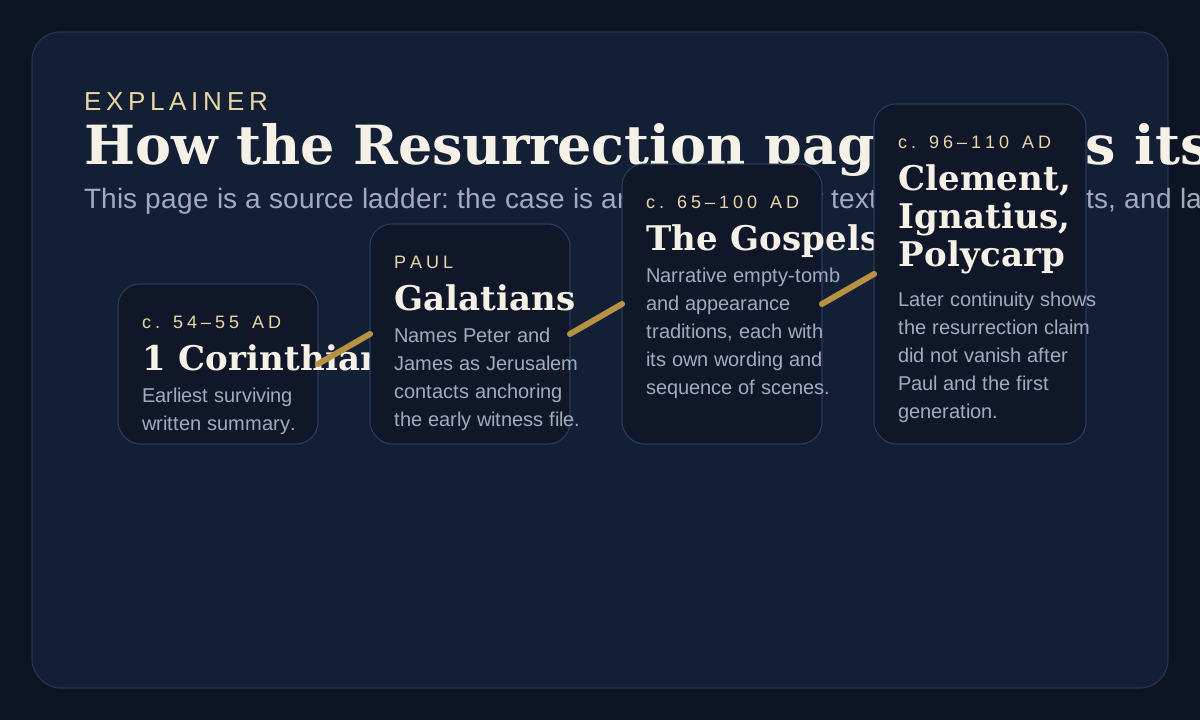
Resurrection source ladder
Historian Gary Habermas has surveyed over 1,400 scholarly works on the Resurrection across theological positions, identifying a set of recurring historical points discussed across the literature.[4]
Bart Ehrman is among the scholars who accepts the following as historically grounded, even while not affirming a bodily Resurrection.[5]
Jesus died by crucifixion
Under Pontius Pilate, c. 30 AD, in Jerusalem. Confirmed by Tacitus (Annals 15.44), Josephus (Antiquities 18.3.3, partially), and all four Gospels. The death is not seriously disputed by any mainstream scholar.
The disciples believed he appeared to them
After his death, some of his followers sincerely believed Jesus had risen and appeared to them. Ehrman: “We can say with complete certainty that some of his disciples claimed this.” The sincerity of the belief — not its truth — is not in question.
Paul became a follower
Paul of Tarsus, who by his own testimony actively persecuted early Christians and participated in their execution, claimed a direct encounter with the risen Jesus (1 Corinthians 15, Galatians 1). He underwent a complete reversal — from persecutor to apostle — and eventually died for his testimony.
James became a follower
James, the brother of Jesus, was not a follower during Jesus’ ministry (John 7:5). After the crucifixion he became a leader of the Jerusalem church and was executed for his faith c. 62 AD (Josephus, Antiquities 20.9.1). His change from skeptical family member to movement leader is one of the more discussed data points in naturalistic explanations.
On the burial and empty tomb traditions: These parts of the story are less straightforward than the crucifixion itself or the simple fact that early Christians preached resurrection. John Granger Cook’s study notes that Roman officials handled crucified bodies in more than one way: sometimes they were left exposed, and sometimes they were buried.[17] W. L. Craig reads the empty-tomb tradition as historically strong, while Dale Allison treats the Friday burial and Sunday empty-tomb traditions as serious early material without writing as if every point were settled.[18] [19] Hostile replies belong to this part of the story too: Matthew 28 says critics claimed the disciples stole the body, Justin Martyr says Jewish leaders were still spreading that explanation in the second century, and the much later Toledot Yeshu gives another hostile version in which the body had been moved by a gardener.[20] [21] [22]
Put more simply: most historians agree that Jesus was crucified. Fewer agree on how secure the burial and empty-tomb traditions are. The key question is not whether Romans ever buried crucified bodies. They sometimes did.[17] The real question is whether this particular burial story, and the later claim that the tomb was empty, belong to the earliest layer of the record.[18] [19]
That is why the hostile counterclaims matter. Matthew says critics answered the resurrection preaching by saying the disciples stole the body. Justin Martyr says Jewish leaders were still spreading the same basic explanation later on. The much later Toledot Yeshu gives a different hostile version in which the body had been moved. None of those texts tells the whole story by itself. Taken together, though, they show ancient opponents trying to explain a missing body rather than simply pointing to a known grave.[20] [21] [22]
Paul’s first letter to the Corinthians, written approximately 54–55 AD, contains the oldest surviving written account of the Resurrection. Within it, Paul cites a creedal formula he explicitly says he received from others:
“For I delivered to you as of first importance what I also received: that Christ died for our sins in accordance with the Scriptures, that he was buried, that he was raised on the third day in accordance with the Scriptures, and that he appeared to Cephas, then to the twelve. Then he appeared to more than five hundred brothers at one time, most of whom are still alive, though some have fallen asleep. Then he appeared to James, then to all the apostles. Last of all, as to one untimely born, he appeared also to me.” — 1 Corinthians 15:3–8[3]
Most scholars think this short formula is older than Paul’s letter itself. Paul says he had received it from others. He also says he later went to Jerusalem and met Peter and James (Galatians 1:18–19). If those dates are roughly right, the formula could have been circulating within five to seven years of Jesus’ death.[3] [4] That matters because it places the core resurrection proclamation very early, long before the four Gospels were written.
When Paul adds that most of the five hundred witnesses are “still alive,” he is presenting the claim as something that still belongs to living memory, not as a legend from a distant past.
Galatians supplies another early control point for the resurrection tradition. In Galatians 1:18-19 Paul says that, after three years, he went to Jerusalem, stayed fifteen days with Cephas, and saw James the Lord’s brother.[12] In Galatians 2:1-10 he later describes a second Jerusalem meeting in which James, Cephas, and John recognized the gospel he was preaching among the Gentiles.[12]
These passages matter because Peter and James also appear by name in 1 Corinthians 15:5-7. In plain terms, Galatians helps answer a simple question: was Paul preaching his own private theory, or was he in contact with the Jerusalem leaders connected to the earliest Resurrection claims?[13] [19]
Mark’s Gospel is the earliest, dated by most scholars to approximately 65–70 AD — roughly 35 years after the crucifixion.[6] Matthew and Luke follow, likely drawing on Mark and a common source (designated “Q” by scholars). John is the latest, approximately 90–100 AD.[6]
All four Gospels agree on the following:
The four accounts disagree on peripheral details (how many women, what the angels said, which appearances occurred in what order), which is consistent with independent testimony from multiple sources and inconsistent with a single coordinated fabrication.[4]
The resurrection claim does not disappear after Paul and the Gospels. It remains visible in the next generation of Christian literature as well:
1 Clement (c. 96 AD)
Clement of Rome says the apostles went out preaching after being “fully assured” by the Resurrection of Jesus. The letter is late first-century evidence that Rome still framed apostolic mission in explicitly resurrection-centered terms.[14]
Ignatius of Antioch (c. 107 AD)
In Smyrnaeans 1-3, Ignatius insists that Jesus truly suffered, truly rose, remained possessed of flesh after the Resurrection, and ate and drank with the disciples. The letter shows how concretely the claim was still being stated in the early second century.[15]
Polycarp of Smyrna (early 2nd century)
Polycarp tells the Philippians that God raised Jesus from the dead, that believers trust the God who raised Him, and that Paul had taught this material in the presence of living hearers. He also links apostolic suffering to the God who raised Jesus.[16]
The Roman historian Tacitus, writing in the Annals (15.44), describes the Great Fire of Rome under Nero (64 AD) and the subsequent persecution of Christians:
“Christus, from whom the name had its origin, suffered the extreme penalty during the reign of Tiberius at the hands of one of our procurators, Pontius Pilatus, and a most mischievous superstition, thus checked for the moment, again broke out not only in Judaea, the first source of the evil, but even in Rome.”[1]
Tacitus does not address the Resurrection directly. He confirms the crucifixion and the subsequent resurgence of the movement. The phrase “mischievous superstition” (exitiabilis superstitio) tells us that Romans in his era were aware of specific claims being made by Christians — but Tacitus, who despised Christians, does not describe what those claims were.
Evidential weight: Confirms crucifixion under Pilate; confirms early Christian movement in Rome by 64 AD; does not address the Resurrection claim.
The Jewish historian Josephus mentions Jesus in the Antiquities of the Jews at two points.
Antiquities 20.9.1 — describing the execution of James: “the brother of Jesus who was called Christ, whose name was James.” This passage is considered authentic by the overwhelming scholarly consensus — it is not written in Christian-favoring terms and serves Josephus’s narrative purpose without embellishment.[2]
Antiquities 18.3.3 — the Testimonium Flavianum — is more contested. The passage as preserved states that Jesus “appeared to them alive again on the third day” and that “the tribe of Christians… has not died out to this day.” Most scholars consider this a Christian interpolation into an authentic Josephan passage: the phrase “he was the Messiah” and the resurrection reference are almost certainly not original, but a shorter, more neutral original notice about Jesus is likely authentic underneath the interpolations.[2]
Evidential weight: The James passage independently confirms a historical Jesus and his identification as “the Christ.” The Testimonium provides indirect evidence that Jesus was a historical figure known to non-Christian Jewish writers.
Matthew 28:13 records that Jewish authorities instructed the guards to say the disciples “came at night and stole him away while we were asleep.”[20] Justin Martyr, writing in the mid-second century, says Jewish leaders had sent chosen men through the world to proclaim the same basic accusation: that Jesus’ disciples stole him by night from the tomb and then said he had risen.[21]
A much later hostile Jewish anti-gospel, the Toledot Yeshu, preserves a different explanation for the same problem. In George Howard’s summary of the text, Jesus’ body is taken from the tomb by Yehuda the gardener, and the disciples then claim that he rose and ascended.[22] The Jewish Encyclopedia retells one version in which the disciples, unable to find the body, use its absence as proof before Queen Helena until the gardener-produced body is brought forward.[23]
The Talmud (Sanhedrin 43a) also refers to Jesus in terms that confirm he was executed on Passover eve — consistent with the Gospel timeline — and describes him as a sorcerer. The language of “sorcery” is hostile but again confirms a figure around whom extraordinary claims were being made.[2]
Why this matters: Matthew and Justin are the earlier witnesses here; the Toledot Yeshu material is much later and more polemical. But across these hostile explanations, the repeating pattern is that opponents try to explain a missing body. They do not answer by saying, “the corpse was still in the tomb and everyone knew it.”[20] [21] [22] [23]
Among the strongest historical arguments for something extraordinary having occurred is the documented behavior of the disciples after the crucifixion.[4]
Before the crucifixion: The disciples fled. Peter denied knowing Jesus three times. By all accounts, the group disbanded in fear.
Weeks later: The same people were publicly proclaiming the Resurrection in Jerusalem — the exact city where the crucifixion had taken place and where a refutation of their claims would have been most straightforward.
Under sustained persecution: They maintained their testimony under threat of imprisonment, torture, exile, and death. Most of the original apostles are recorded by early Church tradition as martyred.
A critical distinction: People die for things they sincerely but wrongly believe all the time. What is historically unusual is that the disciples claimed not a vision, a metaphor, or a spiritual experience, but a physical resurrection — a body that had been touched (Thomas, John 20:27), that had eaten (Luke 24:42–43), that had appeared in a locked room and then on a road and then to 500 people at once.
The historical argument is not that sincere belief proves truth. It is that a fabricated account does not typically produce the kind of transformation documented here — people who scatter in fear at an execution do not, within weeks, return to the place of execution and publicly announce that the executed man rose from the dead, unless they sincerely believe it. And people do not typically die to protect a lie they themselves invented.[4]
Every serious account of early Christianity must explain the origin of the Resurrection belief. These are the main naturalistic proposals:
Grief can trigger genuine visual and auditory experiences of the deceased. This is well-documented in bereavement literature.[5]
Strength: Explains individual appearance accounts (Mary Magdalene, Peter) in emotionally charged circumstances.
Weakness: Hallucinations are individual experiences. They do not occur simultaneously to groups of people. The claim of an appearance to “more than five hundred brothers at one time” (1 Corinthians 15:6) cannot be accounted for by individual grief hallucinations. Even Ehrman, who does not affirm the Resurrection, acknowledges this as a difficulty for the hallucination hypothesis and instead proposes that Paul may have been exaggerating or referring to a visionary community experience.[5]
The Resurrection narrative developed over decades as the movement grew, accumulating details, harmonizing accounts, and transforming a spiritual conviction into a bodily claim.
Strength: This is the standard model for legendary development in religious traditions. Oral transmission is not reliable. Details do accumulate.
Weakness: The creedal formula in 1 Corinthians 15 is not a late development — it is demonstrably early, pre-Pauline, and explicit about physical appearances, including ones Paul says are still verifiable (“most of them are still alive”). The empty tomb tradition is also early and multiply attested. The theory requires that legendary development happened very fast and very early — before living eyewitnesses died — which is unusual.[3]
The disciples or others removed the body and fabricated the story.
Strength: Simple; physically possible.
Weakness: Requires that the disciples knowingly died for a claim they had personally fabricated — an explanation with no parallel in documented human behavior. It also requires the sustained conspiracy of a large group of people, none of whom ever recanted under persecution. And it does not account for the conversion of Paul, who was actively hostile to the movement and had no reason to join a conspiracy he was trying to destroy.[4]
The women went to the wrong tomb. Finding it empty, they concluded the resurrection had occurred.
Strength: Human error is plausible.
Weakness: Requires that Joseph of Arimathea — who had donated his personal tomb and presumably knew where it was — also could not correct the error. And it does not account for the post-resurrection appearance accounts at all, which are the core of the 1 Corinthians creed and predate the Gospels by decades.
Jesus survived the crucifixion and was buried in a comatose state, reviving later.
Strength: Technically, bodies have survived extraordinary trauma.
Weakness: Roman crucifixion specifically combined blood loss, asphyxiation, exposure, and, at its conclusion, the breaking of legs or — as described for Jesus — a spear through the side. The medical likelihood of survival is vanishingly small. Even if he had survived in some form, a barely-living wounded man crawling out of a sealed rock tomb could not have inspired the transforming conviction documented in the disciples. This theory was common in 19th-century rationalist circles and is rejected by virtually all contemporary scholars, including skeptical ones.[5]
The testimonial and historical evidence above is not the only category of evidence relevant to the Resurrection. Several physical objects — some of the most studied relics in the world — are claimed to derive directly from the Passion and burial of Jesus. Their evidential status varies considerably.
The most scientifically studied religious artifact in history. A 14-foot linen cloth bearing the full-length photographic-negative image of a crucified man, with anatomically consistent wounds matching the Gospel account: scourging across the back, a crown of thorns, nail wounds through the wrists and feet, and a post-mortem lance wound to the side.
What the science has established:
What remains unresolved: The image formation mechanism is unknown. No medieval or modern technique has produced a comparable result. The 1988 dating is contested but not yet definitively overturned.
See the full documentation: The Shroud of Turin →
A bloodstained linen cloth approximately 84 × 53 cm, held since at least 616 AD in the Cathedral of San Salvador, Oviedo, Spain. Tradition identifies it as the face cloth described in John 20:7 — “the cloth that had been on Jesus’ head, not lying with the linen wrappings but rolled up in a place by itself.”
What the science has established:
The chain of custody: Written documentation traces the relic to Oviedo by 812 AD; the documented history of its journey from Jerusalem is supported by the 7th-century chronicle of Bishop Pelayo of Oviedo and the pollen evidence. Unlike the Shroud, it has never been radiocarbon dated.
Limitation: The identification of the Sudarium with the Gospel face cloth rests entirely on tradition and the AB blood type / stain pattern correlation with the Shroud. Neither alone constitutes proof of identity.
A wooden board, approximately 25 × 14 cm, held at the Basilica of Santa Croce in Gerusalemme, Rome. It bears a partial inscription in Hebrew, Greek, and Latin — the title nailed above Jesus on the cross (“Jesus the Nazarene, King of the Jews”, John 19:19–20). Only the Latin and partial Hebrew/Greek text survives.
History: Tradition associates it with Helena, mother of Emperor Constantine, who traveled to Jerusalem c. 326 AD. The relic is first clearly documented in Rome in the 12th century.
Scientific examination: In 1998, wood specialist Mechthild Flury-Lemberg and radiocarbon expert Giorgio Bracaglia conducted examinations. A 2002 analysis by the University of Rome (Tor Vergata) dated the wood to the 1st century AD (between 980 BC and 340 AD with 95% confidence — a wide range). Paleographer Carsten Peter Thiede analyzed the Hebrew text and argued it reads right-to-left as authentic 1st-century Hebrew script, consistent with the Gospel description.
Documentation notes: The wide radiocarbon range is not conclusive for a 1st-century date. The historical documentation gap between Helena’s alleged discovery and the 12th-century attestation is significant, and the relic is usually treated more cautiously than the Shroud or Sudarium.
The tomb itself is perhaps the most significant material evidence of all — not as a testable artifact, but as a geographical anchor for the Resurrection claim.
The Church of the Holy Sepulchre in Jerusalem has marked the site of the crucifixion (Golgotha) and burial since Emperor Constantine built the first basilica there in 335 AD. Constantine’s builders identified the site based on local tradition and, according to Eusebius of Caesarea, the discovery of a tomb beneath a pagan temple constructed by Hadrian c. 135 AD.
The 2016 restoration: In October 2016, the Edicule (the small shrine enclosing the tomb) was opened for the first time in centuries for restoration. Workers found the original limestone burial bed beneath a marble slab placed in 1555. Analysis confirmed the tomb is a 1st-century Jewish rock-cut burial — consistent with the Gospel description of Joseph of Arimathea’s tomb.
The location argument: The site lies inside what were the city walls of Jerusalem at the time of the crucifixion — execution and burial outside the walls was standard Roman practice. Archaeological surveys in the 20th century confirmed that the area was outside the first-century walls. The site is geographically plausible as a 1st-century Jewish tomb near the city.
Historically established at the site: A genuine 1st-century Jewish tomb exists at the site traditionally identified since at least 135 AD (when Hadrian built over it — an act that inadvertently preserved the location). The site anchors the burial tradition geographically, while the question of what happened in that tomb remains the central Christian claim.
Several other material objects are claimed as relics of the Passion. Their evidential standing ranges from possible to highly implausible:
Crown of Thorns: The main relic is held in the treasury of Notre-Dame de Paris (survived the 2019 fire in a safe). Acquired by Louis IX of France in 1238 from Baldwin II of Constantinople for an extraordinary sum — Louis then built Sainte-Chapelle specifically to house it. The thorns themselves were distributed widely across Europe over centuries; what remains in Paris is the woven circlet without thorns. No scientific testing has been conducted on the relic itself.
True Cross: Fragments are held in hundreds of churches worldwide. The original discovery is attributed to Helena c. 326 AD. 16th-century Protestant reformer John Calvin famously claimed the total volume of fragments exceeded what a single cross could contain — a claim that has been examined and disputed by subsequent analysts who calculated the actual total as consistent with a single large cross. No fragment has been carbon-dated under controlled conditions that would allow a definitive 1st-century attribution.
Holy Nails: Multiple nails are claimed in Vienna, Rome, Milan, and other cities. Constantine reportedly used fragments in his helmet and in a horse’s bridle (Ambrose of Milan, 395 AD). No systematic forensic examination has been conducted.
The Spear of Longinus: Multiple competing relics exist (Vatican, Kraków, Vienna, Etchmiadzin). The Vatican lance was examined in 1914 and found to be of uncertain date. The Vienna lance (Holy Lance of the Habsburgs) was examined by the British Museum; its iron blade was dated to approximately the 7th century AD, making a 1st-century attribution implausible for that specific relic.
Current source status: The Passion relics outside the Shroud and Sudarium have generally not been subjected to rigorous modern scientific testing, and in several cases the surviving chain of custody is late or fragmentary. Their devotional significance is longstanding, while their historical documentation varies case by case.
| Source | Position | Why It Matters |
|---|---|---|
| N.T. Wright, The Resurrection of the Son of God (2003) | Affirms Resurrection | Most comprehensive academic historical treatment; 800+ pages; interacts with all major skeptical scholarship |
| Gary Habermas & Michael Licona, The Case for the Resurrection of Jesus (2004) | Affirms Resurrection | Develops the “minimal facts” argument using only points accepted by skeptical scholars |
| Bart Ehrman, How Jesus Became God (2014) | Does not affirm; naturalistic | Leading skeptical NT scholar; accepts disciples sincerely believed; proposes visionary experiences not physical resurrection |
| Dale Allison, Resurrecting Jesus (2005) | Agnostic | A careful, non-credulous assessment; Allison is sympathetic to the disciples’ experiences being genuine but resists certainty about their nature |
| Gerd Lüdemann, The Resurrection of Christ (2004) | Rejects; naturalistic | Argues Paul and Peter had grief hallucinations; honest about what his explanation can and cannot account for |