
Legnica, Poland — 2013
The story in one line
a dropped consecrated Host at Legnica developed red tissue-like material later examined in the lab.
The basic story
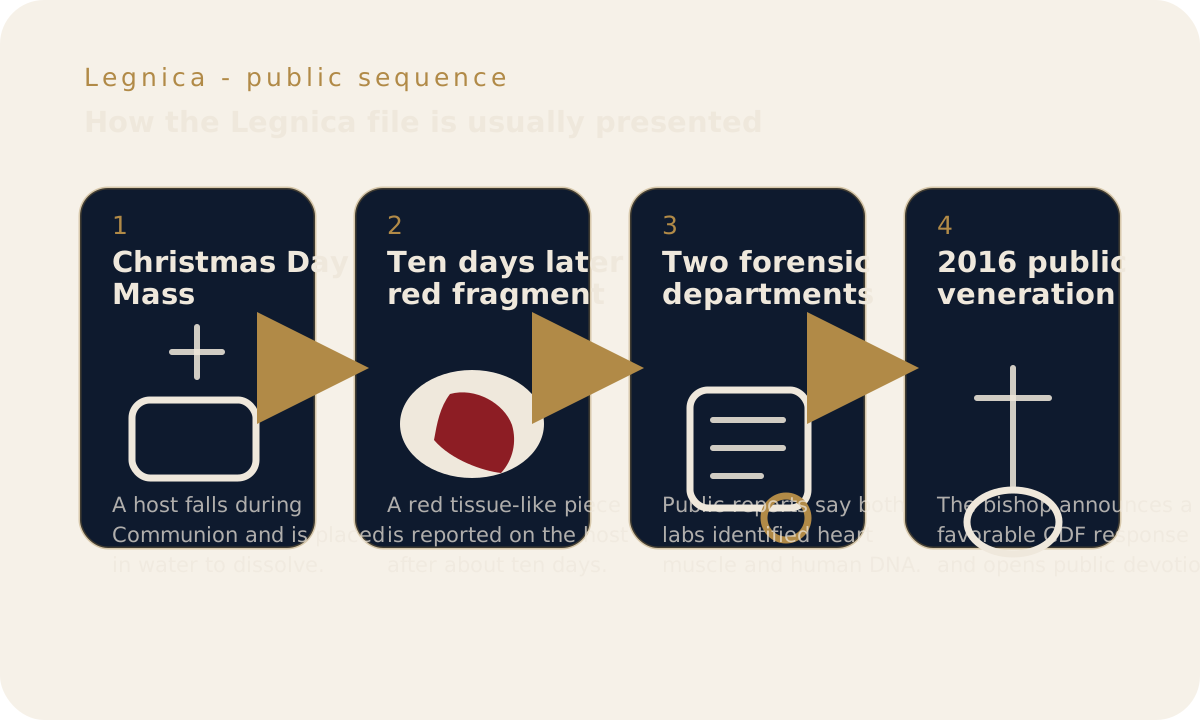
On Christmas Day 2013 in Legnica, a dropped host was placed in water and over ten days transformed into a reddish substance. Forensic medicine departments at two independent Polish universities identified the material as human cardiac muscle with changes consistent with agony. Human DNA was confirmed. In 2016, the Vatican's Congregation for the Doctrine of the Faith responded favorably and authorized public veneration.
Historical setting
The Legnica case belongs to contemporary Poland, where a dropped Host in 2013 entered a diocesan investigation and a modern laboratory chain of custody.
Legnica dossier
- Event Dropped host in water The public file begins with a consecrated host placed in water after it fell during Communion.
- Change Red fragment appears A red-marked fragment is later reported after the host had been set aside.
- Reviews Two forensic opinions The public summaries focus on the two pathology-style reviews that followed.
- Afterward Public veneration opens The case then becomes a shrine file with formal public veneration.
Event date
December 25, 2013
The host was dropped during Christmas Day Mass at St. Hyacinth Parish in Legnica.
Lab review
2 forensic medicine departments
Samples were examined at the Medical Universities of Wrocław and Szczecin, which reported matching conclusions.
Reported finding
Human cardiac muscle with human DNA
Public summaries quote the forensic conclusion that the tissue was human and most similar to heart muscle with changes linked to agony.
Ecclesial outcome
CDF response and public veneration in 2016
Bishop Zbigniew Kiernikowski submitted the case to the Congregation for the Doctrine of the Faith and then authorized public veneration.
Primary-source file
Section titled “Primary-source file”English-language report summarizing the diocesan process, the forensic findings, and the 2016 recognition announcement.
ncregister.com Travel / shrine summary Legnica, Poland: Eucharistic Miracle in Swiety Jacek ChurchSummary of the parish setting, the reliquary, and the local site of public veneration.
thecatholictravelguide.com Catholic analysis summary Magis Center: 4 Approved Eucharistic Miracles from the 21st CenturySummary of the Legnica dossier alongside other recent Eucharistic miracle cases.
magiscenter.comThe basic facts
Section titled “The basic facts”On December 25, 2013, during Christmas Day Mass at Święty Jacek Parish Church (St. Hyacinth’s Church), located at ul. Nadbrzeżna 3, Legnica, Poland, a consecrated host was accidentally dropped during the distribution of Communion.[1][2]
Father Andrzej Ziombra, the parish priest, retrieved the host. Following the standard liturgical protocol, he placed it in a water-filled vessel to dissolve.[1][2]
Legnica is a city of approximately 100,000 people in Lower Silesia, southwestern Poland, and is the seat of the Diocese of Legnica. That matters because the case did not stay at parish level. It moved upward through diocesan investigation, laboratory review, and later Vatican consultation.[1]
Publicly documented chronology
Section titled “Publicly documented chronology”-
December 25, 2013: Host falls during Christmas Mass distribution. Father Andrzej Ziombra retrieves it and places it in a water-filled vessel. The vessel is set aside for the host to dissolve in the normal manner.
-
January 4, 2014 — approximately ten days later: Father Ziombra checks on the host. Rather than having dissolved, it has produced a red substance on its surface, covering approximately one-fifth of the host’s area. The host has only partially dissolved.[1][2]
-
Shortly after January 4: Father Ziombra reports the discovery to diocesan authorities. Bishop Stefan Cichy is informed and forms an ecclesiastical commission to investigate. The red fragment is preserved.[1]
-
January 26, 2014: Diocesan authorities arrange for a sample to be taken directly by forensic scientists for laboratory analysis.[1][2]
-
February 2014: Formal forensic laboratory analysis is conducted at two independent institutions — the forensic medicine departments of the Medical University of Wrocław and the Medical University of Szczecin.[1][2][3]
-
2014–2015: Results are returned to the diocesan commission. Bishop Cichy retires; Bishop Zbigniew Kiernikowski is appointed to the Diocese of Legnica in June 2014. Kiernikowski reviews the findings and undertakes additional consultation.[1]
-
January 2016: Bishop Kiernikowski formally presents the complete findings to the Congregation for the Doctrine of the Faith (CDF) in Rome.[1][2]
-
Holy Week 2016: The CDF responds. Bishop Kiernikowski announces the Vatican’s response supports public adoration and recommends providing a detailed explanation to worshippers.[1][2]
-
April 17, 2016: Bishop Kiernikowski formally announces the Vatican’s decision to all parishes in the Diocese of Legnica.[1][2]
-
July 2, 2016: The transformed host is installed in a special reliquary monstrance at Święty Jacek Parish for permanent public veneration.[2][3]
The physical appearance when examined
Section titled “The physical appearance when examined”When Father Ziombra examined the vessel on or around January 4, 2014, approximately ten days after the host was placed in water:[1][2]
- The host had only partially dissolved — the majority of the bread portion had broken down in the water as expected
- A red substance had formed on the remaining material, covering roughly one-fifth of the host’s surface area
- The substance was described as red, with a fleshy or tissue-like appearance
- A small red fragment subsequently separated from the host material and was placed on a corporal (a square of white linen) — this separated fragment is the piece that was ultimately submitted for laboratory analysis[2][3]
So the claim is not that the whole host instantly turned into a piece of meat in front of a crowd. The public record says something narrower: a host left in water after being dropped later showed a red tissue-like fragment, and that separated fragment became the object sent for testing.
Scientific analysis
Section titled “Scientific analysis”Who conducted it
Section titled “Who conducted it”The analysis was commissioned by Bishop Stefan Cichy through the diocesan commission. The sample was then sent to two forensic medicine departments at Polish medical universities:[1][2][3]
- Department of Forensic Medicine, Medical University of Wrocław
- Institute of Forensic Medicine, Medical University of Szczecin
The public summaries say the Wrocław and Szczecin institutions worked independently and reached the same broad conclusion.
Professor Barbara Engel, Head of the Cardiology Department at the Provincial Specialist Hospital in Legnica, also served as a member of the diocesan ecclesiastical commission overseeing the investigation. Using UV analysis, Professor Engel stated of the substance: “It is human myocardial tissue.”[2][3]
What the public reports say they found
Section titled “What the public reports say they found”Both institutions reported the same findings. The formal result communicated by Bishop Kiernikowski, and reported across multiple sources, was:[1][2][3]
“Tissue fragments were found which contained fragmented parts of cross-striated muscle. The whole image is most similar to the heart muscle with changes that often accompany agony.”
And on the genetic testing:[1][2][3]
“Based on genetic tests, it was confirmed that the tissue is of human origin.”
The Wrocław institution additionally ruled out bacteria and fungus as the cause of the reddish material, according to the public summaries. That matters because one common natural explanation for red discoloration in a wafer left in water is microbial growth.[3][4]
| Finding | Result reported |
|---|---|
| Species | Human (DNA confirmed) |
| Tissue type | Cross-striated muscle — most similar to cardiac muscle (myocardium) |
| Anatomical region | Not specified |
| Tissue state | Changes consistent with agony |
| DNA testing | Positive — human origin confirmed by genetic testing |
| Bacterial/fungal contamination | Ruled out by Wrocław institution |
| Blood typing | Not reported in available documentation |
| Peer-reviewed publication | No — findings in diocesan dossier, submitted to CDF |
| Independent institutions | Two (Wrocław + Szczecin), with identical conclusions |
The Legnica investigation is often presented as methodologically stronger than Sokółka (2008) for three reasons:
- Confirmed human DNA — genetic testing established human origin beyond morphological identification
- Explicit bacterial and fungal ruling — Wrocław’s institution specifically tested for and eliminated microbial contamination as an alternative explanation
- CDF-level engagement — findings were formally submitted to and received a written response from the Vatican’s Congregation for the Doctrine of the Faith, a level of Vatican engagement that Sokółka’s local archdiocesan recognition did not reach
These differences are why readers often find the Legnica file easier to follow than the public Sokółka file. The published summaries say more about DNA, contamination testing, and the diocesan path to Rome.
Published medical reports
Section titled “Published medical reports”Like the Sokółka (2008) case, the Legnica forensic findings were not published in a peer-reviewed scientific journal. In practical terms, that means readers can see summaries of what the reports said, but not a journal article where outside specialists formally reviewed the methods and conclusions before publication.[8]
The 2024 paper by Kearse & Ligaj (Journal of Forensic Science Research) specifically names Legnica (2013) among the cases that lack peer-reviewed publication of findings and identifies visual morphological assessment — without immunohistochemical marker confirmation — as an insufficiently rigorous basis for tissue identification in these investigations.[8]
The 2025 paper by Grzybowski et al. (Applied Microbiology and Biotechnology, involving 13 researchers from multiple Polish universities) analyzed 25 recent alleged Eucharistic phenomena using rigorous microbiology, histology, and forensic DNA, finding natural explanations for all 25. This paper does not specifically analyze Legnica by name in available reporting, but establishes that red coloration in communion wafers has multiple confirmed natural causes and that the investigative standard applied to Legnica-type cases is routinely insufficient.[9]
Church investigation and recognition
Section titled “Church investigation and recognition”The ecclesiastical commission
Section titled “The ecclesiastical commission”Bishop Stefan Cichy formed the initial ecclesiastical commission following the January 4, 2014 discovery. The commission included Professor Barbara Engel (cardiology) and oversaw the sampling and submission of material to forensic institutions.[1][2]
When Bishop Cichy was succeeded by Bishop Zbigniew Kiernikowski in June 2014, Kiernikowski reviewed the completed forensic findings and undertook the formal process of submitting them to the Vatican.[1]
The Vatican engagement — Congregation for the Doctrine of the Faith
Section titled “The Vatican engagement — Congregation for the Doctrine of the Faith”In January 2016, Bishop Kiernikowski formally presented the Legnica case — including the forensic reports from Wrocław and Szczecin and the diocesan commission documentation — to the Congregation for the Doctrine of the Faith (CDF) in Rome.[1][2]
During Holy Week 2016, the CDF responded. The response communicated to Bishop Kiernikowski is described in available sources as establishing “scientific and moral certainty that we were presented with a supernatural occurrence” and directing that the host be made available for public veneration, accompanied by appropriate catechesis for worshippers.[1][2][3]
Bishop Kiernikowski’s announcement
Section titled “Bishop Kiernikowski’s announcement”On April 17, 2016, Bishop Kiernikowski issued his formal announcement to all parishes of the Diocese of Legnica. He stated:[1][2]
He said the event would deepen Eucharistic devotion and described it as “an extraordinary act of love and goodness of God.”
He also stated the event “has the hallmarks of a Eucharistic miracle.”[3]
Pope Francis
Section titled “Pope Francis”Pope Francis is not documented in available sources as having made any personal statement or direct involvement regarding the Legnica case. The CDF, which reported to Pope Francis, engaged with the case and responded favorably — but any direct papal statement or reference to the Legnica miracle is not documented in available records.
Comparison to Lanciano and Buenos Aires
Section titled “Comparison to Lanciano and Buenos Aires”The Legnica case is repeatedly placed alongside Lanciano (750 AD) and Buenos Aires (1996) in Catholic literature. The claimed shared features are:[3][5][6]
- Tissue identified as human cardiac muscle in all three (and also in Sokółka)
- Evidence of cellular changes consistent with agony or severe stress in the tissue
- The tissue found in or derived from a consecrated host
The Legnica case shares the specific pattern of Buenos Aires more closely than Lanciano: both involve a host dropped in contemporary times, placed in water, and transformed within days to weeks. The Buenos Aires analysis (Zugibe, 1999) described the tissue as left ventricular myocardium in a state of acute inflammation, with white blood cells visibly moving — a more specific and dramatic finding than Legnica’s agony-change description. Legnica’s specific distinction from all three predecessors is the confirmed human DNA, which was not reported for Lanciano or Sokółka, and was described as “very low concentration” at Buenos Aires alongside non-human DNA — a result that Kearse & Ligaj (2024) note was overstated in subsequent reporting.[8]
No researcher involved in the Legnica forensic analysis is documented in available sources as having made an explicit comparison to Lanciano or Buenos Aires in the forensic reports themselves. Comparisons appear in secondary commentary by Bishop Kiernikowski, Catholic journalists, and commentators such as Dr. Franco Serafini (a cardiologist who has written on multiple Eucharistic miracle cases).
Proposed explanations and open questions
Section titled “Proposed explanations and open questions”The bacterial and fungal contamination hypothesis
Section titled “The bacterial and fungal contamination hypothesis”The most prominent natural alternative explanation — red-pigment-producing microbial growth in a communion wafer left in water — was explicitly tested and reportedly ruled out by the Wrocław forensic institution in the Legnica investigation.[3][4] This is a material difference from Sokółka, where this control was not documented.
However, Kearse & Ligaj (2024) raise a methodological concern that applies here: the specificity of the bacterial and fungal tests depends on which organisms were tested for, and whether the testing protocol was comprehensive enough to rule out organisms like Epicoccum nigrum (which produces red-orange pigments and can develop on bread within 7–10 days in water). The exact organisms tested for, and the methodology of the ruling-out procedure, are not detailed in publicly available documentation of the Legnica case.[8]
The tissue identification methodology
Section titled “The tissue identification methodology”Kearse & Ligaj (2024) note that visual morphological identification of cardiac muscle — even by trained pathologists — is less definitive than immunohistochemical marker testing, which uses antibodies that bind specifically to cardiac muscle proteins (such as cardiac troponin, myosin heavy chain isoforms specific to cardiac tissue). The Legnica reports describe tissue that is “most similar to” cardiac muscle — which is morphological assessment, not marker-based confirmation. Whether immunohistochemistry was performed is not clear from available documentation.[8]
The “agony” interpretation
Section titled “The “agony” interpretation”The phrase “changes that often accompany agony” — used in the formal forensic finding — is a histopathological observation about the cellular appearance of the tissue. It describes the microscopic appearance being consistent with what is seen in dying cardiac tissue. It does not establish the cause of those changes, how the tissue came to be present, or whether its origin is supernatural. The forensic finding is a description, not an explanation.
The DNA confirmation — what it establishes and what it does not
Section titled “The DNA confirmation — what it establishes and what it does not”The confirmation that the tissue is of human origin via genetic testing establishes:
- The material is genuinely biological human tissue (ruling out manufactured or synthetic origin)
- The tissue is not of animal origin
It does not establish:
- Whose tissue it is
- How human cardiac tissue came to be present on a communion wafer
- Whether a supernatural explanation is required
The presence of human DNA rules out some natural explanations (purely microbial, non-human contamination) but does not itself require a miraculous interpretation. Human cells are present on all handled surfaces; human DNA is detectable in extremely small quantities. The question is whether the quantity, tissue type, and structural organization of the material found is compatible with ordinary environmental contamination — a question that would require much more granular forensic data than is publicly documented.
Comparison to Sokółka (2008)
Section titled “Comparison to Sokółka (2008)”The two Polish cases are structurally very similar and are regularly cited together. Key similarities and differences:
| Feature | Sokółka (2008) | Legnica (2013) |
|---|---|---|
| Date | October 12, 2008 | December 25, 2013 |
| Church | St. Anthony of Padua | St. Hyacinth’s (Święty Jacek) |
| City/Diocese | Sokółka / Białystok Archdiocese | Legnica / Diocese of Legnica |
| How discovered | 7 days after placement in water | ~10 days after placement |
| Vessels used | Vasculum, then separate vessel in safe | Water-filled vessel |
| Analyzing institutions | Medical University of Białystok (2 professors) | Medical University of Wrocław + Medical University of Szczecin |
| Tissue identified | Myocardium | Cross-striated muscle most similar to myocardium |
| Bacterial/fungal control | Not documented | Explicitly ruled out (Wrocław) |
| DNA testing | Not documented | Human DNA confirmed |
| Blood typing | Not documented | Not documented |
| Peer-reviewed publication | None | None |
| Examination legitimacy disputed | Yes — Prof. Chyczewski (same university) | Not reported |
| Recognition level | Local archdiocesan (Archbishop Ozorowski, 2011) | CDF-engaged (Vatican response, 2016) |
Timeline
Section titled “Timeline”| Date | Event |
|---|---|
| December 25, 2013 | Host falls during Christmas Mass at Święty Jacek Parish, Legnica. Fr. Ziombra places it in water-filled vessel. |
| ~January 4, 2014 | Fr. Ziombra discovers red substance on partially dissolved host. Reports to diocese. |
| January 26, 2014 | Sample taken directly by forensic scientists for laboratory analysis. |
| February 2014 | Forensic analysis conducted at Medical University of Wrocław and Medical University of Szczecin. |
| June 2014 | Bishop Kiernikowski appointed to Diocese of Legnica; reviews findings. |
| January 2016 | Bishop Kiernikowski presents complete case to Congregation for the Doctrine of the Faith, Rome. |
| Holy Week 2016 | CDF responds — supports public adoration; describes “scientific and moral certainty” of supernatural occurrence. |
| April 17, 2016 | Bishop Kiernikowski officially announces CDF decision to all parishes of the Diocese of Legnica. |
| July 2, 2016 | Transformed host installed in special reliquary monstrance at Święty Jacek Parish for permanent public veneration. |
Where the host is today
Section titled “Where the host is today”The transformed host is displayed in a special reliquary monstrance at Święty Jacek Parish Church (St. Hyacinth’s), ul. Nadbrzeżna 3, 59-220 Legnica, Poland. It has been available for public veneration since July 2, 2016, and continues to draw pilgrims.
Father Ziombra has reported that the display has been accompanied by accounts of religious conversion and other events described as graces, including one individual reported to have received First Communion after 50 years away from Catholic practice.[5]