
Our Lady of Zeitoun (1968–1971)
The story in one line
crowds in Cairo saw luminous Marian appearances above Saint Mary’s church at Zeitoun beginning in 1968.
The basic story
Between April 1968 and May 1971, a luminous figure identified as the Virgin Mary appeared repeatedly above a Coptic Orthodox church in Cairo, Egypt. The apparitions were witnessed by an estimated hundreds of thousands of people — Muslim and Christian, believer and skeptic — photographed by a staff photographer at Egypt's largest secular newspaper, and officially recognized by both the Coptic Orthodox patriarchate and the Egyptian government.
Reported message
Historical setting
Zeitoun belongs to modern urban Egypt in the late 1960s, where rooftop light-form appearances near a Coptic church drew large interreligious crowds.
Reported span
April 1968-May 1971
The official church site places the apparitions between April 2, 1968 and May 29, 1971.
Setting
Church roof in Zeitoun, Cairo
The reports center on luminous appearances above the domes of the Coptic Orthodox Church of the Virgin Mary on Tomanbay Street.
Witness profile
Mass public crowds
The public record includes Muslim mechanics, police, clergy, journalists, and later large mixed crowds.
Public record
Church, press, and government trail
Zeitoun is documented through church pages, newspaper reproductions, photography archives, and later analyses.
Primary-source file
Section titled “Primary-source file”Official church site documenting the apparition period and preserving the church’s own historical presentation.
stmaryztn.org Primary newspaper archive Al-Ahram Newspaper — May 7, 1968Archive of the Al-Ahram coverage with crowd logistics, witness testimony, and the photography authentication statement.
ourladyofzeitoun.com Primary timeline archive Zeitoun Apparition TimelineTimeline documenting the church’s prior history, 1968-1971 apparition sequence, and later commemorations.
ourladyofzeitoun.com Photo archive Mr. Wagih Rizk Collection of PhotosArchive of dated apparition photographs associated with Al-Ahram photographer Wagih Rizk.
zeitun-eg.orgThe core historical account
Section titled “The core historical account”On the evening of April 2, 1968, a group of Muslim mechanics working late at a bus garage on Tomanbay Street in the Cairo district of Zeitoun noticed a glowing white figure on the roof dome of the Coptic Orthodox Church of the Virgin Mary directly across the street.[1]
They did not begin by saying, “Mary has appeared.” They thought a woman was standing in danger on the church roof and might jump. So they shouted, called the police, and drew other people into the street. The police arrived, but the figure remained. That is how the Zeitoun case begins in the sources: not with one child claiming a private vision, but with a public commotion in the street around a bright figure above a church.[1] [2]
From there the claim grew much larger. The figure was reported again and again over more than three years. Crowds gathered night after night. Journalists photographed the scene. Church officials and state officials both investigated. So the page is really about a repeated public light-and-figure phenomenon above one church in Cairo, not about a private conversation between Mary and a single seer.[1] [2]
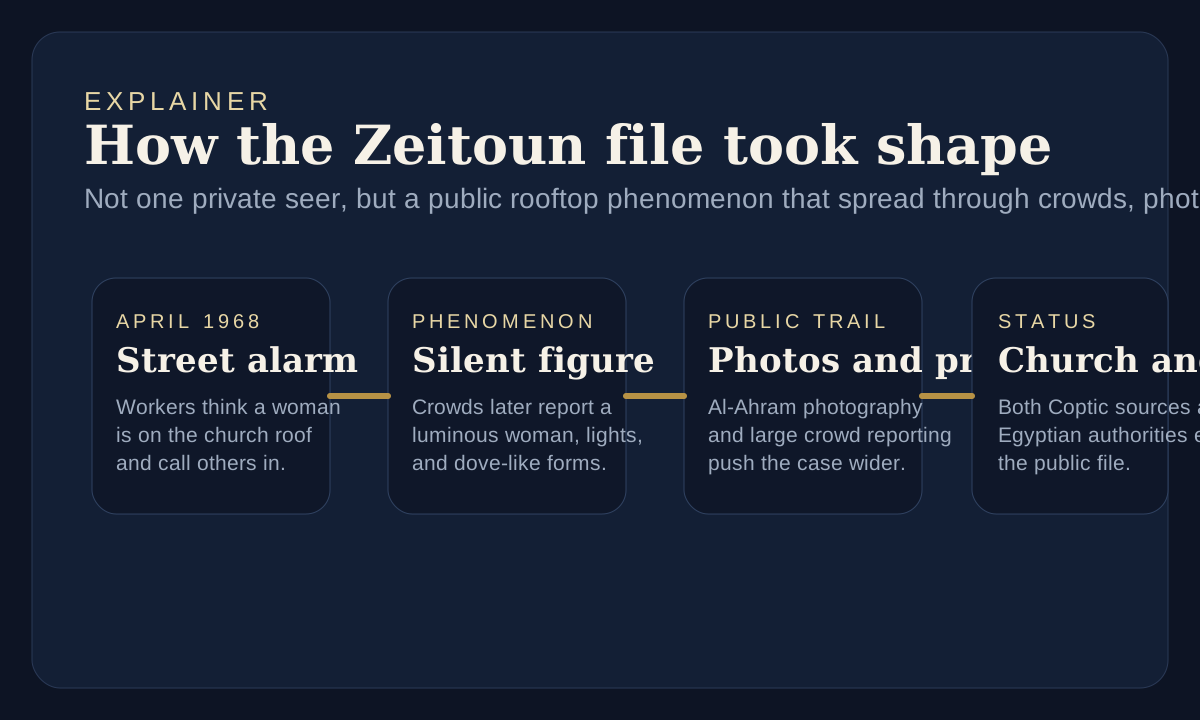
Zeitoun file
- Start Street alarm The case begins when workers think a woman is standing in danger on the church roof.
- Phenomenon Repeated silent appearances Crowds later report a luminous female figure, lights, and dove-like forms above the church.
- Record Photos and press Secular newspaper photography and wide public reporting become part of the file.
- Status Church and state acknowledgment Both Coptic church sources and Egyptian public authorities enter the public record.
The cited sources describe several recurring features of the Zeitoun reports:
- Scale: Crowds of 100,000–250,000 gathered on individual nights.[3]
- Cross-religious witness: The first witnesses were Muslim. Muslim, Jewish, and non-religious Egyptians testified to witnessing the figure alongside Christians.[2]
- No message: Unlike almost every other major approved Marian apparition, the Zeitoun figure delivered no verbal message, made no prophecy, transmitted no secrets. It was entirely silent.[4]
- Photographic documentation: Staff photographers for Al-Ahram — Egypt’s leading secular daily, run by the state — photographed the figure. The original negatives were examined by Al-Ahram’s photography department, which certified them free of montage.[5]
- Government acknowledgment: The Egyptian government conducted its own investigation, shutting off all electricity within a wide radius to test for artificial-light explanations. The apparitions continued. The government published a formal acknowledgment in its official gazette.[2]
The public record described on this page consists of witness claims, church and government statements, press photography, and later discussion of possible explanations.[2] [5]
What the apparitions did - and did not communicate
Section titled “What the apparitions did - and did not communicate”Zeitoun is not remembered for spoken instructions. The cited church, press, and archive sources preserve no verbal message, no named seer receiving a secret, and no long speech from Mary.[2] [4] [5]
What people said they witnessed instead was a repeated public sign: a bright female figure above the church, blessing gestures, flashes of light, and luminous dove-like forms moving through the scene.[2] [5] [9] So for Zeitoun, the “message” is not something said out loud. It is the claim that this figure kept appearing in public, in silence, before huge mixed crowds.
The church and its location
Section titled “The church and its location”Official name: The Coptic Orthodox Church of the Virgin Mary, Zeitoun
Address: 122 Tomanbay Street (also transliterated Tumanbay), El-Zeitoun district, Cairo, Egypt 11321[6]
Phone: +20 222-59-2928
The Zeitoun district is a northern suburb of Cairo, located on the traditional route that Coptic tradition identifies as the path taken by the Holy Family — Mary, Joseph, and the infant Jesus — during their flight into Egypt, recorded in Matthew 2:13–15. This association deeply shaped local religious culture and the interpretation of the subsequent apparitions.[7]
The church’s origin and a prior prediction
Section titled “The church’s origin and a prior prediction”The church was built by Tawfik Khalil Ibrahim, a wealthy Coptic Christian landowner, on land he had first planned to develop commercially. Around 1918–1920, according to later church accounts, he experienced a vision telling him to build a church there instead. Those same accounts say Mary promised that she would later honor the site herself, roughly forty years in the future.[7]
The church was completed and consecrated on June 29, 1925. It was designed by Italian architect Leomingelli in the form of a miniature of the Hagia Sophia in Istanbul, with multiple rounded domes.[6]
The reported apparitions began forty-three years after consecration, in 1968.
Publicly documented chronology
Section titled “Publicly documented chronology”Farouk Mohammed Atwa was a 31-year-old Muslim mechanic employed at the Cairo Transit Authority bus garage located directly across the street from the Church of the Virgin Mary on Tomanbay Street.[8]
On the evening of April 2, 1968, at approximately 8:30 p.m., Atwa was outside the garage when he noticed a luminous white figure on the highest dome of the church. He believed the figure — a woman, kneeling, in white robes — was about to throw herself off the building. He shouted upward: “Lady, don’t jump!” and pointed his bandaged hand at her, urging her down.[8]
Atwa was also later linked to the first healing story associated with the apparitions. He said one finger had severe gangrene and that amputation had been planned for the next day. When he went back to the hospital, he said the doctor found the finger healed and cancelled the procedure.[8] That detail is part of the public tradition around Zeitoun, but it remains testimonial; no hospital chart or independent medical record has been published.
Evidential significance: Atwa was Muslim and had no devotional stake in interpreting the figure as the Virgin Mary. His initial response — treating it as a suicidal woman — speaks against the interpretation that religious expectation shaped his perception. His gangrene healing, if verified, would constitute the first of many reported medical phenomena at the site, but the documentation is testimonial.
Several other workers from the same bus garage were present with Atwa or came out quickly after he raised the alarm. Sources consistently describe the initial group as Muslim mechanics and bus drivers — employees of the Cairo public transit system — rather than church attendees.[1]
As the workers stared and argued about what they were seeing, a crowd began to form on the street. The crowd then attracted passersby, and within minutes hundreds of people were gathered in front of the church. Accounts describe the figure as visible to all of them — not as a private vision reported only by one person, but as something seen by everyone who looked.[1] [2]
The police were called. They arrived. They also saw it.
First-night accounts describe the crowd attempting natural explanations in real time: some suggested a reflection, some thought it was a nun, some thought it was a trick of the lights. The police checked the roof of the church and found it empty. The figure continued to be visible.[1]
The apparitions of April 2 were reported the following day in local news. Within two weeks, nightly crowds of thousands were gathering on Tomanbay Street.
Source note: The specific names of workers other than Farouk Mohammed Atwa are not preserved in the available documentary record. Accounts consistently identify the initial group as Muslim transit workers, but the primary record gives only Atwa’s name with certainty.
What witnesses described
Section titled “What witnesses described”The following descriptions summarize accounts from church sources, newspaper reports, and later eyewitness compilations.[2] [5] [9]
The luminous figure
Section titled “The luminous figure”The central phenomenon reported was a luminous female figure appearing above the church’s domes — typically the large central dome or the smaller northeastern dome — visible against the night sky. Accounts consistently describe:[2] [9]
- A figure clothed in white and light blue robes extending below the feet, with a bluish-white veil
- A dazzling halo or crown surrounding the head; several witnesses described the figure as radiating light independently of the surrounding darkness
- The figure appeared sometimes in full-body form, sometimes as a half-length or bust form surrounded by a luminous halo
- Movement across the dome: bowing, kneeling, facing the crowd, raising and extending arms in a blessing gesture, waving an olive branch, and at times holding an infant
- On several occasions the figure appeared to walk or glide across the curved dome surface — a surface that is not walkable by an ordinary person — with what witnesses described as effortless ease
- Duration varied: some appearances lasted only minutes; others persisted for two hours or more. One appearance on the night of April 29–30, 1968, reportedly lasted from approximately 2:45 a.m. until after 5:00 a.m.[10]
Bishop Anba Athanasius personally observed the April 29, 1968 apparition and later testified to “movement of the body and of the clothing.”[11]
Zaki Shenouda, Director of the Afro-Asian Conference, stated: “I saw her in full stature, like a queen, wearing a crown upon her head.”[10]
Safaa Gerges, a teaching assistant at the Faculty of Commerce, gave the following account to Al-Ahram: “When I first saw the Virgin, her full figure within a circle of light above the eastern dome, I doubted my own eyes.”[5]
The silent doves
Section titled “The silent doves”One of the most frequently reported and most discussed accompanying phenomena was the appearance of luminous dove-shaped forms in the sky around and above the figure. These are described across many independent accounts, and the descriptions are strikingly consistent in one unusual detail: the forms moved — rapidly, in formation — without moving their wings.[9]
Accounts describe them as:
- Bird-like creatures made of light, white or brilliantly luminous
- Flying in formation — sometimes pairs, sometimes groups of seven or twelve, sometimes in the shape of a cross
- Moving at speeds described as “astonishing” or “extraordinary”
- Absent of wing movement — gliding rather than flapping
This “no wing movement” detail appears again and again in witness accounts and is one reason the dove reports stand out. The point is not that bright birds were seen in the sky. The point is that witnesses kept describing bright dove-like forms moving quickly without flapping the way ordinary birds do.[9]
Incense clouds and fragrance
Section titled “Incense clouds and fragrance”Many witnesses reported a smell — variously described as incense, flowers, or perfume — accompanying the appearances. The smell was widely reported both by witnesses who also saw the figure and by people who were present on the street but who may not have had a direct sightline to the dome.[2]
Additionally, witnesses and investigators reported billowing clouds of what appeared to be incense smoke rising from the church — from windows that were sealed and not open. This smoke or vapor was reportedly accompanied by the fragrance. The church’s interior was empty and locked on multiple occasions when these clouds were reported.[2]
Accompanying light phenomena
Section titled “Accompanying light phenomena”Accounts describe flashes of brilliant light preceding and surrounding the main apparition, described variously as:
- Starlike objects moving across the sky above the church
- Sudden illumination of the dome without visible source
- A general luminosity described as brighter than the surrounding street lighting
The Egyptian government’s investigation included a test in which all electrical power within a wide radius of the church was shut off. The apparitions and the associated luminosity continued during the blackout, which the government used as evidence against an artificial-light-source explanation.[2]
Scale of witnesses
Section titled “Scale of witnesses”Crowd estimates from contemporary newspaper accounts and Coptic Church records are large:
- On individual nights during peak periods (spring and summer 1968), crowds on Tomanbay Street and surrounding areas are estimated at 100,000 to 250,000 people.[3]
- The Al-Ahram report of May 7, 1968, described 92 trains running every 10 minutes to bring crowds from across Egypt, each carrying 1,500 passengers on carriages designed for 900; 50 buses on 8 routes; and 150 metro cars converging on the site.[5]
- The first anniversary gathering on April 2, 1969, drew approximately 250,000 people.[12]
Who witnessed it
Section titled “Who witnessed it”Witnesses were notably cross-religious and socially diverse:
- Muslim Egyptians made up a large proportion of the crowds, including officials of the Nasser government, military officers, students, and ordinary workers[2]
- Coptic Orthodox Christians constituted the core devotional community[2]
- Catholic observers — including Cardinal Stephanos I (Catholicos of the Coptic Catholic Church) and a Vatican envoy who arrived April 28, 1968 — saw the apparitions and submitted reports[13]
- Secular journalists — including reporters from Al-Ahram, Al-Akhbar, and foreign press — witnessed and reported on the phenomena[5]
- Medical doctors testified to witnessing the apparitions[2]
- Government officials and investigators[2]
- President Gamal Abdel Nasser — a practicing Sunni Muslim and the head of a secular Arab nationalist government — visited the site and is reported to have witnessed the apparition and “believed in its authenticity”[14]
Photographs and film
Section titled “Photographs and film”First authenticated photographs — April 13, 1968
Section titled “First authenticated photographs — April 13, 1968”The first documented photographs of the apparition were taken on the night of April 13, 1968, by Wagih Rizk (also transliterated Wajih Rizk or Wagih Rizk Matta), a photojournalist employed by Al-Ahram, Egypt’s largest and most prestigious daily newspaper.[5]
Rizk photographed the apparition at approximately 3:40 a.m. on that date. His photographs were then published on the front page of Al-Ahram on May 5, 1968, the same day as Pope Cyril VI’s official statement.[5]
Authentication process: The original film was submitted to Al-Ahram’s photography department, which examined it and issued a formal statement: the film was found authentic and free of any technical tampering. The chief photographer at Al-Ahram stated that there was no possibility of photo-montage.[5]
This is an important evidentiary detail: the authentication was carried out not by a religious body but by the technical staff of a major secular press institution whose professional reputation depended on accurate photographic reporting.
Subsequent photography
Section titled “Subsequent photography”Multiple photographs were taken over the following months by various photographers. The Wagih Rizk Collection, archived on the official Zeitoun website (zeitun-eg.org), includes photographs taken on specific documented dates, including:
- April 13, 1968 (first authenticated image)
- May 6, 1968 (2:35 a.m.): The figure transfigured over the main dome
- May 21, 1968 (4:30 a.m.): Half-length apparition over the northeastern dome
- Numerous subsequent dates through 1968 and 1969[15]
Another photographer, Fawzi Mansour, also captured images during this period.[6]
Egyptian television footage
Section titled “Egyptian television footage”The apparitions were also filmed by Egyptian state television. Footage was broadcast nationally. Video documentation has been archived by the official church and is referenced on the church’s website (stmaryztn.org).[4]
A documentary film
Section titled “A documentary film”A documentary on the Zeitoun apparitions was produced and has circulated in various forms. A version is available on YouTube (video ID: nMEWxRB-1dc).[16]
The Egyptian government investigation
Section titled “The Egyptian government investigation”The cited sources describe a government response to the Zeitoun apparitions in addition to church investigation.[2]
What was investigated
Section titled “What was investigated”- Police investigated the church interior and rooftop on the first night (April 2, 1968) — they found the roof empty while the figure remained visible to the street crowd
- Security services searched for light projectors, holograms, or other mechanical devices within a 15-mile (approximately 24 km) radius of the church — none were found[2]
- The government conducted a power blackout, disconnecting all electricity in a wide area around the church — the apparitions and the associated luminosity continued during the blackout[2]
Official conclusions
Section titled “Official conclusions”The Egyptian government published a formal acknowledgment in Al-Waqa’i’ Al-Masryia (the official state gazette), stating that no natural explanation for the phenomena had been identified.[2]
The Ministry of Tourism issued a validation of the sightings and began printing and distributing pamphlets about the events at Zeitoun. This was a formal government action in support of the apparitions’ authenticity as a genuine and unexplained phenomenon.[2]
Al-Ahram and the secular Egyptian press
Section titled “Al-Ahram and the secular Egyptian press”Al-Ahram (meaning “The Pyramids”) is Egypt’s oldest and most prestigious daily newspaper, founded in 1875. It is state-run and is considered the paper of record for the Egyptian government. Its coverage of the Zeitoun events represents secular, state-affiliated press engagement with a religious phenomenon.
Early reticence
Section titled “Early reticence”Initial coverage was minimal. In the first days and weeks after April 2, Al-Ahram published only brief mentions of crowds gathering at the Zeitoun church — noting the gathering without characterizing what people were seeing.[17] Lebanese newspapers were among the first to cover the story extensively.
By mid-April 1968, Egyptian newspapers began allocating full pages to coverage.
May 5, 1968: front-page coverage
Section titled “May 5, 1968: front-page coverage”On May 5, 1968 — the day of Pope Cyril VI’s official statement — Al-Ahram published its landmark front-page report. The headline read: “Pope Cyril announces apparition is real.”[17]
The paper published a photograph of the apparition (the Wagih Rizk photograph) with the following notation beneath it:[5]
“The photography department at Al-Ahram has inspected the original film and found no traces of photo-montage.”
This is a formal authentication statement from the technical staff of the largest secular newspaper in Egypt, published in that newspaper’s own pages.
May 7, 1968: crowd reporting
Section titled “May 7, 1968: crowd reporting”Al-Ahram reporter Ezzat El-Saadani’s report of May 7, 1968, documented the logistical scale of the phenomenon. He reported 92 trains running every 10 minutes, carrying 1,500 passengers per carriage designed for 900; 50 buses on 8 routes; 150 metro cars; and approximately 150,000 soda bottles sold nightly to the crowds.[5]
Al-Akhbar coverage — May 5, 1968
Section titled “Al-Akhbar coverage — May 5, 1968”Al-Akhbar, another major Egyptian daily, also covered the papal press conference on May 5, 1968. The account published in Al-Akhbar recorded the papal statement beginning with the Coptic calendar date: “Since the evening of Tuesday, April 2, 1968, corresponding to 24 Baramhat, 1684 [Coptic calendar]…”[10]
Al-Akhbar also recorded testimony from Bishop Anba Athanasius, who personally testified at the press conference: “Yes, I saw her, along with countless others, tens of thousands.”[10]
Official ecclesial recognition
Section titled “Official ecclesial recognition”The Coptic investigation committee
Section titled “The Coptic investigation committee”On April 23, 1968 — three weeks after the first sighting — Pope Cyril VI appointed a formal investigative committee of senior bishops:[12]
- Bishop Anba Gregorios (Bishop of Postgraduate Studies, Coptic Culture, and Scientific Research) — direction of the investigation
- Bishop Girgis Matta
- Bishop Youhanan Abdel Masih
- Bishop Benjamin Kamel
The committee gathered witness testimony, documented the phenomena, and conducted its inquiry over approximately six weeks.
Pope Cyril VI’s official statement — May 4, 1968
Section titled “Pope Cyril VI’s official statement — May 4, 1968”On Saturday, May 4, 1968 (corresponding to Barmouda 26, 1684 in the Coptic calendar), Pope Cyril VI issued his official papal statement from the Papal Residence in Cairo. It was announced at a press conference at the Coptic Orthodox Patriarchate attended by more than 150 journalists, and read by Anba Athanasius (Metropolitan of Beni Suef) and Anba Samuel (Bishop of Social Services).[10]
The statement was subsequently read in every Coptic Orthodox church.
The key declaration, as preserved in Al-Akhbar and the official Coptic Patriarchate record:[10]
“The Patriarchal See declares with complete faith, great joy and humble gratitude to the Almighty, that the Blessed Virgin Mary has appeared repeatedly in clear and stable forms, during many nights and for varying periods, lasting up to more than two hours, since April 2, 1968 until now, above the Coptic Orthodox church of Zeitoun, Cairo, on the road to Matarieh, where the Holy Family passed during its stay in Egypt, as tradition reports.”
Pope Cyril VI simultaneously authorized the addition of “The Feast of the Apparition of the Virgin in Zeitoun” to the official liturgical calendar of the Coptic Orthodox Church and directed that it be included in the Synaxarion (the Coptic liturgical martyrology).[12]
Pope Cyril VI’s April 2, 1970 visit
Section titled “Pope Cyril VI’s April 2, 1970 visit”On April 2, 1970 — the second anniversary of the first apparition — Pope Cyril VI personally visited the church at Zeitoun to commemorate the event.[12]
Catholic engagement — Cardinal Stephanos I and the Vatican
Section titled “Catholic engagement — Cardinal Stephanos I and the Vatican”The Coptic Catholic Church’s patriarch, Cardinal Stephanos I, independently examined the apparitions and issued a statement confirming their validity: “The apparitions of Our Lady at Zeitoun are beyond any doubt and were seen by many of my trustworthy Coptic Catholic children.”[13]
Nuns of the Society of the Sacred Heart witnessed the apparitions and sent a detailed report to the Vatican. On April 28, 1968, a Vatican envoy arrived in Zeitoun, witnessed the apparitions personally, and submitted a report to Pope Paul VI.[13]
The Vatican took no official public position — the apparitions occurred above an Eastern (Coptic) Orthodox church, placing canonical jurisdiction outside Rome. The Vatican formally deferred to Coptic Orthodox authorities for the official investigation and ruling.[13]
Duration, frequency, and end
Section titled “Duration, frequency, and end”The full apparition period ran from April 2, 1968 to May 29, 1971 — approximately three years and two months.[4]
Frequency varied substantially across this period:
- April–June 1968: Near-nightly appearances, sometimes lasting hours; the period of most intensive public witnessing
- 1968–1969: Appearances continued multiple times per week; the first feast celebration on April 2, 1969 drew approximately 250,000 people[12]
- 1970: Frequency declined to approximately once per month
- May 29, 1971: Final reported apparition[4]
The apparitions had no announced ending. They simply ceased.
Reported healings
Section titled “Reported healings”Among the most discussed phenomena associated with the Zeitoun apparitions were claimed miraculous healings. The following cases are cited across multiple sources, though it must be noted that independent medical documentation — hospital records, physician statements in primary form, pre- and post-event clinical examinations by non-affiliated medical professionals — has not been published or publicly produced for most cases. The accounts derive from the Coptic Church’s investigative record, Pearl Zaki’s eyewitness account, and testimony compiled by Francis Johnston and other researchers.
| Person | Condition | Reported Outcome |
|---|---|---|
| Farouk Mohammed Atwa (Muslim, age 31) | Severe gangrene; amputation scheduled next day | Finger completely healed overnight; amputation cancelled[8] |
| Sami Abd-el-Malek (age 40) | Terminal bladder cancer | Reportedly healed[9] |
| Fathma Zahi Reda (Muslim woman) | Incurable thyroid condition | Reportedly healed[9] |
| Madiha Mohammed Said (age 20, Muslim) | Nervous disorder causing blindness and inability to speak | Reportedly recovered both sight and speech[9] |
| Adel Abdel Malek (age 34) | Mute from birth | Reportedly gained speech[9] |
| Mrs. Mahmoud Shoukry Ibrahim (age 45) | Total paralysis of lower limbs | Reportedly healed[9] |
| William Nashed Zaki (physician) | Hernia | Reportedly healed[9] |
| Two unnamed girls from a school for the blind | Blind from birth | Reportedly regained sight[9] |
| Unnamed Muslim girl | Malignant tumor on head | Tumor reportedly absent the morning after visiting the church[9] |
Pope Cyril VI’s official statement specifically noted that “miraculous healings had been verified by physicians” — but did not identify the physicians, publish their reports, or produce clinical records in the public statement.[10]
The political and historical context
Section titled “The political and historical context”Understanding Zeitoun requires understanding Egypt in April 1968.
The Six-Day War and its aftermath (1967–1968)
Section titled “The Six-Day War and its aftermath (1967–1968)”On June 5–10, 1967, Egypt suffered a catastrophic military defeat in the Six-Day War against Israel. In six days, Israel destroyed the Egyptian Air Force largely on the ground, captured the Sinai Peninsula, and inflicted an estimated 11,000–15,000 Egyptian casualties against approximately 700 Israeli deaths. The lopsidedness of the defeat was a traumatic shock to Egyptian national identity.[18]
Nasser announced his resignation on June 9, 1967. Mass demonstrations — many of them genuine, not organized — called for him to stay. He rescinded his resignation, but his authority was weakened.
By February 1968 — six weeks before the Zeitoun apparitions began — Cairo’s universities had exploded in protest. The proximate cause was the lenient sentences handed down to air force commanders who had overseen the military disaster. Students and workers demanded freedom of expression, accountability, and representative government. Approximately 100,000 university students participated.[18]
Egypt in April 1968 was a nation in a condition of profound demoralization, social unrest, and spiritual searching.
The cultural-religious dimension
Section titled “The cultural-religious dimension”Multiple observers — including the sociologist Cynthia Nelson and the historian Michael Carroll — noted that the Zeitoun apparitions resonated with a specific cultural mood: a widespread Egyptian feeling that the 1967 defeat had resulted from abandoning genuine religious faith in favor of secular nationalism.[19] [20]
The figure appearing above a Christian church was interpreted not merely by Christians but by many Muslims as a divine sign — a message of comfort and hope for a defeated, humiliated nation. The cross-religious response to Zeitoun was in part a function of this shared national grief.
Nasser reportedly visited the site, witnessed the apparition, and — according to Catholic World Report and other sources — “believed in its authenticity.” The same accounts note that witnessing the apparition is said to have influenced his subsequent policy toward Egypt’s Coptic Christian minority, a community that had experienced systematic marginalization under the nationalizations and land reforms of the 1950s–60s. In June 1968, Nasser inaugurated the new Coptic Cathedral in central Cairo alongside Pope Cyril VI.[14]
The same sources describe formal public acknowledgment, Ministry of Tourism promotion, and very large Muslim attendance at the site during the 1968 apparitions.[14]
Skeptical analysis and counter-arguments
Section titled “Skeptical analysis and counter-arguments”Proposed by: Sociologists Robert Bartholomew and Erich Goode (2000), in their study “Mass Delusions and Hysterias: Highlights from the Past Millennium,” published in the Skeptical Inquirer.[20]
The argument: Bartholomew and Goode classify Zeitoun as a case of collective sociogenic illness or mass delusion. Witnesses were “predisposed by religious background and social expectation to interpreting the light displays as related to the Virgin Mary.” In a nation traumatized by military defeat, with the population seeking signs of divine favor, any ambiguous luminous phenomenon above a church was likely to be interpreted as Marian.
Further source notes:
- Mass hysteria typically involves anxiety symptoms spreading through crowds — fainting, paralysis, rashes — not cross-independent accounts of a specific, stable, visually detailed figure. Bartholomew and Goode’s framework is designed for anxiety-propagation events, and applying it to visual perception of a described external object involves conceptual stretching.
- The first witnesses were Muslim mechanics who had no prior expectation of a Marian apparition. Their initial interpretation was “suicidal woman.” The religious interpretation followed their visual description, rather than the religious expectation producing the visual description.
- The photographs were taken before widespread public awareness had created significant crowd expectation. Wagih Rizk photographed the apparition on April 13, 1968 — eleven days after the first sighting and three weeks before major press coverage.
- Sociologist Michael Carroll, also cited by Bartholomew and Goode, attributed Zeitoun specifically to the psychological aftermath of the 1967 defeat — but this does not explain why, out of a population experiencing the same defeat, some specific persons on a specific street at a specific moment described a specific figure above a specific building.
Proposed by: John S. Derr (U.S. Geological Survey) and Michael A. Persinger (Laurentian University), in their peer-reviewed paper “Geophysical Variables and Behavior: LIV. Zeitoun (Egypt) Apparitions of the Virgin Mary as Tectonic Strain-Induced Luminosities,” published in Perceptual and Motor Skills, 68(1), 123–128, 1989.[21]
This is the only peer-reviewed scientific paper directly addressing the Zeitoun phenomena.
The argument: Derr and Persinger performed a temporal analysis correlating the frequency of Zeitoun apparitions (using the available — incomplete — record of dates) with regional seismic activity. They found a moderate correlation (reported correlation coefficient: 0.56) between monthly increases in seismicity and the occurrence of luminous phenomena at or near the same period. The seismic source region was approximately 400 km to the southeast. The tectonic strain theory (originally proposed by Persinger in 1976) holds that anomalous luminous phenomena and earthquakes are both generated by tectonic stress, and that strain energy can produce luminous effects in the surface environment.
Further source notes:
- The exact dates of all apparitions at Zeitoun were not systematically recorded, meaning the correlation analysis was performed on an incomplete dataset — a limitation Derr and Persinger acknowledged.
- Tectonic strain theory has no established physical mechanism. No process by which tectonic strain at 400 km produces a stationary, three-dimensional luminous human figure on a specific rooftop for three years has been described or modeled.
- Persinger’s broader tectonic strain theory is not accepted as established science by the mainstream geophysical community.
- If tectonic strain produced the Zeitoun lights, similar luminous phenomena would be expected across the region during the same seismic periods — and no such phenomena were reported.
- The correlation value of 0.56 is a moderate association at best; given the incomplete dataset and the number of potential confounds, it does not constitute strong evidence.
Caveat: The paper is nonetheless significant as the only peer-reviewed scientific attempt to explain Zeitoun. It represents the state of serious naturalistic inquiry.
Proposed by: Multiple non-supernatural commentators, including Brian Dunning (Skeptoid) and philosopher Etienne Vermeersch.
The argument: The lights — whatever their source — were ambiguous. The crowd, primed by religious expectation and communal excitement, perceived them as the Virgin Mary because that is what they hoped and expected to see. Pareidolia (the tendency to perceive meaningful patterns in ambiguous stimuli) combined with social reinforcement (“she’s there!”) and the specific Marian devotional context of a Coptic church produced a shared interpretive framework.
Anthropologist Cynthia Nelson (American University in Cairo) visited the church site multiple times in April–June 1968. She described seeing “intermittent flashes of light” — and noted that “every time the slightest reflection would appear, the crowd would swell in cheers.” She characterized the phenomenon as consistent with ambient reflections, and noted that crowd dynamics strongly amplified any ambiguous stimulus into confirmatory perception.[19]
Further source notes:
- Nelson is a single investigator who visited on specific evenings; she did not see what other witnesses on other evenings described. The fact that she saw only “intermittent flashes of light” does not establish that this was all that was ever visible — the apparitions varied significantly in intensity and duration.
- The “pareidolia” explanation accounts for ambiguous perception of a vague glow; it is less convincing as an account of specific, repeated, multi-hour apparitions of a distinctly described figure with specific features (bowing, olive branch, doves, movement across dome) described consistently by independent witnesses across three years.
- Philosopher Etienne Vermeersch raised the objection that if this were a genuine supernatural event, a “powerful sky being” would be capable of producing “one clear, unambiguous miracle.” This is a theological argument about what divine action should look like, not a scientific argument about what was observed.
Raised by: Brian Dunning (Skeptoid, Episode 766) and other investigators.
The argument: When the claimed photographic evidence is critically examined, much of what circulates as “photographs of the Zeitoun apparition” turns out not to be photographs at all, but illustrations — drawings, painted images, or composite images combining a photograph of the church with painted additions. Many were produced by street vendors and sold to visitors during the apparition period. Some are explicitly acknowledged as illustrations.
Dunning’s specific claim: The most widely circulated “Zeitoun photograph” combines a daytime photo of the church with a painted night sky, a painted halo, and a painted white figure. This is not a photograph of the apparition. It is a devotional illustration.
Further source notes and the Wagih Rizk distinction:
- This criticism applies to the popular circulation of Zeitoun “photographs” — not to the authenticated Wagih Rizk images specifically. The Rizk photographs were authenticated by Al-Ahram’s photography department, which examined the original negatives. The process of confusing street-vendor illustrations with authenticated press photographs is a genuine evidentiary problem, but it does not negate the press photographs.
- The existence of many false or uncertain images in a popular corpus does not establish that no authentic images exist. The critical question is whether the authenticated images — those for which original negatives were examined by qualified professionals — show something that requires explanation. Al-Ahram’s authentication of the Rizk negatives specifically addresses this.
- Dunning’s analysis is careful and well-reasoned. His conclusion — that Zeitoun evidence is weaker than usually presented — is supported by the illustration-contamination of the popular image corpus. His analysis does not specifically address the Rizk photographs and Al-Ahram’s authentication.
Later apparitions in Egypt
Section titled “Later apparitions in Egypt”The Zeitoun events appear to have initiated a pattern of reported Marian apparitions at Coptic churches in Egypt that has continued to the present.
| Location | Period | Recognition | Notes |
|---|---|---|---|
| Zeitoun, Cairo | April 2, 1968 – May 29, 1971 | Coptic Orthodox (Pope Cyril VI, May 1968) | Original event |
| Shubra (Shoubra), Cairo, Church of St. Demiana | 1986–1991 | Coptic Orthodox (Pope Shenouda III) | Same reported phenomena: luminous figure, doves, incense[22] |
| Assiut | August 2000 – January 2001 | Coptic Orthodox (Pope Shenouda III, confirmed on his North American visit) | Thousands of witnesses; same phenomenological repertoire[22] |
| Warraq, Cairo | 2009 | Under investigation at time of press | Attracted large crowds; video footage circulated widely online[22] |
All four locations share a traditional connection to the route of the Holy Family’s flight into Egypt. The recurrence of the same phenomenological elements — luminous figure on church dome, wingless luminous doves, incense smell, large crowds — across multiple decades and locations is noted by both devotional and investigative sources.
Academic and scholarly treatment
Section titled “Academic and scholarly treatment”Primary peer-reviewed publication
Section titled “Primary peer-reviewed publication”Derr, J.S. and Persinger, M.A. (1989). “Geophysical Variables and Behavior: LIV. Zeitoun (Egypt) Apparitions of the Virgin Mary as Tectonic Strain-Induced Luminosities.” Perceptual and Motor Skills, 68(1), 123–128. — The only peer-reviewed scientific paper directly addressing the Zeitoun phenomena. Proposes a tectonic strain explanation and reports a 0.56 correlation between seismic activity and apparition frequency. Limitations acknowledged by the authors include the incomplete apparition date record. PubMed ID: 2648309.[21]
Primary scholarly article (anthropological)
Section titled “Primary scholarly article (anthropological)”Nelson, C. (1973). “The Virgin of Zeitoun.” Worldview, 16(9), 5–11. — An anthropological field account by a professor at the American University in Cairo who visited the site multiple times between April and June 1968. Nelson describes seeing intermittent light flashes and provides sociological analysis of what the apparitions meant to Egyptian society in the aftermath of the 1967 war. Represents one of the main skeptical scholarly engagements from the period.[19]
Recent book-length treatment
Section titled “Recent book-length treatment”Dumsday, T. (2024). The Marian Apparitions at Zeitoun: An Evidential Inquiry. SVS Press, 312 pp. ISBN 978-0-88141-761-6. — A philosophical examination of the Zeitoun evidence by Travis Dumsday, Associate Professor of Philosophy at Concordia University of Edmonton. Dumsday evaluates all major naturalistic explanations and argues they are collectively insufficient to account for the documented phenomena. He argues the apparitions constitute “powerful evidence for the reality of the supernatural.” Note: Dumsday’s conclusion is explicitly pro-supernatural; his work should be read alongside Dunning and Bartholomew/Goode for a complete evidential picture. SVS Press is the press of St. Vladimir’s Orthodox Theological Seminary.[23]
Sociological treatment
Section titled “Sociological treatment”Bartholomew, R.E. and Goode, E. (2000). “Mass Delusions and Hysterias: Highlights from the Past Millennium.” Skeptical Inquirer, 24(3). — Classifies Zeitoun as a case of mass sociogenic illness. Available online via the Center for Inquiry. The paper is widely cited in skeptical literature as the primary sociological treatment.[20]
How the main explanations compare
Section titled “How the main explanations compare”A simple fraud reading — a projected image, an actress on a rooftop, or a cleverly positioned light — has to account for the combined weight of:
- The government’s search of a 15-mile radius for projectors or devices finding nothing
- The government’s power blackout test, during which apparitions continued
- The duration (three years) and frequency (multiple times weekly at peak) — maintaining a sophisticated projection-based fraud over this period, against active government investigation, in a crowd of up to 250,000 people many of whom would have been looking for the source, is not a plausible scenario
- Al-Ahram’s authentication of the original film negatives as free of montage
Zeitoun does not read like a private mystical vision reported only by one seer or one small circle. The sources describe phenomena seen by large crowds that included Muslim workers, secular journalists, and government investigators.
The cited discussions do not agree on the nature of the phenomenon. The main explanations discussed are:
- Tectonic-strain-induced luminosities (Derr and Persinger)
- Collective perceptual phenomena shaped by crowd expectation (Nelson, Bartholomew and Goode)
- Atmospheric optics combined with expectation and pareidolia
- Genuine supernatural apparition (Coptic Church, Dumsday)
The cited sources present these as competing explanations for the same witness and press record.
The cited sources repeatedly highlight this combination of features:
- Scale (hundreds of thousands of witnesses over three years)
- Cross-religious independence (Muslim-majority witnesses with no devotional stake)
- Press authentication (secular newspaper photography department)
- Government elimination of simple fraud (active investigation, power blackout)
- Institutional recognition by bodies with different interests (Coptic Church, Coptic Catholic Church, Egyptian government)
The cited sources present these factors together in the Zeitoun record.[2] [4] [5]
References
Section titled “References”- indefenseofthecross.com. “Our Lady of Zeitoun Egypt.” — Secondary synthesis account; reconstructs first-night events from multiple sources. Identifies Farouk Mohammed Atwa as primary first witness. Available at: https://indefenseofthecross.com/marian-apparitions/our-lady-of-zeitoun-egypt/
- divinemysteries.info. “Our Lady of Light, Zeitoun, Egypt, 1968–1971.” — Detailed synthesis account documenting government investigation, blackout test, witness demographics, and phenomenological descriptions. Available at: https://www.divinemysteries.info/our-lady-of-light-zeitoun-egypt-1968-1971/
- ucatholic.com. “This Marian Apparition Was Witnessed by 250,000 People!” — Estimates 250,000 nightly attendance at peak. Available at: https://ucatholic.com/blog/this-marian-apparition-was-witnessed-by-250000-people/
- stmaryztn.org. Coptic Orthodox Patriarchate — Saint Mary Church, Zeitoun. Official church website; documents apparition period April 2, 1968 – May 29, 1971; television footage archived. Available at: https://www.stmaryztn.org/saintmary/en/
- ourladyofzeitoun.com. “Al-Ahram Newspaper — May 7, 1968.” — Reproduces the El-Saadani report of May 7, 1968, including crowd logistics, witness testimony from Safaa Gerges, and the photography department authentication statement. Available at: https://ourladyofzeitoun.com/en/newspaper/al-ahram-newspaper-may-7-1968/
- thecatholictravelguide.com. “Zeitoun (Cairo), Egypt: Virgin Mary Church.” — Documents church address (122 Tomanbay Street, El-Zeitoun, 11321, Cairo), phone number, and architectural history. Available at: https://thecatholictravelguide.com/destinations/holy-land/zeitoun-cairo-egypt-virgin-mary-church-apparitions-of-the-blessed-virgin-mary/
- ourladyofzeitoun.com. “Zeitoun Apparition Timeline.” — Documents the 1918–1920 vision of Tawfik Khalil Ibrahim, church construction and consecration June 29, 1925, and subsequent apparition history. Available at: https://ourladyofzeitoun.com/en/timeline/
- Various sources including thecatholictravelguide.com and miraclehunter.com. Farouk Mohammed Atwa, age 31, Muslim mechanic; gangrene diagnosis; scheduled amputation; healing the morning of April 3, 1968. Note: no hospital records have been publicly produced. Account is testimonial.
- schooloffaith.com / multiple secondary sources. Pearl Zaki, Francis Johnston. Healing case names including Sami Abd-el-Malek, Fathma Zahi Reda, Madiha Mohammed Said, Adel Abdel Malek, Mrs. Mahmoud Shoukry Ibrahim, William Nashed Zaki. Luminous doves “made of light” flying “without moving their wings.” Note: all healing accounts are testimonial; no independent medical documentation has been publicly produced.
- ourladyofzeitoun.com. “Al-Akhbar Newspaper — May 5, 1968.” — Reproduces the May 5, 1968 Al-Akhbar coverage of the papal press conference, including the beginning of the official Coptic statement with Coptic calendar date, testimony from Bishop Anba Athanasius (“Yes, I saw her, along with countless others, tens of thousands”), and testimony from Zaki Shenouda. Available at: https://ourladyofzeitoun.com/en/newspaper/al-akhbar-newspaper-may-5-1968/
- udayton.edu. “Mary in Zeitoun: Silent Presence.” University of Dayton Marian Library, April 29, 2024. — Notes Bishop Athanasius’s personal testimony and “movement of the body and of the clothing.” Also cites Cynthia Nelson and Michael Carroll. Available at: https://udayton.edu/blogs/marianlibrary/2024-04-29-mary-in-zeitoun.php
- ourladyofzeitoun.com. “Zeitoun Apparition Timeline.” — Documents April 23, 1968 committee appointment; April 2, 1969 first feast (250,000 attendees); April 2, 1970 Pope Cyril VI personal visit. See ref-7.
- Various including miraclehunter.com and catholicworldreport.com. Cardinal Stephanos I statement; Vatican envoy arrival April 28, 1968; report to Pope Paul VI; Vatican deferral to Coptic authority.
- catholicworldreport.com. “Our Lady of Zeitoun and Christianity in Egypt.” April 26, 2017. — Documents Nasser’s personal witnessing and reported belief in authenticity; June 25, 1968 inauguration of Coptic Cathedral. Available at: https://www.catholicworldreport.com/2017/04/26/our-lady-of-zeitoun-and-christianity-in-egypt/
- zeitun-eg.org. “Mr. Wagih Rizk Collection of Photos.” — Archive of authenticated Zeitoun photographs with dates and times. Available at: https://www.zeitun-eg.org/mrwagihr.htm
- miraculousrosary.blogspot.com. Documentary YouTube link (video ID: nMEWxRB-1dc). Available at: http://miraculousrosary.blogspot.com/2010/12/miracle-apparitions-at-zeitoun-egypt.html
- egyptindependent.com. “This week in 1968: The Virgin Mary revisits Egypt.” — Notes Al-Ahram’s initial reticence (only brief mentions), later full-page coverage, and front-page headline on May 5, 1968. Available at: https://www.egyptindependent.com/week-1968-virgin-mary-revisits-egypt/
- Various. Six-Day War: June 5–10, 1967. Approximately 11,000–15,000 Egyptian casualties; Sinai captured; Nasser’s resignation announcement June 9 and reversal. February 1968 student protests. Historical context for the Zeitoun apparitions.
- Nelson, C. (1973). “The Virgin of Zeitoun.” Worldview, 16(9), 5–11. Carnegie Council for Ethics in International Affairs. — Primary anthropological field account; Nelson visited April 15, April (late), and June 1, 1968; observed “intermittent flashes of light”; concluded religious expectation shaped crowd perception. Available (archived) at: https://worldview.carnegiecouncil.org/archive/worldview/1973/09/2208.html
- Bartholomew, R.E. and Goode, E. (2000). “Mass Delusions and Hysterias: Highlights from the Past Millennium.” Skeptical Inquirer, 24(3). — Classifies Zeitoun as mass sociogenic illness; available at: https://skepticalinquirer.org/2000/05/mass-delusions-and-hysterias/. Note: Bartholomew and Goode’s framework for mass hysteria is designed for anxiety-propagation events; its application to stable visual phenomena described by non-anxious, cross-independent witnesses is debated.
- Derr, J.S. and Persinger, M.A. (1989). “Geophysical Variables and Behavior: LIV. Zeitoun (Egypt) Apparitions of the Virgin Mary as Tectonic Strain-Induced Luminosities.” Perceptual and Motor Skills, 68(1), 123–128. DOI: 10.2466/pms.1989.68.1.123. PubMed ID: 2648309. — The only peer-reviewed scientific paper directly addressing the Zeitoun phenomena. Available at: https://journals.sagepub.com/doi/10.2466/pms.1989.68.1.123
- Multiple sources including divinemysteries.info. Subsequent Egyptian apparitions: Shubra 1986–1991 (Pope Shenouda III recognition); Assiut August 2000 – January 2001 (Pope Shenouda III confirmation); Warraq 2009.
- Dumsday, T. (2024). The Marian Apparitions at Zeitoun: An Evidential Inquiry. SVS Press. 312 pp. ISBN 978-0-88141-761-6. — Philosophical examination evaluating naturalistic explanations and arguing they are collectively insufficient. Author: Associate Professor of Philosophy, Concordia University of Edmonton. Publisher: St. Vladimir’s Orthodox Theological Seminary Press. Available at: https://svspress.com/the-marian-apparitions-at-zeitoun-an-evidential-inquiry/. Note: author’s conclusion is explicitly pro-supernatural; publisher is Orthodox Christian.