
Our Lady of Pontmain (1871)
The story in one line
children at Pontmain saw a Marian figure in the sky in January 1871 while the village was praying during wartime.
The basic story
On January 17, 1871, during the Franco-Prussian War, four children in Pontmain reported seeing a luminous lady in the sky accompanied by a message of prayer and hope. The apparition was officially recognized in 1872.
Reported message
Historical setting
Pontmain is set against the Franco-Prussian War in January 1871, when children in a threatened French village reported a Marian vision while adults gathered to pray.
Date
January 17, 1871
The sanctuary treats the event as a three-hour apparition during the Franco-Prussian War.
Witnesses
Four village children
Eugène and Joseph Barbedette, Françoise Richer, and Jeanne-Marie Lebossé.
Message
"But pray, my children..."
The message is presented as appearing line by line in gold letters across the sky.
Recognition
Officially recognized February 2, 1872
Bishop Wicart of Laval issued the decree after the canonical process.
The story
Section titled “The story”Pontmain begins in a village under strain. On the evening of January 17, 1871, while the Franco-Prussian War was still unfolding and local families were desperate for news, children in Pontmain reported seeing a Beautiful Lady in the sky above a nearby house.[1]
The sanctuary’s narrative is unusually dramatic because the scene builds in public. Four children said they could see the Lady while adults gathered below, prayed, sang hymns, and watched the message unfold line by line in gold letters across the sky.[1]
Over the course of the apparition, a written message appeared:
“But pray, my children, God will hear you in a short time. My Son lets Himself be touched.”[1]
Primary-source file
Section titled “Primary-source file”The sanctuary history gives the wartime context, the phases of the apparition, the written message, and the 1872 decree.
sanctuaire-pontmain.fr Official sanctuary schedule Current liturgy, confessions, and annual anniversaryThe schedule page shows that Pontmain remains an active pilgrimage site with daily prayer, confession, and annual January 17 celebrations.
sanctuaire-pontmain.fr Official apparition account Le recit de l’apparitionThe sanctuary’s narrative account preserves the sequence of the evening and the visual development of the message in the sky.
sanctuaire-pontmain.frPublicly documented chronology
Section titled “Publicly documented chronology”How the evening unfolded
Section titled “How the evening unfolded”The official sanctuary history places the apparition in a very specific village crisis. Thirty-eight young men from the parish were away at war, no news had come back, and a typhoid outbreak had begun to trouble the area.[1]
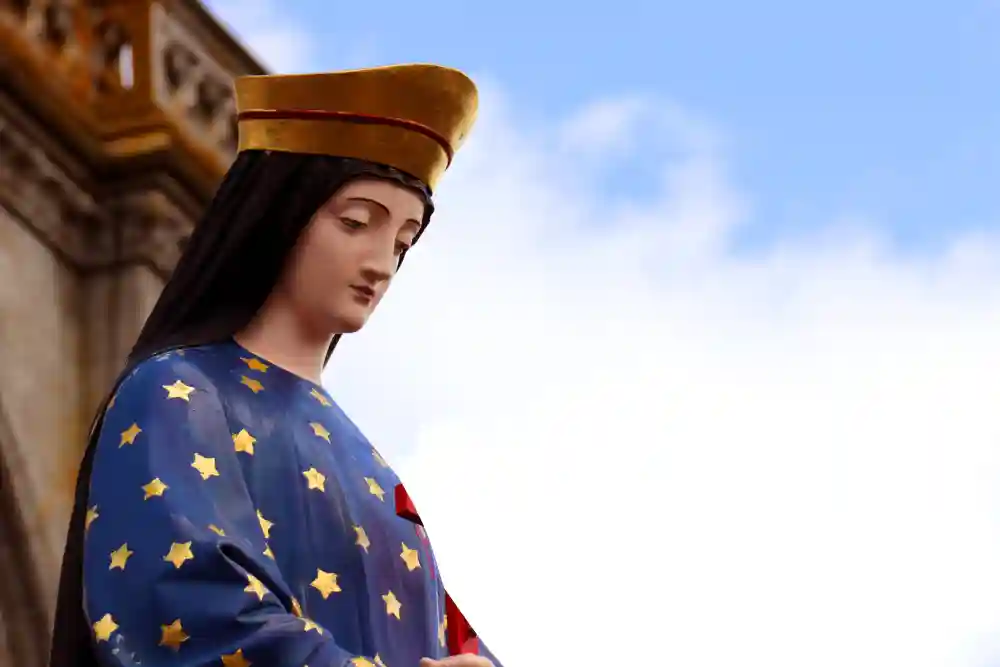
That evening the brothers Eugène and Joseph Barbedette were outside near the family barn when Eugène noticed what looked like a beautiful lady suspended in the sky above the neighboring house.[1] He called Joseph, who said he saw the same figure. The sanctuary account describes her as dressed in deep blue with golden stars, with a black veil and a gentle smile.[1] When adults came out into the lane, they generally said they could not see the Lady herself, though the children kept pointing to the same place overhead.[1]
Two other girls, Françoise Richer and Jeanne-Marie Lebossé, soon joined the boys and described the same figure.[1] As more villagers gathered, the evening turned into a long public scene of prayer: people sang hymns, recited the rosary, and watched the children report each new change in the apparition.[1] The sanctuary narrative says the message then appeared gradually in gold letters, line by line, until the whole sentence could be read by those gathered below.[1]
Recorded details
Section titled “Recorded details”The official sanctuary history ties the apparition closely to:
- fear of Prussian advance[1]
- communal prayer in a rural village[1]
- a message focused on prayer, hope, and divine mercy[1]
The sanctuary’s own history also links the event to the village’s later memory of protection and peace when the feared advance did not unfold as expected.[1]
The official sanctuary history is unusual in preserving a written message that appeared line by line in the sky while the community prayed.[1]
Formal recognition and aftermath
Section titled “Formal recognition and aftermath”The official sanctuary history records that Bishop Wicart of Laval officially recognized the apparition on February 2, 1872.[1]
The same sanctuary chronology highlights the speed with which the site developed afterward:
- the Oblates of Mary Immaculate were entrusted with the sanctuary project in May 1872[1]
- the sanctuary was consecrated in 1900[1]
- Pius X raised it to the rank of basilica in 1905[1]
- the image of the Virgin was formally crowned in 1934[1]
The event, the decree, and the sanctuary development are presented in the official history as a tight historical sequence.
The sanctuary today
Section titled “The sanctuary today”The current Pontmain agenda page shows that the site is still organized as a working place of pilgrimage rather than as a memorial only. The sanctuary publicly schedules:
- daily Masses and regular confession hours[2]
- weekday and Sunday rosaries, vespers, and Eucharistic adoration[2]
- annual January novena and the January 17 anniversary of the apparition[2]
Those public schedules show that Pontmain remains an active pilgrimage site, while the dedicated apparition narrative page keeps the detailed sequence of the evening in public circulation.[3]
References
Section titled “References”- Sanctuaire de Pontmain. “L’histoire.” Official sanctuary history giving the date of the apparition, the wartime setting, the written message, and the 1872 recognition by Bishop Wicart. Available at: https://sanctuaire-pontmain.fr/lhistoire/
- Sanctuaire de Pontmain. “Horaires & agenda.” Official sanctuary schedule page listing current Masses, confessions, adoration, and the annual January 17 anniversary observance of the apparition. Available at: https://sanctuaire-pontmain.fr/horaires-agenda/
- Sanctuaire de Pontmain. “Le recit de l’apparition.” Official sanctuary account preserving the visual phases of the apparition and the line-by-line appearance of the message. Available at: https://sanctuaire-pontmain.fr/le-recit-de-lapparition/