Start with the modern Lourdes benchmark
Open the file. Bernadette Moriau is the cleanest first stop if you want a recent recognition with named dates, Lourdes review bodies, and an identifiable bishop’s declaration.
The basic story
Catholic authorities have formally recognized dozens of medically inexplicable cures. At Lourdes alone, the Medical Bureau has reviewed over 7,000 reported recoveries and officially recognized 70. This page explains the process and documents key cases.
Recognized Lourdes cures
70
The sanctuary’s public record now lists seventy officially recognized miraculous healings at Lourdes.
Reported recoveries examined
7,000+
The Lourdes Medical Bureau’s review pipeline screens thousands of reported recoveries but forwards only a small number toward recognition.
Medical review structure
Bureau + CMIL + diocese
The public Lourdes file separates the medical question from the later Catholic judgment by the bishop.
Section focus
Lourdes and related canonization cures
This section combines the Lourdes system with other medically investigated healing files connected to sainthood causes.
Official sanctuary page summarizing the recognized healings and the current public Lourdes record.
lourdes-france.org Official process page Lourdes: Recognition of a MiracleOfficial explanation of how a reported recovery moves from medical review to diocesan recognition.
lourdes-france.org Peer-reviewed overview The Lourdes Medical Cures RevisitedPeer-reviewed historical-medical study frequently cited in discussion of Lourdes and its cure files.
pmc.ncbi.nlm.nih.govOf all the miracle categories recognized in Catholic practice, healing stories are the most methodically and scientifically investigated. In brief: a panel of independent physicians, including non-Catholics and non-believers, must unanimously conclude that there is no scientific explanation for a recovery before the case advances.[5]
The doctors are not asked whether a miracle occurred. They are asked only whether medicine can explain what happened. If it can — the case stops. Only the cases medicine cannot explain proceed.[5]
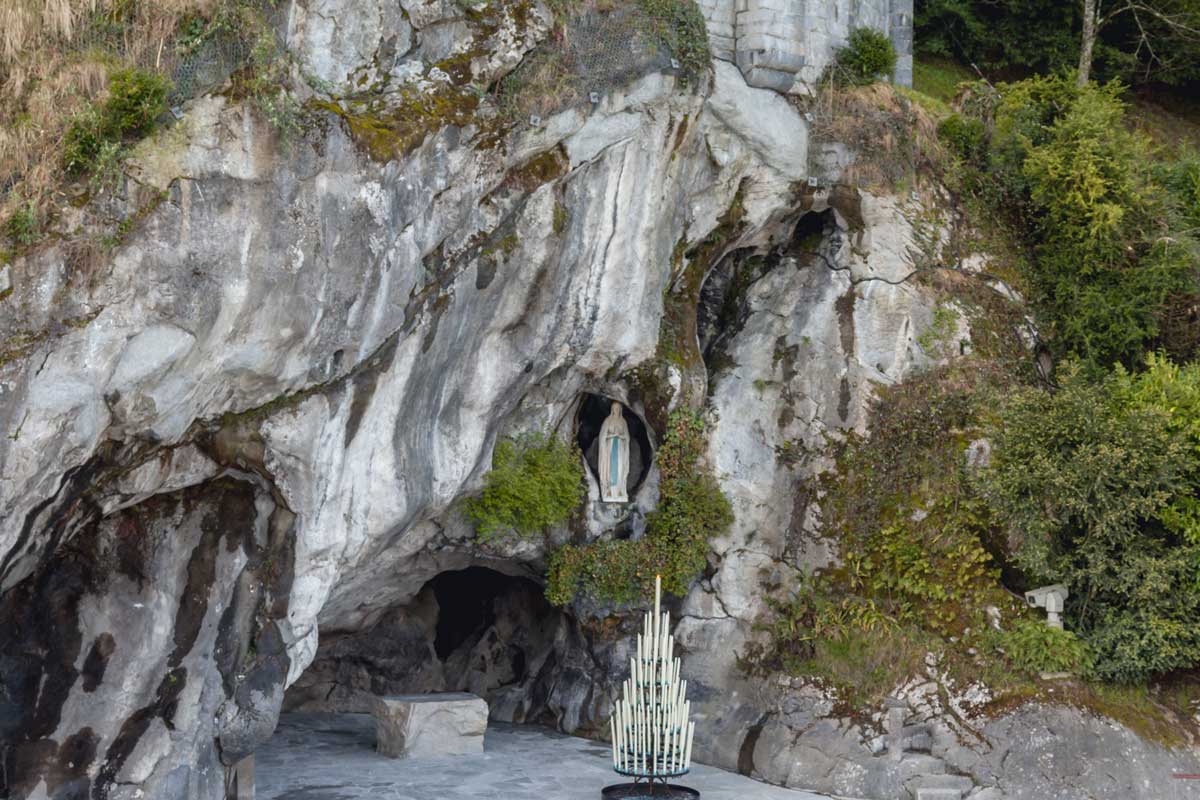
In 1858, a 14-year-old girl named Bernadette Soubirous reported 18 apparitions of the Virgin Mary in a grotto near Lourdes in southern France.[3] The Lady directed her to dig in the ground at a specific spot — and a spring emerged that has flowed continuously since, now producing approximately 32,000 liters of water per day.[3]
Since 1858, the spring at Lourdes has been visited by an estimated 200 million pilgrims.[2] Tens of thousands have reported recoveries. The Medical Bureau of Lourdes — an independent body of physicians established in 1883 — has investigated over 7,000 reported cures using strict medical criteria.[2]
As of 2024, 70 have been officially declared miraculous by Catholic authorities.[2]
The gap between 7,000 reported recoveries and 70 official recognitions shows how restrictive the review pipeline is.
## Best first pages in this sectionThese are the clearest entry points depending on whether you want a Lourdes benchmark, a pathology-heavy case, a cancer-remission case, or a neurological cure with long follow-up.
Start with the modern Lourdes benchmark
Start with the striking bone-regeneration file
Start with a Lourdes cancer-remission file
Start with a neurological follow-up file
The Medical Bureau is the part of Lourdes that handles the medical question first.[2] Doctors of any faith, or no faith, may participate. Its job is not to preach or to lead worship. Its job is to ask whether a reported cure can be explained medically. The Bureau maintains:
Cases are evaluated in stages:[2]
So the process works in two layers. First comes the doctor’s question: is there a good medical explanation? Then comes the bishop’s question: should this cure be officially called miraculous?
Diagnosis: Advanced sarcoma of the left hip — the pelvis had been almost entirely destroyed by the cancer. His left leg was held in place only by soft tissue. He was placed in a full-body plaster cast.[2]
What happened: On May 1, 1962, Micheli immersed himself in the baths at Lourdes. He immediately felt something extraordinary. When his cast was removed weeks later, his doctors found the cancer was gone — and more than that, the destroyed pelvis had regenerated. New bone had formed where the cancer had consumed it.[2]
Medical review: Micheli’s case was investigated by the International Medical Committee for 12 years before being declared scientifically inexplicable in 1976. The committee specifically noted that bone does not regenerate from cancer destruction in any known medical context. Sixteen years of follow-up confirmed complete recovery.[2]
Official declaration: Recognized as miraculous by the Bishop of Verona in 1976.[2]
Diagnosis: Ewing’s sarcoma of the right knee — a rare and almost universally fatal bone cancer, especially in children. Delizia was 12 years old. Her doctors had told her parents there was no treatment and she would not survive.[2]
What happened: Her family brought her to Lourdes on December 1, 1976. She returned home no different. Over the following months, the tumor began to disappear. Within a year, it was gone completely.[2]
Medical review: The case was investigated over several years. The Medical Bureau confirmed complete disappearance of the tumor with no medical treatment administered. No recurrence occurred over decades of follow-up.[2]
Official declaration: Recognized as miraculous by the Bishop of Catania in 1989.[2]
Diagnosis: Multiple sclerosis (MS) in an advanced stage. Bely was bedridden, partially paralyzed, required full-time nursing care, and had been told his condition was permanent.[2]
What happened: On October 9, 1987, during a visit to Lourdes, Bely felt a profound warmth spread through his body. He stood up from his wheelchair. When he returned home, his neurologist confirmed that his multiple sclerosis had disappeared.[2]
Medical review: MS is an incurable, progressive, degenerative neurological disease. It does not spontaneously resolve. The Medical Bureau investigated the case for 12 years, including full neurological examination. The International Medical Committee declared the cure “complete, lasting, and scientifically inexplicable.”[2]
Official declaration: Recognized as miraculous by the Bishop of Angoulême in 1999. Bely was not Catholic at the time of his cure; later accounts say the experience led him to become Catholic.[2]
The characteristics shared by the officially recognized Lourdes cures:[1][2]
| Feature | What it rules out |
|---|---|
| Organic disease confirmed before cure | Misdiagnosis |
| Instantaneous or very rapid recovery | Gradual natural remission |
| Complete recovery (not partial) | Partial improvement consistent with treatment |
| No medical treatment administered at time of cure | Treatment effect |
| Years of follow-up with no recurrence | Temporary remission |
| Unanimous agreement among secular physicians | Selection bias |
Bernadette’s own life is worth noting in this context. She:[3]
The Diocese of Tarbes recognized her apparitions in 1862.[3] Bernadette was canonized in 1933.[3]
Her body — like several other saints — was found incorrupt when exhumed, decades after her death. It is now displayed at the Chapel of Saint Gildard in Nevers, France.[3]
The strongest peer-reviewed paper is:
François, B., Sternberg, E.M. and Fee, E. (2012). “The Lourdes Medical Cures Revisited.” Journal of the History of Medicine and Allied Sciences, 69(1), 135–162. PMC: PMC3854941
Key findings:
Also note:
No peer-reviewed paper is dedicated exclusively to refuting Lourdes cures. The critical literature exists primarily in the François et al. paper (which challenges the miraculous framing while acknowledging unexplained phenomena) and in the broader MS misdiagnosis literature.
The 70 recognized Lourdes cures do not stand alone. Catholic authorities have also formally recognized healing miracles in beatification and canonization causes, each requiring at least one, and usually two, verified cures attributed to the candidate’s intercession.[5]
As of 2024, the Vatican’s Congregation for the Causes of Saints has recognized thousands of miracles across all canonization and beatification causes since systematic records began.[1] Each was subjected to the same process: independent medical panels, theological review, cardinals, bishops, and papal approval.
The volume of cases — across different centuries, cultures, diagnoses, and investigators — constitutes a large transnational record of medically investigated healing stories in Catholic history.[1]