Our Lady of Good Success (Quito, Ecuador)
The story in one line
Mother Mariana in colonial Quito received Marian apparitions and prophetic warnings under the title of Our Lady of Good Success.
The basic story
A long-venerated Marian apparition tradition centered on the Conceptionist convent in Quito, Ecuador and the visions attributed to Mother Mariana de Jesus Torres from 1594 onward. The devotion is tied to a revered statue, centuries of public veneration, and the 1991 canonical coronation and sanctuary decree.
Reported message
Historical setting
The Good Success tradition is set in colonial Quito, where convent life, Spanish Catholic rule, and later devotional memory shaped the record attached to Mother Mariana.
Tradition window
1594–1634
The apparition tradition centers on Mother Mariana de Jesus Torres and the convent chronology preserved in later devotional histories.
Documented decree
January 7, 1991
The Archdiocese of Quito decree orders the canonical coronation of the image and names the convent church an archdiocesan Marian sanctuary.
Public devotion noted
About 380 years
The 1991 decree explicitly says the image had received enduring public devotion in Quito and Ecuador for roughly 380 years.
Shrine focus
Convent church in Quito
The devotion is tied to the Royal Convent of the Immaculate Conception and the sacred image venerated there.
Primary-source file
Section titled “Primary-source file”English translation of the Quito decree ordering the canonical coronation and naming the convent church an archdiocesan Marian sanctuary.
cdn.shopify.com Devotional history Home of the Mother: Our Lady of Good SuccessSummary of Mother Mariana, the requested image, and the long-venerated Quito tradition.
homeofthemother.org Tradition summary Miracle Hunter: Quito / Our Lady of Good SuccessReference summary of the convent chronology and later devotional reception of the Quito case.
miraclehunter.com Message summary Miracle Hunter: Messages of QuitoCollected summary of the warnings most often repeated in later presentations of the Quito messages.
miraclehunter.comThe story
Section titled “The story”According to the Quito tradition, the Conceptionist nun Mother Mariana de Jesus Torres reported apparitions of the Virgin Mary in the Royal Convent of the Immaculate Conception beginning in 1594.[2] [4] The apparitions are linked to the title Our Lady of Good Success, to a requested statue for the convent, and to messages later readers understood as warnings about crisis in Catholic religious life and in society.
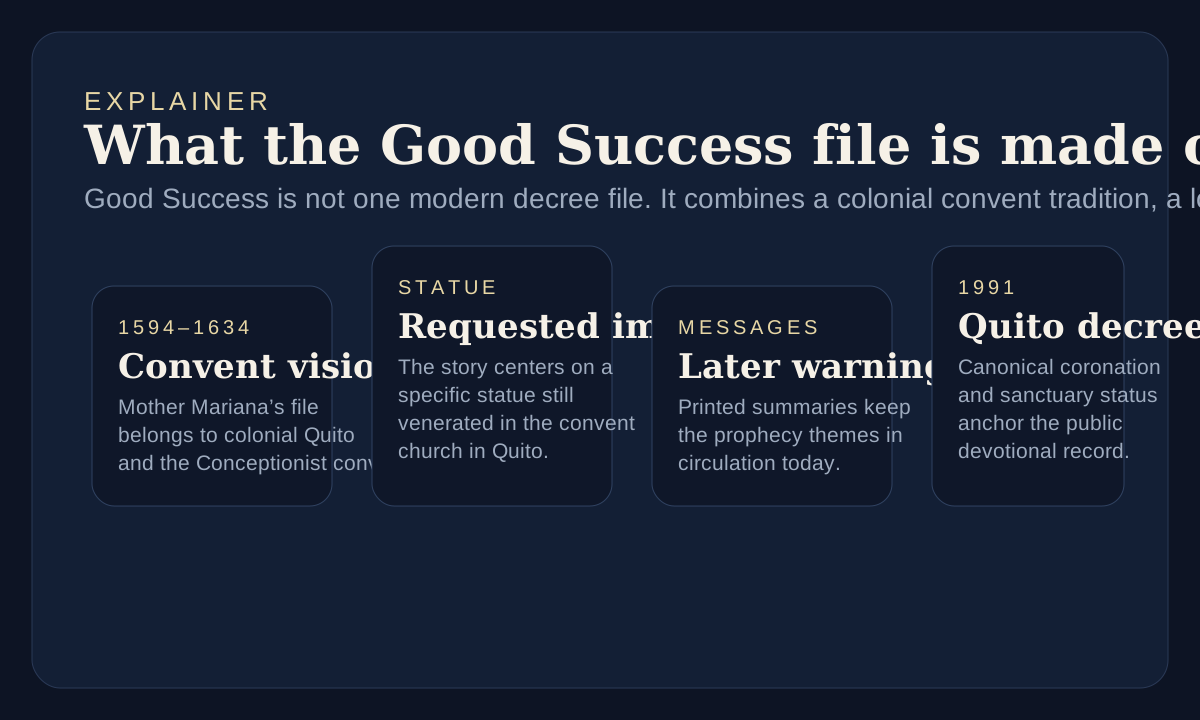
This page is easier to understand if it is read as an old convent tradition rather than a modern apparition file. There is no single modern investigation packet that neatly tells the whole story from start to finish. Instead, the public record is built from several layers that were joined together over time:
- a cloistered religious house in colonial Quito[2]
- a public devotion that lasted for centuries[1]
- a specific sacred image still venerated in the convent church[1]
Good Success tradition
- Origin Colonial convent story The tradition begins inside the Conceptionist convent in Quito with Mother Mariana.
- Object A specific statue The devotion centers on a named image still kept and honored in the convent church.
- Messages Later prophecy summaries Most readers encounter the case through later summaries of warnings attributed to the Virgin.
- Recognition 1991 decree The modern public anchor is the Quito decree recognizing the shrine and devotion.
What is clearly documented
Section titled “What is clearly documented”The clearest part of the record is not the full apparition story itself, but the later public life of the shrine.
In a decree dated January 7, 1991, Archbishop Antonio J. Gonzalez Z. ordered the canonical coronation of the sacred statue of Mary of Good Success and also declared the church of the Convent of the Immaculate Conception in Quito an Archdiocesan Marian Sanctuary.[1]
The decree explicitly states:
- the devotion had been publicly and continuously rendered in Quito and Ecuador for roughly 380 years[1]
- the sacred statue had long been the object of established public veneration[1]
- the sanctuary declaration was made because of enduring public devotion[1]
In plain terms, the 1991 decree shows that the image and devotion were not fringe or private. By that point they had already been publicly honored in Quito for centuries, and the archdiocese formally recognized that continuing devotion.[1]
Publicly documented chronology
Section titled “Publicly documented chronology”The cited source set preserves both a convent tradition and a later archdiocesan decree.[1] [2] [4]
| Date / period | Public record |
|---|---|
| February 2, 1594 | The devotional histories identify this as the first reported apparition to Mother Mariana.[2] [4] |
| 1594 onward | The same histories tie the devotion to the Royal Convent of the Immaculate Conception in Quito and to the title Our Lady of Good Success.[2] [4] |
| Early convent tradition | Later devotional accounts say the Virgin requested a statue under the title Our Lady of Good Success and connect that image with the convent church.[2] [4] |
| January 7, 1991 | The Archdiocese of Quito orders the canonical coronation of the statue and declares the convent church an archdiocesan Marian sanctuary.[1] |
The recurring elements in the later tradition are:
- a first apparition dated to February 2, 1594[4]
- a later request that a statue be made under the title Our Lady of Good Success[2] [4]
- a tradition that the statue’s completion was treated as miraculous and later received episcopal consecration[2] [4]
- messages interpreted as warning of future corruption of customs, crisis in vocations, attacks on marriage and the sacraments, and a great trial in Catholic life[2] [4]
Reported future warnings
Section titled “Reported future warnings”In the message summaries most often repeated by devotees, Mary is not presented as speaking only about the convent in seventeenth-century Quito. She is presented as warning about a much later crisis in Catholic life and in society, especially from the late 19th century into the 20th century.[2] [4] [5]
The reported warnings most often repeated in those summaries include:
- a coming “total corruption of customs”[2] [4] [5]
- a deliberate targeting of children, with innocence becoming hard to find[2] [4] [5]
- difficulty receiving Baptism, Confirmation, Penance, and Extreme Unction[2] [4] [5]
- attacks on Matrimony and laws making sinful unions easier[2] [4] [5]
- profanation of the Eucharist and neglect of the sacraments[2] [4]
- a shortage of priestly and religious vocations, connected in the summaries to secular education and loss of faith[2] [4] [5]
- the line that “modesty in women” would nearly disappear[2] [4]
- priests losing fervor and Catholic leadership weakening[2] [4] [5]
That is the clearest form of the prophecy in the source set used for this page. Later devotional writers often apply those broad warnings to much more specific modern issues. The older summaries themselves are usually more general: they speak about moral confusion, weakened faith, attacks on marriage, neglect of the sacraments, and a crisis in religious life. In other words, the public summaries preserve a broad warning, and later readers often connect that warning to the problems of their own time.
Ecclesial status
Section titled “Ecclesial status”The canonical coronation of the statue and the sanctuary decree are documented ecclesial acts.[1]
Catholic Answers notes that a canonical coronation means the Church is honoring a long-venerated image and the devotion surrounding it. It does not by itself mean that every later written detail about the apparitions has been separately proved in the way a modern investigation might try to prove them.[3] The same answer also notes that the devotion is locally accepted in Ecuador while acknowledging that the written tradition is layered and developed over time.[3]
The public record therefore shows:
- the devotion and shrine are clearly established in Quito[1]
- the apparition tradition is longstanding and widely treated by devotees as authentic[2] [4]
- the textual history of the full apparition corpus is more layered than in a modern one-decree apparition file[3]
Quito in the record
Section titled “Quito in the record”The cited sources document:
- an early Marian apparition tradition in the Americas[4]
- a specific convent, statue, feast, and urban sanctuary that still exist[1]
- devotional circulation beyond Ecuador through printed summaries and later retellings of the prophecies[2]
References
Section titled “References”- Archdiocese of Quito decree, English translation hosted by the Apostolate of Our Lady of Good Success. “Canonical Coronation of the Sacred Statue” and declaration of the Convent church as an Archdiocesan Marian Sanctuary, dated January 7, 1991. Available at: https://cdn.shopify.com/s/files/1/1164/7336/files/CanonicalCoronationandDeclarationofMarianSanctuary.pdf
- Home of the Mother. “Our Lady of Good Success.” Summary article on Mother Mariana de Jesus Torres, the requested statue, the prophetic message tradition, and the support given by bishops of Quito. Available at: https://www.homeofthemother.org/en/magazine/selected-articles/spiritual-life/13722-good-success
- Catholic Answers. “Is Our Lady of Good Success Approved?” Useful caution on the distinction between devotion to the statue and a modern-style apparition approval, while noting local acceptance and documentary debate. Available at: https://www.catholic.com/qa/is-our-lady-of-good-success-approved
- Miracle Hunter. “Quito, Ecuador (1594) — Our Lady of Good Success” and “The Messages of Quito.” Secondary summary of the timeline, tradition, and longstanding classification as a traditionally approved apparition case. Available at: https://www.miraclehunter.com/marian_apparitions/approved_apparitions/quito/ and https://www.miraclehunter.com/marian_apparitions/messages/quito_messages.html
- Apostolate of Our Lady of Good Success. “The Prophectic Words of Our Lady of Good Success.” Devotional summary of the apparition cycle and its later-century warnings, including corruption of customs, attacks on marriage, loss of innocence, and a crisis in vocations and clergy. Available at: https://www.ourladyofgoodsuccess.com/blogs/news/the-prophectic-words-of-our-lady-of-good-success