
The Shroud of Turin
The story in one line
the Shroud of Turin is Jesus’s burial cloth and that its body image has not been fully explained by ordinary image-making methods.
The basic story
A 14-foot linen cloth bearing the image of a crucified man. Thirty-three scientists spent five days running every available test on it in 1978. They could not explain how the image was formed. The blood is real. The wounds are consistent with Roman crucifixion. The image mechanism remains unknown.
Historical setting
The Shroud enters documented European history in the late Middle Ages, though the cloth is claimed to be older; since then it has been treated both as a burial relic of Jesus and as a forensic puzzle.
Artifact type
Linen burial cloth
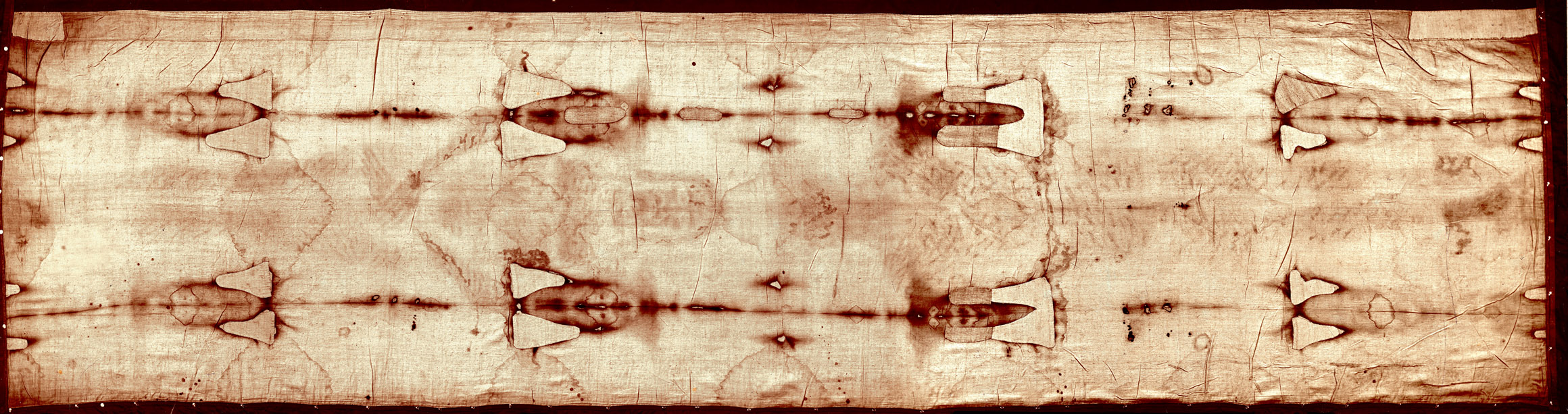
The Shroud is a long linen cloth bearing front-and-back images of a crucified man and multiple bloodstains.
Major lab study
STURP in 1978
Thirty-three STURP researchers conducted direct testing in Turin in October 1978.
Main dispute
Image mechanism and dating
The record includes both the STURP findings on the image and the later dispute over the 1988 radiocarbon date.
Current custody
Cathedral of Turin / Holy See
The cloth is kept in Turin and has been in the custody of the Holy See since Umberto II’s 1983 bequest.
Primary-source file
Section titled “Primary-source file”Collective summary statement of the Shroud of Turin Research Project after the 1978 direct testing.
shroud.com Peer-reviewed chemistry Rogers (2005) on the radiocarbon samplePeer-reviewed Thermochimica Acta paper challenging the representativeness of the 1988 radiocarbon sample.
doi.org Radiocarbon paper Damon et al. (1989) Radiocarbon dating of the ShroudNature publication of the 1988 radiocarbon dating results.
nature.com Inter-lab review Walsh and Schwalbe (2020)Journal of Archaeological Science: Reports review of the 1988 dating history and inter-laboratory context.
doi.orgPublicly documented chronology
Section titled “Publicly documented chronology”| Year | Development |
|---|---|
| 1353 | The cloth first appears in a documented medieval setting.[5] |
| 1898 | Secondo Pia’s photographs revealed the negative-image property in the first modern photographs.[8] |
| 1978 | STURP conducted direct testing on the cloth in Turin.[1] |
| 1988 | Oxford, Zurich, and Tucson published the radiocarbon date range of 1260-1390 AD.[5] |
| 2005 | Raymond Rogers published his peer-reviewed challenge to the representativeness of the radiocarbon sample.[6] |
| 2020 | Walsh and Schwalbe revisited the 1988 dating as an inter-laboratory comparison problem.[10] |
What it is
Section titled “What it is”
The Shroud of Turin is a 4.4m × 1.1m (14.3 × 3.7 ft) linen cloth bearing two full-length images of a man — front and back — and hundreds of bloodstains consistent with crucifixion wounds. [1]
What readers are usually being asked to focus on is not just the cloth’s existence but the image on it. The story attached to the Shroud is that the cloth bears an unexplained body image of a crucified man together with real bloodstains, and that modern testing has not shown how that image was produced.[1] [2] [3]
So the phenomenon at issue is not that a burial cloth survived for centuries. It is that this particular cloth carries a front-and-back body image that behaves unlike ordinary paint or print, looks like a photographic negative, and preserves wound patterns that match crucifixion trauma.[1] [2] [4] [7]
It is kept in the Cathedral of Saint John the Baptist in Turin, Italy, and is one of the most scientifically investigated religious artifacts in the world.
The blood is real. [3] The wounds are anatomically accurate for Roman crucifixion. [7] The image was not painted, printed, or produced by any known chemical or biological process. [2] After over a century of scientific investigation, the mechanism of image formation remains unknown. [1]
The image — what makes it anomalous
Section titled “The image — what makes it anomalous”The STURP team — 33 American scientists from national laboratories, universities, and research institutions, who conducted 120 hours of continuous testing in October 1978 — published their collective finding: [1]
“The image is an ongoing mystery and… the problem remains unsolved.”
Specific findings that rule out known production methods:
- No paint or pigment: No paint, dye, powder, or organic colorant was found in the image area. The coloring is not a substance on the cloth — it is an alteration of the cloth fibers themselves. [2]
- Surface phenomenon: The image is confined to the outermost fibrils of the linen threads — a layer a few micrometers thick. No known painting technique produces color at this depth. [2]
- No brush strokes, no directionality: Under microscopic examination, there is no evidence of a brush, stylus, or other instrument having been used. [2]
- No saturation between fibers: In any painting technique, the colorant saturates the spaces between threads. On the Shroud, the image is only on the raised portions of individual fibers — not between them. This is not achievable by any known artistic method. [2]
In 1977, researchers Jackson, Jumper, and Ercoline analyzed the Shroud using a VP-8 Image Analyzer — a device used by NASA to convert brightness data in photographs into 3D topographical maps. [4]
When applied to a normal photograph, the VP-8 produces a distorted image — because a photograph’s light and shadow do not correspond directly to spatial distance.
When applied to the Shroud, the VP-8 produced a perfect, undistorted three-dimensional relief of a human face and body. [4]
The image encodes accurate spatial information about the distance between the cloth and the body it covered. No painting technique produces this — a painter encodes visual appearance, not spatial distance data. The Shroud’s image behaves as if it were produced by direct physical proximity to a three-dimensional object. [4]
This finding was published by Jackson et al. at the 1977 United States Conference of Research on the Shroud of Turin. [4]
The Shroud image is a photographic negative: the lightest areas of the cloth (where a photograph would show shadows) correspond to the areas closest to the body; the darkest areas correspond to points of greatest distance. [8]
This was not discovered until 1898, when amateur photographer Secondo Pia made the first photograph of the Shroud and found that the negative plate showed a clearer, more natural image than the cloth itself — as if the cloth were already a photographic negative. [8]
No medieval artist would have had reason to paint a negative image, nor the conceptual framework to do so. Photographic negatives were not understood until the 19th century.
The blood
Section titled “The blood”The blood on the Shroud has been subjected to extensive chemical analysis.
Heller & Adler (1981), published in the Canadian Society of Forensic Science Journal, confirmed: [3]
- The blood is real human blood — not paint, not red ochre, not any other substance [3]
- It contains hemoglobin, serum albumin, and other blood components [3]
- The blood soaked into the cloth before the image was formed — meaning the image was produced around existing bloodstains, not painted over them [3]
- Blood type: AB [3]
The wounds
Section titled “The wounds”The Shroud bears wounds consistent with the Roman crucifixion method documented in historical sources and confirmed by modern forensic analysis. [7]
| Wound | Location on Shroud | Forensic note |
|---|---|---|
| Scourging marks | Across back, shoulders, legs | Consistent with Roman flagrum (whip with metal tips); ~100 individual wounds |
| Crown of thorns | Scalp and forehead | Multiple puncture wounds in circular pattern |
| Carrying a heavy beam | Shoulder abrasion | Right shoulder shows skin abrasion consistent with carrying a rough wooden beam |
| Nail wound | Wrist (not palm) | Wound is in the wrist, not the palm — consistent with forensic analysis of crucifixion load-bearing requirements |
| Nail wound | Feet | Single wound consistent with both feet nailed through a single point |
| Spear wound | Right side | Large wound, showing separated blood and serum — consistent with post-mortem cardiac puncture |
Dr. Frederick Zugibe, Chief Medical Examiner of Rockland County and forensic expert on crucifixion, analyzed the wound patterns and concluded they are consistent with the wounds described in the Gospel accounts and with the archaeological and historical record of Roman crucifixion. [7]
The 1988 radiocarbon dating — and the challenge to it
Section titled “The 1988 radiocarbon dating — and the challenge to it”In 1988, laboratories in Oxford, Zurich, and Tucson radiocarbon dated a sample from the Shroud and produced a date range of 1260–1390 AD, consistent with medieval origin. [5]
This was widely reported as a definitive refutation of the Shroud’s authenticity.
The situation is more complicated.
Raymond Rogers’ challenge (2005)
Section titled “Raymond Rogers’ challenge (2005)”Raymond Rogers was a physical chemist at Los Alamos National Laboratory and a member of the original 1978 STURP team. He was initially skeptical of challenges to the 1988 dating. In 2005, he published a paper in Thermochimica Acta — a peer-reviewed journal — that changed his own position. [6]
Rogers obtained threads from the same corner of the Shroud that had been sampled in 1988. His chemical analysis found: [6]
- The sampled threads contained vanillin — a decomposition product of lignin in plant fiber [6]
- The main body of the Shroud contains no vanillin [6]
- Vanillin degrades at a known rate with age. Its presence in the sample and absence in the main cloth indicates the sampled threads are significantly younger than the main cloth. [6]
- Rogers concluded the 1988 sample was taken from a medieval reweave or patch — not from the original linen. [6]
From Rogers’ published conclusion: [6]
“The sample used for the radiocarbon dating was taken from a rewoven area of the Shroud. The consequence of this is that the radiocarbon date was not valid for the determining the age of the whole cloth.”
Rogers' conclusion paragraph — a Los Alamos chemist who began skeptical of challenges to the 1988 dating, changed his own position after running the chemistry himself. DOI: 10.1016/j.tca.2004.09.029
Available via doi.org/10.1016/j.tca.2004.09.029 (ScienceDirect/Elsevier). Screenshot the abstract and the conclusion section.
The chemical data: vanillin present in the 1988 sampled threads, absent in the main Shroud linen — the empirical basis for Rogers' conclusion that the samples were from different cloth
Same paper — screenshot Table 1
Rogers estimated the original linen of the Shroud to be between 1,300 and 3,000 years old. [6]
Rogers died in 2005, shortly after publication. He was not a Catholic.
The STURP investigation — what 33 scientists found
Section titled “The STURP investigation — what 33 scientists found”The Shroud of Turin Research Project (STURP) was organized in 1977 by American scientists who obtained Vatican permission for a direct investigation. [1] In October 1978, 33 scientists from national laboratories, universities, and research institutions brought approximately $6 million worth of equipment to Turin and conducted 120 hours of continuous testing. [1]
The team included researchers from: [1]
- Los Alamos National Laboratory
- Sandia National Laboratories
- NASA’s Jet Propulsion Laboratory
- Air Force Weapons Laboratory
- Stanford Research Institute
- Multiple universities
Their institutional summary statement, published 1981: [1]
“We can conclude for now that the Shroud image is that of a real human form of a scourged, crucified man. It is not the product of an artist. The blood stains are composed of hemoglobin and also give a positive test for serum albumin. The image is an ongoing mystery and, until further chemical studies are made, perhaps by this group of scientists, or perhaps by some scientists in the future, the problem remains unsolved.”
The official statement from 33 scientists after 120 hours of testing: 'The image is an ongoing mystery... the problem remains unsolved.' Note the institutional affiliations: Los Alamos, Sandia, NASA JPL, and others.
Freely available at shroud.com — search 'STURP 1981 summary statement.' Screenshot the conclusion paragraph and the full author/institution list.
Investigation access since 1978
Section titled “Investigation access since 1978”The only direct scientific access to the Shroud since the STURP 1978 examination was the 1988 radiocarbon dating, when a single strip was cut and distributed to three labs. According to sindonological accounts documented by Walsh & Schwalbe (2020), STURP submitted formal proposals for follow-up testing in the years following 1978 — all were declined by Church authorities. [10] No independent scientific group has been granted hands-on access since.
Publicly documented factors include:
- Ownership and control: The Shroud was transferred to the Holy See by King Umberto II of the House of Savoy, who died on March 18, 1983 and willed it to Pope John Paul II. [9] The Vatican, via the Archbishop of Turin, controls all access. The institution has interests as custodian of a major devotional object.
- The conservation argument: Church authorities have cited conservation concerns as a reason to limit sampling, particularly the argument that sampling is destructive and the Shroud must be preserved. According to researchers in the field, this argument has reportedly been applied even against proposed non-destructive methods. [10]
- Post-1988 political dynamics: The 1988 carbon dating produced a medieval date that intensified controversy around the cloth. Any further testing would reopen that controversy, whether it confirmed or challenged the 1988 result.
- All post-1988 research (Fanti’s mechanical tests, spectroscopic studies) used archive samples from the 1978 STURP examination or Raes thread fragments from 1973 — not new samples from the Shroud. [11]
The complete peer-reviewed record
Section titled “The complete peer-reviewed record”The following are the primary peer-reviewed publications on the Shroud, with full citations, findings, and bias disclosures. This is the scientific record — distinct from the non-peer-reviewed STURP Summary Statement.
1. McCrone, W.C. and Skirius, C. (1980). “Light Microscopical Study of Turin ‘Shroud’ I.” The Microscope, 28(3/4), 105–113. Also: McCrone (1980) Part II, same journal. McCrone (1981) Part III, The Microscope, 29(1), 19–38.
Finding: Using polarized light and electron microscopy on STURP sticky-tape samples, McCrone concluded the image was painted with red ochre (iron oxide/hematite) in a collagen tempera medium, and blood areas were enhanced with vermilion (mercuric sulfide). He concluded the Shroud was a medieval painted forgery.
Bias disclosure: Walter McCrone was a secular skeptic with no documented religious affiliation. His findings contradicted the STURP team consensus; he was marginalized and resigned in 1980. The American Chemical Society gave him its National Award in Analytical Chemistry in 2000.
Classification: Anti-authenticity.
2. Pellicori, S.F. (1980). “Spectral Properties of the Shroud of Turin.” Applied Optics, 19(12), 1913–1920. DOI: 10.1364/AO.19.001913.
Finding: Spectrophotometric analysis found body image consistent with cellulose degradation rather than added pigment. Blood stains consistent with hemoglobin.
Classification: Pro-authenticity/methodological.
3. Schwalbe, L.A. and Rogers, R.N. (1982). “Physics and Chemistry of the Shroud of Turin.” Analytica Chimica Acta, 135, 3–49. DOI: 10.1016/S0003-2670(01)85263-6.
Finding: Most comprehensive single summary of all STURP 1978 data. Concluded image formed by cellulose oxidation/dehydration, not paint; blood stains are real; image formation mechanism unknown.
Bias disclosure: Both were STURP members. Rogers had no documented religious affiliation.
Classification: Pro-authenticity/methodological.
4. Jackson, J.P., Jumper, E.J., and Ercoline, W.R. (1984). “Correlation of Image Intensity on the Turin Shroud with the 3-D Structure of a Human Body Shape.” Applied Optics, 23(14), 2244–2270. DOI: 10.1364/AO.23.002244.
Note: The commonly cited “1977” VP-8 finding was presented at a conference organized by the Holy Shroud Guild (a Catholic devotional organization) and published in conference proceedings — NOT a peer-reviewed journal. This 1984 Applied Optics paper is the actual peer-reviewed publication.
Bias disclosure: Jackson is Catholic and explicitly stated belief in the Shroud as Jesus’s burial cloth before and after the investigation.
Classification: Pro-authenticity.
5. Garlaschelli, L. (2010). “Life-Size Reproduction of the Shroud of Turin and Its Image.” Journal of Imaging Science and Technology, 54(4), 040301. DOI: 10.2352/J.ImagingSci.Technol.2010.54.4.040301.
Finding: Demonstrated that a full-size cloth with Shroud-like image properties — including superficial image confined to top fibers and 3D-encoded intensity — could be produced using medieval materials and techniques (linen over a real person, rubbed with acidic ochre, washed and aged). Argues the Shroud could be a medieval forgery.
Bias disclosure: Garlaschelli is a secular organic chemist at the University of Pavia with documented affiliation with CSICOP (Committee for Skeptical Inquiry). A documented ideological stance in the opposite direction from STURP.
Classification: Anti-authenticity.
6. Di Lazzaro, P., Murra, D., Nichelatti, E., Santoni, A. and Baldacchini, G. (2012). “Superficial and Shroud-Like Coloration of Linen by Short Laser Pulses in the Vacuum Ultraviolet.” Applied Optics, 51(36), 8567–8578. DOI: 10.1364/AO.51.008567.
Finding: VUV excimer laser pulses can produce superficial Shroud-like yellowing of linen fibrils. Energy required vastly exceeds any known natural or medieval artificial source. Authors suggest this supports uniqueness of image formation but stop short of supernatural claims.
Bias disclosure: Authors were researchers at ENEA (Italy’s national energy/technology agency) — secular state institution. No documented religious affiliations.
Classification: Methodological (supports uniqueness; cannot explain mechanism).
7. Bella, M., Garlaschelli, L. and Samperi, R. (2015). “There Is No Mass Spectrometry Evidence That the C14 Sample from the Shroud of Turin Comes from a ‘Medieval Invisible Mending’.” Thermochimica Acta, 617, 169–171. DOI: 10.1016/j.tca.2015.08.010.
Finding: Used pyrolysis mass spectrometry to directly test Rogers’s (2005) invisible reweave hypothesis. Found no chemical difference consistent with a medieval cotton reweave. The differences found were attributable to a common aliphatic contaminant. Concluded Rogers’s theory is scientifically unsupported.
Bias disclosure: Lead author Garlaschelli: CSICOP/CFI affiliation (documented secular skeptic).
Classification: Anti-authenticity (directly refutes Rogers 2005).
8. Barcaccia, G. et al. (2015). “Uncovering the Sources of DNA Found on the Turin Shroud.” Scientific Reports, 5, 14484. DOI: 10.1038/srep14484.
Finding: DNA from dust on the Shroud (collected 1977–1988) shows traces of plant taxa and human mtDNA from diverse geographic origins including Western Eurasian, Near Eastern, Arabian Peninsula, and Indian subcontinent lineages. Authors explicitly state this cannot resolve the authenticity question — consistent with both a widely-traveled medieval cloth and a 1st-century cloth.
Bias disclosure: University of Padua, Perugia, and Pavia. No stated religious affiliations.
Classification: Methodological/neutral.
9. Casabianca, T., Marinelli, E., Pernagallo, G. and Torrisi, B. (2019). “Radiocarbon Dating of the Turin Shroud: New Evidence from Raw Data.” Archaeometry, 61(5), 1223–1231. DOI: 10.1111/arcm.12467.
Finding: After obtaining raw 1988 data through legal action against Oxford, found statistically significant heterogeneity between and within laboratories and a spatial gradient in ages — inconsistent with a homogeneous sample, suggesting contamination unevenly removed by pretreatment. Argues 1988 date is unreliable.
Bias disclosure: Casabianca is a French Catholic lawyer with documented pro-authenticity publications in Catholic journals. Marinelli is a well-known Italian sindonologist with documented Catholic beliefs and long history of pro-authenticity advocacy. Published in legitimate Archaeometry journal but authors have significant bias concerns.
Classification: Pro-authenticity (challenges C-14 result).
10. Walsh, B. and Schwalbe, L. (2020). “An Instructive Inter-Laboratory Comparison: The 1988 Radiocarbon Dating of the Shroud of Turin.” Journal of Archaeological Science: Reports, 29, 102015. DOI: 10.1016/j.jasrep.2019.102015.
Finding: Confirmed inter-laboratory heterogeneity and spatial gradient in the 1988 raw data. Argues the result “does not match current accuracy requirements” and the sampling location was problematic. Does not conclude the cloth is first-century; argues the 1988 result should not be treated as definitive.
Bias disclosure: No documented religious affiliation for either author.
Classification: Methodological (critical of 1988 C-14 reliability, without asserting authenticity).
References
Section titled “References”- STURP (Shroud of Turin Research Project) Summary Statement (1981). Collective conclusion of 33 scientists after 120 hours of direct testing in October 1978. Available at: https://www.shroud.com/78conclu.htm
- Jumper, E.J., Adler, A.D., Jackson, J.P., Pellicori, S.F., Heller, J.H., & Druzik, J.R. (1984). “A comprehensive examination of the various stains and images on the Shroud of Turin.” ACS Advances in Chemistry Series, 205, pp. 447–476.
- Heller, J.H. & Adler, A.D. (1981). “A chemical investigation of the Shroud of Turin.” Canadian Society of Forensic Science Journal, 14(3), pp. 81–103. (Available via ResearchGate.)
- Jackson, J.P., Jumper, E.J., & Ercoline, W.R. (1977). “Three-dimensional characteristic of the Shroud image.” Proceedings, 1977 US Conference of Research on the Shroud of Turin.
- Damon, P.E., Donahue, D.J., Gore, B.H., et al. (1989). “Radiocarbon dating of the Shroud of Turin.” Nature, 337, pp. 611–615.
- Rogers, R.N. (2005). “Studies on the radiocarbon sample from the Shroud of Turin.” Thermochimica Acta, 425(1–2), pp. 189–194. DOI: 10.1016/j.tca.2004.09.029
- Zugibe, F.T. (2005). The Crucifixion of Jesus: A Forensic Inquiry. M. Evans & Co.
- Pia, S. (1898). Photographs of the Shroud — first documentation of the negative image property. Historical record held by the Diocese of Turin.
- Umberto II, King of Italy (1983). Last Will and Testament — bequest of the Shroud of Turin to the Holy See. Umberto II died March 18, 1983; the Shroud was transferred to Pope John Paul II. Documented in the Vatican’s official announcement and reported by international press at the time. See also: Petrosillo, O. & Marinelli, E. (1996). The Enigma of the Shroud. Publishers Enterprises Group. Historical record; the bequest is not disputed.
- Walsh, B. and Schwalbe, L. (2020). “An Instructive Inter-Laboratory Comparison: The 1988 Radiocarbon Dating of the Shroud of Turin.” Journal of Archaeological Science: Reports, 29, 102015. DOI: 10.1016/j.jasrep.2019.102015. — Discusses the history of access to the Shroud and institutional dynamics surrounding proposals for further investigation.
- Fanti, G., Malfi, P. & Cennini, F. (2013). “Non-destructive dating of ancient flax textile by means of vibrational spectroscopy.” Journal of Cultural Heritage, 14(6), 1085–1093. DOI: 10.1016/j.culher.2013.04.001. — Fanti’s mechanical and spectroscopic dating tests used archive samples (Raes threads from the 1973 sampling and STURP sticky-tape residues from 1978) rather than new samples from the Shroud itself.