
Our Lady of Knock (1879)
The story in one line
villagers at Knock saw a silent apparition of Mary, Joseph, and Saint John on the church wall in 1879.
The basic story
On August 21, 1879, fifteen witnesses in Knock, County Mayo, Ireland watched a silent apparition of the Virgin Mary, St. Joseph, and St. John the Evangelist on the south gable of their parish church for approximately two hours — while the ground beneath it stayed dry in heavy rain.
Reported message
Historical setting
Knock is set in post-famine Ireland in 1879, where a poor village gathered around a silent church-wall vision during years of hardship and emigration.
Event date
August 21, 1879
The Knock Shrine history and the witness depositions place the reported apparition on the evening of August 21, 1879.
Witness depositions
15 sworn witnesses
The 1879 commission examined fifteen local witnesses whose depositions remain the core historical record.
Inquiry record
1879 and 1936 commissions
Knock Shrine preserves both the first inquiry and the later 1936 re-examination of surviving witnesses.
Current shrine status
International Sanctuary since 2021
Papal visits in 1979 and 2018 were followed by Pope Francis elevating Knock in 2021.
Primary-source file
Section titled “Primary-source file”Official sanctuary chronology of the 1879 event, later commissions, papal visits, and shrine development.
knockshrine.ie Official inquiry summary Knock Shrine: The Commissions of EnquirySanctuary summary of the 1879 and 1936 inquiry records and the surviving witness statements.
knockshrine.ie Vatican archive John Paul II Homily at Knock Shrine (1979)The Vatican transcript of John Paul II’s centenary visit and his elevation of the shrine church to basilica status.
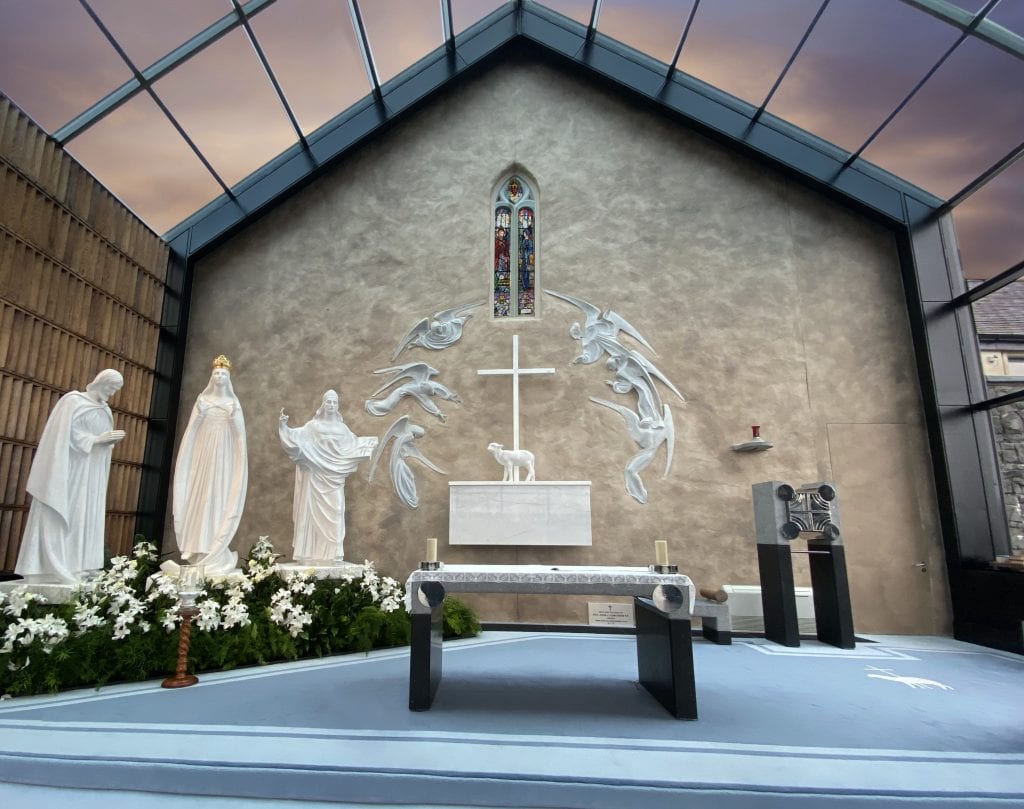
vatican.va Official shrine site Knock Shrine: The Apparition ChapelOfficial page on the chapel enclosing the original gable wall and the shrine’s physical memorial to the witness record.
knockshrine.ieThe story
Section titled “The story”At approximately 7:30 PM on August 21, 1879, fifteen people of Knock — including a 74-year-old woman who spoke only Irish, a 5-year-old boy, a farmer who observed from half a mile away, and the parish housekeeper — all independently described the same scene on the south gable wall of their church.[1]
The apparition lasted approximately two hours, in driving rain, with the wind blowing from the south directly toward the gable wall. The witnesses standing in the field were thoroughly soaked. The ground beneath the figures and the gable wall itself remained completely dry throughout.[1] [2]
No figure spoke. No message was given. There was no prophecy, no secret, no instruction. The witness record presents the Knock event as entirely silent.[3]
What the apparition said - and did not say
Section titled “What the apparition said - and did not say”The striking thing about Knock is that the witnesses did not report hearing words.[2] [3] No one said Mary, Joseph, or John addressed the crowd. There was no request for a chapel, no call to penance, no secret, and no prophecy.
So the “message” of Knock, as the public file presents it, comes from the scene itself rather than from speech: Mary in prayer, Joseph bowed, John in a preaching posture with an open book, and an altar with the Lamb and Cross.[1] [2] That is why Knock is often described as a silent apparition or a visual tableau rather than a spoken-message apparition.
The witnesses
Section titled “The witnesses”Fifteen individuals gave sworn depositions to the 1879 Commission of Enquiry. They ranged in age from approximately 5 to 75 and included farmers, labourers, a domestic servant, and children.
Age approximately 45. Housekeeper to Archdeacon Bartholomew Cavanagh, the parish priest of Knock.[2]
The first adult to observe the apparition, around 7:00–7:30 PM while walking to visit the Beirne family. She saw luminous figures at the gable and initially assumed the priest had received decorative statues from Dublin. She continued to the Beirne house and mentioned what she had seen — triggering the gathering of other witnesses.[2]
Her initial assumption of statues, and her subsequent return when the figures proved to still be present, speaks against fabrication on her part: she was not expecting a supernatural event and did not immediately interpret what she saw in that way.
Age approximately 29. One of the key witnesses; daughter of Margaret Beirne. Later married and became Mary O’Connell.[2]
Her testimony preserved a notably careful identification of St. John. She said: “It is only an opinion… I am not in any way sure what saint or character the figure represented” — comparing the figure to a statue she knew at the chapel of Lecanvey near Westport.[2]
Crucially, she survived to testify before the 1936 Commission at approximately age 86, on her deathbed. Her final statement: “I am quite clear about everything I have said, and I make this statement knowing I am going before my God.”[3] She confirmed her 1879 testimony in full.
Age 11. Gave arguably the most vivid and physically detailed account of any witness.[2]
He described the figures as “fully rounded, as if they had a body and life… about 2–3 feet out from the church wall.” He reported seeing “the pupils and iris of Our Lady’s eyes” and stated the figures “did not speak but, as we drew near, they retreated a little towards the wall.” He said he could see words printed in the book held by St. John.[2]
He also reported angels hovering near the altar area for the duration: “for the space of one hour and a half or longer; I saw their wings fluttering.”[2]
The richness and specificity of a child’s account — with verifiable spatial and physiological details — is difficult to attribute to coaching or suggestion.
Age approximately 74–75. The oldest witness. Spoke only Irish.[2]
She arrived at the scene, threw herself on her knees, and exclaimed: “A hundred thousand thanks to God and to the glorious Virgin that has given us this manifestation.”[2]
She attempted to embrace the feet of the figure of Our Lady and later testified: “I felt nothing in the embrace but the wall, and I wondered why I could not feel with my hands the figures which I had so plainly and so distinctly seen.”[2]
An elderly Irish-speaking woman’s experience of seeing luminous figures but feeling only cold stone when she tried to touch them is among the more striking specific details in the corpus of testimony.
Age approximately 65. Farmer.[2]
Observed from approximately half a mile away at his own home. He saw the gable “blazing” with light and assumed the church was on fire. He is considered an independent witness of particular evidential significance — he observed before being told anything by others, and his account corroborates the scale of the light without being contaminated by the other witnesses’ descriptions.[2]
The full list of witnesses who gave sworn depositions:
| Name | Approx. Age | Notes |
|---|---|---|
| Mary McLoughlin | ~45 | Parish housekeeper; first adult to observe |
| Mary Beirne (O’Connell) | ~29 | Key witness; survived to 1936 deathbed statement |
| Margaret Beirne Sr. | ~68 | Widow; friend of McLoughlin |
| Dominick Beirne Sr. | ~36 | |
| Dominick Beirne Jr. | ~19 | |
| Patrick Byrne | ~16 | |
| Margaret Byrne (younger) | ~21 | |
| Patrick Hill | 11 | Most detailed testimony |
| John Durkan | ~24 | |
| Catherine Murray | ~8 | |
| John Curry | ~5–6 | Youngest witness |
| Judith Campbell | ~22 | |
| Mrs. Hugh Flatley | ~44 | |
| Patrick Walsh | ~65 | Independent observer from half a mile |
| Bridget Trench | ~74–75 | Oldest witness; felt only wall when she tried to embrace figures |
What was seen
Section titled “What was seen”The scene appeared against the south gable wall, elevated approximately two feet above the ground, bathed in brilliant white light. Despite the rain, the figures and the area beneath them were completely dry.
Our Lady
Section titled “Our Lady”- White robes, described as radiant and flowing
- A brilliant gold crown; the upper portion appeared to have a series of glittering crosses or star-like points
- A large rose at the brow of the crown
- Eyes and hands raised toward heaven, in an attitude of prayer
- Life-size or slightly above
St. Joseph
Section titled “St. Joseph”- Positioned to Our Lady’s right
- Head bowed forward and slightly inclined toward her, as if in reverence
- Appeared elderly
St. John the Evangelist
Section titled “St. John the Evangelist”- Positioned to Our Lady’s left
- Dressed in bishop’s vestments — long dark robe, mitre
- Slightly turned toward the people, away from the other two figures
- Right hand raised in a gesture of preaching or blessing
- Left hand holding a large open book
The Altar, Lamb, and Angels
Section titled “The Altar, Lamb, and Angels”- A plain altar stood behind and to the left of the three figures
- On the altar stood a Lamb facing west, with a Cross upright behind it
- Golden stars or small glittering lights surrounded the Lamb and Cross
- Patrick Hill and at least one other witness reported seeing angels with wings in motion hovering near the altar area
Discrepancies within the testimony corpus
Section titled “Discrepancies within the testimony corpus”Not all accounts agreed on every detail. Skeptical researchers have noted:[5]
- Some witnesses described a crucifix; others did not mention or denied seeing one
- Not all witnesses reported a Lamb
- Only two witnesses explicitly reported seeing moving angels
- Crown color descriptions ranged from golden to brilliant white
These discrepancies are consistent with genuine eyewitness observation of a complex scene under unusual conditions (darkness, rain, varying distances) — but they are also consistent with group fabrication around a shared framework. They do not resolve the question either way.
The physical anomaly: dry ground in heavy rain
Section titled “The physical anomaly: dry ground in heavy rain”Multiple witnesses independently testified to the following:[1] [2]
- Heavy, sustained rain fell throughout the approximately two-hour duration
- The wind was blowing from the south — directly toward the south gable wall
- Witnesses standing in the open field were thoroughly soaked
- The gable wall and the ground immediately beneath the figures remained completely dry
- After the apparition ended, the wall became wet and dark — consistent with normal rain resuming contact
The directional detail is significant. A wall sheltered from driving rain would be in the lee of the structure — the north gable, in this case. The south gable, which faces directly into a southerly wind, should have been among the wettest surfaces present. That multiple witnesses independently noted the dry ground beneath the apparition — while standing in rain themselves — is an observation that does not have an obvious natural explanation within the context of their testimony.
The commissions of enquiry
Section titled “The commissions of enquiry”1879 Commission
Section titled “1879 Commission”Established by Archbishop John MacHale of Tuam approximately seven weeks after the event (October 8, 1879).[3]
Presided over by Canon Ulick Bourke, Canon James Waldron, and Archdeacon Bartholomew Cavanagh (the parish priest himself). All 15 witnesses were examined individually, under oath.[3]
Conclusion: “The testimony of all the witnesses, taken as a whole, is trustworthy and satisfactory.” The commission found that “no solution as from natural causes could be offered” and explicitly ruled out deliberate trickery.[3]
A significant limitation: Most original documents from the 1879 commission are believed to have been lost. The commission’s findings are known primarily through press reports and early devotional publications. This is one reason a second inquiry was conducted 57 years later.
1936 Commission
Section titled “1936 Commission”Established by Archbishop Thomas P. Gilmartin of Tuam.[3]
Three surviving witnesses were located and examined: Mary O’Connell (née Beirne, approximately 86, on her deathbed), Patrick Byrne, and John Curry. All three confirmed their 1879 statements without material deviation.[3]
Mary O’Connell’s deathbed statement: “I am quite clear about everything I have said, and I make this statement knowing I am going before my God.”[3]
The commission declared the testimony “upright and satisfactory.” This remains the de facto formal episcopal approval of Knock as a genuine apparition site.
Publicly documented chronology
Section titled “Publicly documented chronology”| Year | Development |
|---|---|
| 1879 | Archbishop MacHale’s commission: testimony declared “trustworthy and satisfactory” |
| 1936 | Archbishop Gilmartin’s commission: surviving witnesses confirmed; testimony again declared satisfactory |
| 1979 | Pope John Paul II visits on centenary (September 30); elevates church to Basilica of Our Lady, Queen of Ireland; presents Golden Rose |
| 2018 | Pope Francis visits during World Meeting of Families; prays in Chapel of the Apparition; presents golden rosary |
| 2019 | Bishop Francis Duffy formally recognizes the healing of Marion Carroll as miraculous — the first miracle officially recognized by the Irish Church in Knock’s 140-year history |
| 2021 | Pope Francis elevates Knock to International Sanctuary of Special Eucharistic and Marian Devotion |
Pope John Paul II at Knock — September 30, 1979
Section titled “Pope John Paul II at Knock — September 30, 1979”On the centenary of the apparition, approximately 450,000 people attended an outdoor Mass at Knock. John Paul II declared it “the goal of my journey to Ireland” and presented the shrine with a Golden Rose — his personal tribute to Our Lady of Knock.[4]
He elevated the shrine’s church to a Basilica, declaring: “It gives me great pleasure today to honor Our Blessed Lady, Mother of the Church, in this Her centenary year at Knock; the new Church, recently built in Her honor, will be known from this day forward as the Basilica of Our Lady, Queen of Ireland.”[4]
His central scriptural message drew on Mary’s words at the Wedding of Cana: “Do whatever he tells you.” Applied to contemporary Ireland — then in the early years of the Troubles in Northern Ireland — the choice of this passage was deliberate.
The Marion Carroll miracle (2019)
Section titled “The Marion Carroll miracle (2019)”The one formally recognized miracle at Knock is the healing of Marion Carroll, a woman from Athlone, County Westmeath, who suffered from severe multiple sclerosis with associated paralysis, impaired vision, and epilepsy.[6]
In September 1989, Carroll was brought to Knock on a stretcher. During Eucharistic adoration in the Basilica — as a monstrance was carried in blessing over the congregation by Bishop Colm O’Reilly — she experienced a sudden, complete transformation. She rose from her stretcher and walked.[6]
The Medical Bureau at Knock Shrine, led by Dr. Diarmuid Murray, investigated the case for 30 years. The extended investigation was partly due to the need to establish a reliable prior diagnosis and to rule out spontaneous remission.[6]
On September 1, 2019, Bishop Francis Duffy of Ardagh formally recognized the healing. Archbishop Michael Neary stated: “The Church formally acknowledges that this healing does not admit of any medical explanation.”[6]
Since her healing, Marion Carroll has returned to Knock regularly, volunteering to assist other pilgrims.
Proposed explanations and discussion
Section titled “Proposed explanations and discussion”Magic lantern projection
Section titled “Magic lantern projection”The most persistent alternative theory is that a hoaxer projected images onto the gable wall using a magic lantern — an early oil-burning slide projector in use by the 1870s.[5]
Revived in a 1987 British television programme, the theory was demonstrated in a controlled indoor setting using a right-angle mirror. However, several features of the Knock event make direct application difficult:
- The apparition began in twilight, not darkness — magic lanterns of the era could not project visible images in overcast daylight or dusk conditions
- It was raining heavily; projecting sharp images through rain is technically difficult even with modern equipment
- Witnesses approached from multiple angles over two hours; a projector beam would have been visible from at least some of those vantage points
- The figures appeared to recede slightly as witnesses approached (Patrick Hill’s testimony) — a static projection cannot do this
- No lantern, operator, smell of oil combustion, or apparatus was ever found, identified, or confessed to[5]
Optical illusion / pareidolia
Section titled “Optical illusion / pareidolia”Investigators writing in the Skeptical Inquirer (2017) proposed that the setting sun, combined with rain mist and reflections from a nearby school building’s angled wall, could have projected ambiguous shapes onto the gable that observers — saturated with Catholic iconography — resolved into the figures they expected to see.[5]
Proponents of the apparition dispute the geometry of this account. The described light was reported as internally luminous (emanating from the figures), not reflected from outside. Patrick Walsh’s sighting from half a mile — before any contact with other witnesses — is difficult to integrate into a pareidolia account: he saw a blaze of light intense enough to think the building was on fire.
Social contagion
Section titled “Social contagion”Once Mary McLoughlin established an initial description and Mary Beirne identified the figures as “Our Lady” and “St. Joseph,” subsequent witnesses gave testimony in a social context primed toward that interpretation. Conformity bias in small communities under religious excitement is well-documented.[5]
This is the most difficult alternative explanation to rule out — and it is the only one that is internally consistent with all the evidence. It requires that the initial experience (McLoughlin’s and Beirne’s) was a genuine perceptual anomaly of some kind, with subsequent witnesses shaped by suggestion; or that the initial accounts were embellished and others conformed. Neither version is easily verified or refuted at this distance.
Academic and scholarly context
Section titled “Academic and scholarly context”The most comprehensive scholarly treatment of Knock is:
Eugene Hynes, Knock: The Virgin’s Apparition in Nineteenth-Century Ireland (Cork University Press, 2008)[7]
Hynes, a sociologist at Kettering University, Michigan, situates the apparition within 19th-century Irish rural poverty, Land League agitation, and the politics of Catholic clerical authority in post-Famine Ireland. His approach is neither credulous nor simply dismissive — he analyzes the social conditions that shaped how the event was experienced, reported, and institutionalized. The book won the James S. Donnelly Sr. Award from the American Conference for Irish Studies (2009) and was reviewed in the Journal of British Studies, Journal of Ecclesiastical History, and Journal of Social History.[7]
A more skeptically inclined critical analysis is provided by Michael Walsh in The Apparition at Knock: A Critical Analysis of Facts and Evidence (Columba Press, 2008).[5]
References
Section titled “References”- Knock Shrine official history. knockshrine.ie/history/. Retrieved 2025.
- The Apparitions and Miracles at Knock, with the Official Depositions of the Eye-Witnesses. Dublin, 1880. Reprinted with introduction; primary source compilation of the 1879 witness depositions. Also summarized at knockshrine.ie/the-commissions-of-enquiry-2/.
- Knock Shrine. “The Commissions of Enquiry.” knockshrine.ie/the-commissions-of-enquiry-2/. Retrieved 2025.
- Pope John Paul II. Homily at Knock Shrine, September 30, 1979. Vatican Archives. vatican.va/content/john-paul-ii/en/homilies/1979/documents/hf_jp-ii_hom_19790930_irlanda-knock.html.
- McGaha, James, and Joe Nickell. “Miracle Tableau: Knock, Ireland, 1879.” Skeptical Inquirer, March/April 2017. skepticalinquirer.org/2017/03/miracle-tableau-knock-ireland-1879/. Disclosure: Published by the Committee for Skeptical Inquiry, an organization with institutional commitment to naturalistic explanations. This does not disqualify the analysis but should be read alongside primary source evidence, not as a replacement for it.
- EWTN News. “Miraculous healing at Knock Shrine confirmed by Irish bishops,” September 2019. Bishop Francis Duffy, Diocese of Ardagh, formal declaration. Archbishop Michael Neary, Diocese of Tuam, statement.
- Hynes, Eugene. Knock: The Virgin’s Apparition in Nineteenth-Century Ireland. Cork: Cork University Press, 2008. Winner, James S. Donnelly Sr. Award, American Conference for Irish Studies, 2009. Reviewed: Journal of British Studies (Cambridge Core); Journal of Ecclesiastical History; Journal of Social History.